 How-to
What Does an AI Agent Data Privacy Risk Assessment Cover?
Last Updated: November 11, 2026
Quick Summary
An AI agent data privacy risk assessment is a structured review of how autonomous agents collect, hold, share, and act on personal data. It differs from a standard privacy review because agents change their own behavior at runtime, so the assessment must cover behavior, not just configuration. The method runs through inventory, questions, scoring, a template, a worked example, and post-deployment monitoring.
- Inventory every agent, data source, and tool, because most privacy exposure lives in third-party integrations.
- Score each risk on six factors, then apply autonomy and blast radius multipliers plus a reversibility penalty.
- The email approval gate scored highest because it was autonomous, wide-reaching, and irreversible.
- Require a partial reassessment within five business days of a permission change, model update, or new data source.
- Treat agent memory as a second data store that no one inventoried.
Table of Contents
- Why AI Agent Data Privacy Risk Assessments Break Traditional Reviews
- Inventorying Agents, Data Flows and Third-Party Tool Access
- AI Agent Data Privacy Risk Assessment Questions That Surface Real Exposure
- Scoring Likelihood, Impact and Blast Radius to Prioritize Fixes
- What an AI Agent Data Privacy Risk Assessment Template Should Contain
- A Worked AI Agent Data Privacy Risk Assessment Example
- AI Agent Privacy Monitoring After Deployment
- Scoping Your First Agent Privacy Assessment With AI Modularity
- Frequently Asked Questions
Why AI Agent Data Privacy Risk Assessments Break Traditional Reviews
An AI agent data privacy risk assessment is a structured review of how autonomous agents collect, hold, share, and act on personal data. It differs from a standard privacy review because agents change their own behavior at runtime. A traditional review checks a fixed system. An agent decides, calls tools, and chains actions on its own.
That gap is the whole problem. Teams often run a clean privacy review, ship the agent, then discover it pulled more data than the workflow ever needed. Nobody lied. The agent simply found a path the review never modeled.
Three things break the old approach:
- Autonomy tiers. A read-only assistant and an agent that moves money need different controls.
- Tool access. Each integration is a new exit door for data.
- Delegated permissions. Agents often act with more rights than the task requires.
So the assessment has to cover behavior, not just configuration. Below, we walk through a repeatable method: inventory, questions, scoring, template, a worked example, and post-deployment monitoring.
Inventorying Agents, Data Flows and Third-Party Tool Access
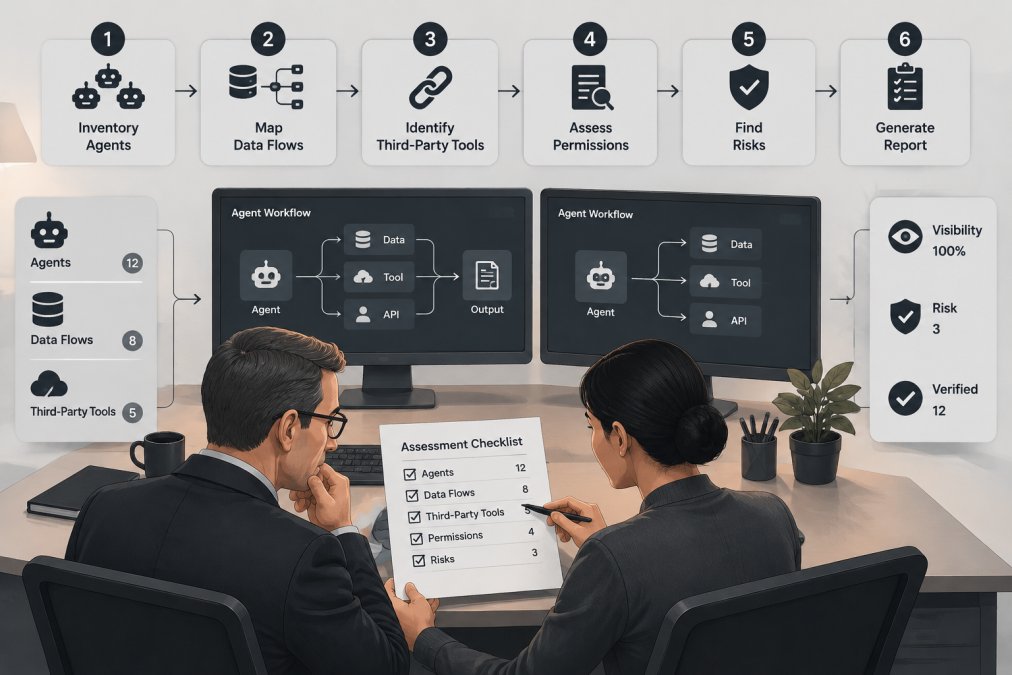
Start with a data inventory, because you cannot assess what you cannot see. List every agent, every data source it touches, and every tool it can call.
A common mistake is inventorying the agent but not its tools. In practice, most privacy exposure lives in third-party integrations. An agent with one CRM connection and one email tool has two data flows, not one.
Build the map in four passes:
- Agents. Name, owner, autonomy tier, and business purpose.
- Data sources. What personal data each agent reads, and whether any of it is sensitive data.
- Data flows. Where data goes: storage, processing, sharing, and retention.
- Tool access. Which integrations exist and what permissions each one holds.
For modular and multi-agent systems, map the handoffs between agents too. Our guide to security risks in modular AI agent systems goes deeper on that handoff problem.
AI Agent Data Privacy Risk Assessment Questions That Surface Real Exposure
The right AI agent data privacy risk assessment questions force a specific answer, not a yes or no. "Is data protected?" invites a shrug. "Which sensitive fields can this agent read, and who approved that?" does not.
Work through these in order:
- Data collection: What is the minimum data this agent needs, and does it collect more?
- Sensitive data: Can the agent touch health, financial, or identity data?
- Access control: Does the agent run on least privilege, or inherited admin rights?
- Delegated permissions: What can the agent do on a user's behalf, and can that be revoked?
- Tool access: Which third-party integrations receive personal data, and under what terms?
- Data leakage: What stops the agent from putting personal data into a prompt or log?
- Unauthorized access: What happens if a tool credential is stolen?
- Retention: How long does data live in agent memory, and can it be deleted?
- Human oversight: Which actions require approval before execution?
- Accountability: Who owns the outcome when the agent gets it wrong?
What most guides miss is the retention question. Agent memory quietly becomes a second data store that no one inventoried. Treat it like one.
Scoring Likelihood, Impact and Blast Radius to Prioritize Fixes
Scoring turns a long question list into a ranked fix list.
Use a six-factor model. Score each factor on a 1-5 scale with written anchors so two reviewers reach roughly the same number.
| Factor | Score 1 | Score 3 | Score 5 |
|---|---|---|---|
| Data sensitivity | Public or non-personal | Internal or limited personal data | Regulated or highly sensitive personal data (health, financial, identity, precise location) |
| Exposure likelihood | Requires an unusual sequence of failures | Plausible under normal operation | Routine, the agent hits this path daily |
| Impact | Minor inconvenience | Moderate harm, complaint, or remediation cost | Severe harm, notification duty, or regulatory exposure |
| Autonomy level | Read-only or suggestion-only | Acts with human approval | Acts autonomously on consequential actions |
| Blast radius | One record or one user | One system or one team | Many systems, many users, or downstream vendors |
| Reversibility | Easy rollback | Partial recovery with effort | Irreversible, data disclosed, deleted, or sent externally |
Compute a base score as sensitivity × exposure likelihood × impact.
Worked example using the support agent from the next section:
- Over-broad CRM read access. Sensitivity 4, exposure 5, impact 3 = 60. Autonomy 1.25, blast radius 1.25 = 93.75. Reversibility partial, +10 = 103.75. Priority: high.
- Personal data in logs. Sensitivity 4, exposure 4, impact 3 = 48. Autonomy 1.0, blast radius 1.25 = 60. Reversibility partial, +10 = 70. Priority: medium-high.
- Email tool can send without approval. Sensitivity 3, exposure 3, impact 4 = 36. Autonomy 1.5, blast radius 1.5 = 81. Reversibility irreversible, +25 = 106. Priority: highest.
- Memory retains records past policy. Sensitivity 4, exposure 4, impact 3 = 48. Autonomy 1.0, blast radius 1.25 = 60. Reversibility partial, +10 = 70. Priority: medium-high.
That ordering is the point. The email approval gate scores highest not because it is the most likely failure but because it is autonomous, wide-reaching, and irreversible.
Add detection lag as a tiebreaker. Because detection lag depends on where an agent enters a workflow, score the existing process before deployment and carry that evidence into the assessment at EntreAgents.ai.
Watch out: teams often inflate sensitivity to force a high score and then ignore the ranking entirely. Calibrate anchors against two or three known cases before scoring the full inventory.
Risk scores for the support agent's four assessed risks
What an AI Agent Data Privacy Risk Assessment Template Should Contain
A useful AI agent data privacy risk assessment template is short enough to finish and specific enough to act on. Long questionnaires get filled in once and never opened again.
Include these sections:
- Agent profile: name, owner, autonomy tier, business purpose.
- Data map: sources, sensitive fields, storage, sharing, retention.
- Permissions record: least privilege status, delegated permissions, tool access list.
- Question set: the exposure questions above, with written answers.
- Scoring sheet: likelihood, impact, blast radius, reversibility, final score.
- Mitigation log: fix, owner, due date, status.
- Evidence pack: logs, approval records, and test results that back each claim.
- Review date: when this assessment expires.
The evidence pack is the part teams skip. It is also the part auditors ask for first. If you want to see what a comparable deliverable looks like before you build your own, review what an AI agent security audit covers and costs. It helps you scope the assessment realistically.
A Worked AI Agent Data Privacy Risk Assessment Example
Here is a short AI agent data privacy risk assessment example to make the method concrete. A support agent reads customer records and drafts replies. It has CRM and email tool access.
The team scores four risks:
- Over-broad CRM read access. Likelihood 5, impact 3, blast radius 3. Fix: least privilege scoping.
- Personal data in logs. Likelihood 4, impact 3, blast radius 2. Fix: redaction at the logging layer.
- Email tool can send without approval. Likelihood 3, impact 4, blast radius 4. Fix: human approval gate.
- Memory retains records past policy. Likelihood 4, impact 3, blast radius 2. Fix: retention limit and purge job.
The first fix ships in days. The approval gate takes longer but removes the worst outcome. That ordering is the point of scoring: it tells you what to do first, not just what is wrong.
AI Agent Privacy Monitoring After Deployment
An assessment is a snapshot.
Define reassessment triggers in the assessment itself. A common pattern is to require a partial reassessment within five business days when any of the following occurs:
- Permission change. The agent gains a new tool, scope, or delegated right, or an existing permission is widened.
- Model or prompt update. The underlying model version changes, or the system prompt or tool descriptions are edited in a way that changes what data the agent can reach.
- New data source. A new CRM field, document store, or vendor feed is connected.
- Anomalous access. Logs show the agent reading fields or records outside its approved map, or calling a tool at an unusual rate.
- Retention breach. Memory or logs outlive the stated retention period.
- Incident. Any confirmed or suspected data disclosure involving the agent.
Pair those triggers with three concrete incident scenarios and a short playbook for each. These are the cases practitioners most often hit.
Scenario 2: Excessive tool permissions. The agent was granted write or send rights it never needed, and a misconfigured workflow uses them.
Scenario 3: Sensitive data in logs. Personal data appears in prompts, tool payloads, or memory snapshots that flow to a logging system.
Runtime monitoring plus audit logs give you the evidence to catch drift early and to reconstruct what happened during an incident. Our how-to on monitoring autonomous AI agent execution covers the practical setup. Teams that also need an ongoing process should read the guide to continuous AI compliance monitoring.
Watch out: monitoring that only watches infrastructure metrics will miss agent-specific drift. Track tool-call volume by tool, data fields read per agent, and approval-gate bypasses as first-class signals.
AI Modularity's execution trust ecosystem is built around verifying agents before deployment, authorizing consequential actions before they run, and attributing outcomes afterward.
Scoping Your First Agent Privacy Assessment With AI Modularity
Start small. Pick one agent with real data access and one clear owner. Run the inventory, answer the questions, score the risks, and fix the top item.
Then expand by autonomy tier. Low-risk pilots can use a lighter review.
For teams preparing to ship, our AI agent security checklist covers the pre-launch checks that pair with this assessment.
AI Modularity helps you close the loop between assessment and execution. Agent Verify™ checks agent code and workflows before deployment. A2SPA™ cryptographically authorizes payloads at the point of execution.
Most agent privacy failures do not come from a missing policy. They come from a control that was never enforced at execution. That is the gap worth closing first.
Frequently Asked Questions
What is an AI agent data privacy risk assessment?
It is a structured review of how an autonomous agent collects, processes, stores, shares and retains personal data across every tool and system it can reach. Unlike a standard privacy review, it has to account for delegated permissions, non-deterministic behavior and memory that persists between sessions. The output is a scored risk register plus evidence you can show auditors, covering likelihood, impact, blast radius and reversibility for each identified risk.
How often should an AI agent privacy assessment be updated?
Reassess whenever the agent's tools, permissions, prompts or model version change, and at least quarterly for agents touching sensitive data. Continuous AI agent privacy monitoring should run between formal reviews, watching for new data flows, unusual volume spikes and access outside the approved scope. Any incident or near miss should trigger an out-of-cycle reassessment of the affected agent and anything sharing its credentials.
Is a DPIA required for an AI agent that handles personal data?
A Data Protection Impact Assessment is generally expected when processing is likely to result in high risk to individuals, such as large-scale profiling, sensitive categories of data or automated decisions with significant effects. Many agent deployments meet that bar because they combine broad data access with autonomous action. Documenting a DPIA-style assessment also gives you the evidence trail regulators and procurement reviewers ask for.
What should an AI agent data privacy risk assessment template include?
At minimum: an agent inventory with owner and autonomy tier, an end-to-end data flow map including third-party integrations, a permission and least-privilege review, a question set covering collection through retention, scoring columns for likelihood, impact and blast radius, mitigation owners and dates, and evidence requirements for each control. Add a reassessment trigger list so the template stays useful after the pilot ends.