 how-to
AI Agent Economic Attribution Tracking: A How-To Guide
Table of Contents
- What Is AI Agent Economic Attribution?
- Why Attribution Matters for Autonomous Systems
- Step 1: Establish Baseline Metrics and Data Provenance
- Step 2: Implement AI Agent Cost Monitoring
- Step 3: Track Token Usage and API Calls
- Step 4: Calculate AI Agent ROI and Unit Economics
- Selecting and Deploying Token Usage Tracking Tools
- Common Attribution Challenges and How to Overcome Them
Last Updated: August 16, 2026
What Is AI Agent Economic Attribution?
AI agent economic attribution is the process of tracking, measuring, and assigning financial value to the actions and outcomes generated by autonomous AI systems. It answers a critical question: which specific agent decisions drove which business results, and what did those decisions cost to execute?
Unlike traditional software where costs and outcomes are straightforward to trace, autonomous agents operate across multiple environments, invoke various APIs, consume computational resources in real-time, and make decisions that cascade through workflows. Without proper attribution, organizations lose visibility into whether their autonomous systems generate positive ROI or simply consume resources.
Most enterprises deploying autonomous agents face a fundamental accountability gap: they know what agents should do, but struggle to prove what they actually did and whether it was worth the cost. This gap becomes critical in regulated industries and high-stakes workflows where every decision must be auditable.
Effective AI agent economic attribution requires three capabilities: tracking every token consumed, API call made, and computational resource allocated; connecting those costs to specific business outcomes; and attributing financial value back to agent decisions with cryptographic certainty.
Why Attribution Matters for Autonomous Systems
Organizations deploy autonomous agents to handle repetitive tasks, accelerate decision-making, and reduce operational overhead. But autonomy creates accountability challenges that traditional software doesn't face.
In traditional software, code execution is traceable through logs and transactions. With AI agents, the chain of causation is complex: agents invoke multiple tools, make probabilistic decisions, interact with other agents, and produce outcomes dependent on real-time data. Determining why something succeeded or failed requires a complete audit trail most organizations don't maintain.
The stakes are highest in financial services, government, and regulated industries. A regulatory audit demands: "Show us every decision this agent made, prove it was authorized, and demonstrate compliance." Without proper attribution infrastructure, that becomes a crisis.
Beyond compliance, attribution drives efficiency. When you know which agents consistently generate positive ROI and which underperform, you optimize deployment strategy: scale winners, retire losers, and reallocate resources to higher-value workflows.
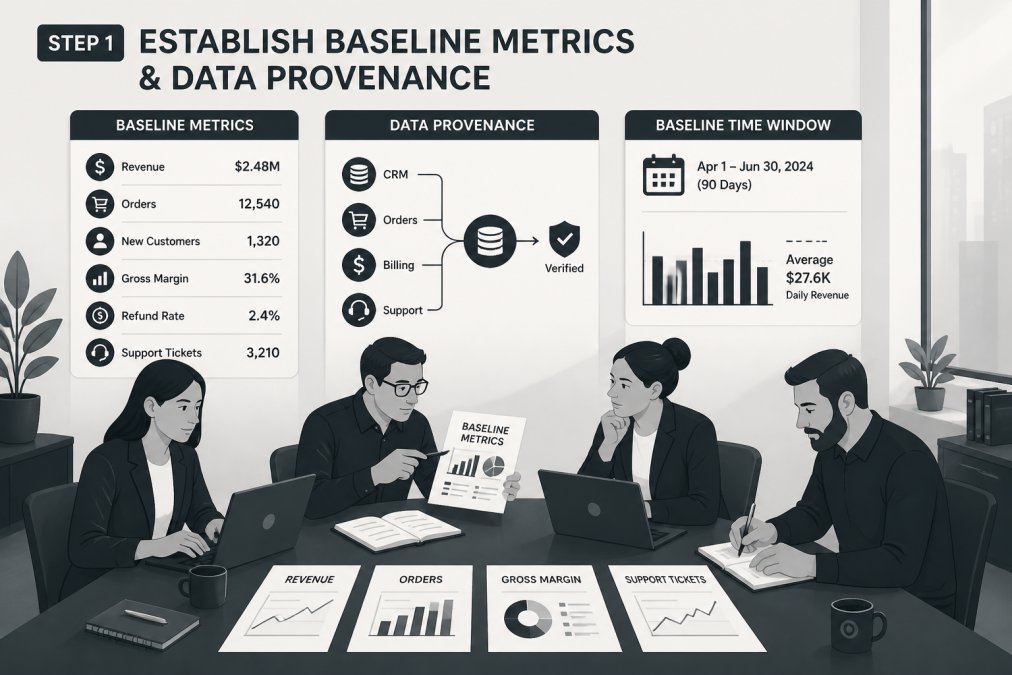
Step 1: Establish Baseline Metrics and Data Provenance
Before attributing economic value to agent actions, establish what you're measuring and where data comes from.
Define baseline metrics: What specific outcomes does each agent target? For a sales agent, this might be pipeline velocity or deal size. For procurement, cost savings or contract cycle time. For customer service, resolution rate or satisfaction score. These metrics become your north star for attribution.
Next, establish data provenance, an auditable record of where every piece of data originates, when it was captured, and how it was transformed. Instrument your agent's execution environment to capture:
- Agent initialization data: Version, parameters, execution start time
- Tool invocation records: APIs called, payloads sent, responses received
- Decision logs: Reasoning for each action, alternatives considered, path chosen
- Outcome data: Business result, timing, and influencing factors
Data provenance is only valuable if immutable and timestamped. Use structured logging or event streaming to create an append-only record. Capture events as they happen, don't rely on post-hoc reconstruction.
Instrument attribution requirements before deploying agents, not after. Retrofitting attribution onto existing deployments means reverse-engineering from incomplete logs.
Step 2: Implement AI Agent Cost Monitoring
Once you have baseline metrics and data provenance, implement real-time cost monitoring for your autonomous systems.
AI agent cost monitoring captures the direct financial cost of each agent's execution: token usage for language models, API call charges, compute resource allocation, storage costs, and infrastructure overhead. The goal is a real-time ledger showing exactly how much each agent decision costs.
Start with token usage tracking. Most autonomous agents rely on large language models charged by token consumption. Your monitoring system needs to capture:
- Prompt tokens: Input tokens sent to the model
- Completion tokens: Output tokens generated
- Token efficiency: Ratio of useful output to total tokens
- Cost per decision: Total tokens × provider pricing
Next, track API calls and tool invocations. Every external service call is billable. Log:
- API endpoint called: Which service was invoked
- Request size: Volume of data sent
- Response latency: Call duration
- Cost per call: Based on provider pricing
Infrastructure costs require attribution across shared workloads. If your agent runs on a shared Kubernetes cluster, allocate a portion of compute, memory, and storage to that agent. Track:
- CPU time consumed: Seconds allocated to the agent
- Memory footprint: Peak and average usage
- Execution duration: Wall-clock time from start to finish
- Infrastructure cost allocation: Your internal cost model
Real-time monitoring enables two capabilities: halt agents mid-execution if costs exceed thresholds, and correlate cost spikes with specific decisions to optimize behavior.

Step 3: Track Token Usage and API Calls
Token usage and API call tracking form the foundation of accurate cost attribution.
Token usage tracking requires understanding your LLM provider's pricing model. Most charge per million tokens with separate rates for input and output. Your tracking system needs to:
- Capture token counts from each API call: Request counts from provider response metadata
- Aggregate tokens by agent: Sum total tokens consumed over a period
- Calculate token cost: Multiply token count by provider rate
- Track efficiency trends: Monitor whether agents improve or degrade over time
Token tracking requires integration at the API layer. You need actual counts from the provider, not text-length estimates. Instrument every LLM call your agent makes.
API call tracking requires comprehensive logging. For each invocation, capture:
- Timestamp, endpoint, request method
- Request and response size
- Response code and latency
- Cost: Calculated from provider pricing
Most API providers publish pricing documentation mapping request types to costs. Implement these pricing rules so costs are calculated accurately.
Correlate token usage and API calls to specific agent decisions. When your agent invokes a tool, which tokens were consumed? If the tool call failed, how much did that failed attempt cost? This correlation creates a detailed cost ledger for each decision.
Step 4: Calculate AI Agent ROI and Unit Economics
With cost and outcome data, calculate whether autonomous agents generate positive ROI.
Explore Ecosystem Government Contracting →
ROI calculation follows: (Business Value Generated - Total Costs) / Total Costs × 100. Business value comes from your baseline metrics. If your sales agent increased deal size by $50,000 monthly, that's measurable value. If your procurement agent reduced contract cycle time by 10 days, calculate the value of that time savings. If your customer service agent reduced support tickets by 20%, quantify that as salary and infrastructure savings.
Connect agent actions to business outcomes with reasonable confidence. You need to say: "This agent made this decision, which led to this outcome, which generated this value."
Unit economics breaks ROI down per transaction or decision. If your agent handles 1,000 transactions monthly and generates $100,000 in value at $5,000 cost, your unit economics are: $95 value per transaction, or 20:1 ROI.
Unit economics reveal which agents deserve scaling and which should be retired. An agent with 5:1 ROI is worth expanding. An agent with 0.5:1 ROI is burning resources and should be optimized or shut down.
Calculate ROI monthly minimum, weekly if possible. Fast feedback reveals whether agents perform as expected. If ROI drops suddenly, investigate quickly, the agent's model may have degraded, external conditions changed, or a bug was introduced.
Account for indirect or delayed benefits. A customer service agent might reduce support costs immediately but increase customer lifetime value through better experiences, a benefit appearing months later. Build your ROI model to account for these time-delayed effects.
Selecting and Deploying Token Usage Tracking Tools
Implementing token usage tracking requires infrastructure. Purpose-built tools integrate with LLM providers and infrastructure better than custom solutions.
When evaluating tracking tools, look for:
- Multi-provider support: Handle OpenAI, Anthropic, and open-source models without custom integrations
- Real-time cost visibility: Cost data as it accumulates, not daily batch reports. Real-time tracking enables alerts and spending caps
- Granular attribution: Attribute costs to specific agents, workflows, or users. Generic "total spend" reporting doesn't help optimize
- Integration depth: SDK-level integration is more reliable than application-level instrumentation
- Audit trail: Provide complete, immutable records for compliance audits
Deployment typically involves: installing a tracking SDK in your agent runtime, configuring API credentials, setting up cost alerts and spending caps, creating real-time dashboards, and exporting cost data to financial systems.
Common Attribution Challenges and How to Overcome Them
Real-world AI agent attribution is messier than textbook versions. Here are challenges and practical solutions.
Challenge: Attribution across multi-agent orchestration. When multiple agents collaborate, how do you attribute value to each? If Agent A gathers data, Agent B analyzes it, and Agent C executes a decision, which deserves credit?
Solution: Implement a contribution model. Track each agent's specific role and attribute value proportionally. Agent A might get 30% (data gathering), Agent B 40% (analysis), Agent C 30% (execution). Instrument your agent orchestration layer to track hand-offs.
Challenge: Latent outcomes and delayed attribution. Some decisions have outcomes appearing days or weeks later. A recommendation engine suggests a product, but the customer purchases two weeks later. How do you connect them?
Solution: Use event correlation with time windows. When an outcome occurs, look back through event logs to find which agent actions preceded it within a reasonable window. Mark that correlation and accept some uncertainty, weighting accordingly.
Challenge: External factors that confound attribution. An agent's perfect decision might fail due to market changes. A suboptimal decision might succeed due to favorable conditions. How do you separate agent performance from luck?
Solution: Build a control model. Compare agent-driven outcomes against randomized baselines or alternatives. If your agent beats the baseline consistently, that's genuine performance.
Challenge: Incomplete or missing data. Agent logs might be incomplete due to system failures, and outcome data might be partial.
Solution: Implement data validation and gap-filling procedures. Flag incomplete records. For gaps, use conservative estimates rather than guessing. Underestimate value rather than overestimate and document assumptions.
Challenge: Regulatory compliance and audit requirements. Financial regulators require complete audit trails for autonomous financial decisions.
Solution: Design attribution systems with auditability as a first-class requirement. Use immutable event logs, cryptographic signing of decision records, and complete chain-of-custody documentation. AI Modularity's execution trust ecosystem provides cryptographic authorization and attribution capabilities for regulated environments.
| Challenge | Root Cause | Solution |
|---|---|---|
| Multi-agent value attribution | Unclear contribution boundaries | Implement proportional contribution model per agent role |
| Delayed outcomes | Temporal gap between decision and result | Use event correlation with configurable time windows |
| External factor noise | Confounding variables beyond agent control | Build control models and baseline comparisons |
| Incomplete data | System failures or missing integrations | Implement validation procedures and conservative estimates |
| Audit compliance | Regulatory requirements for autonomous decisions | Design for immutability and cryptographic signing from start |
Effective AI agent economic attribution is an ongoing operational capability, not a one-time setup. Start with clear baseline metrics and data provenance, implement real-time cost monitoring, track token usage and API calls precisely, and calculate ROI regularly. As you mature, discover optimization opportunities: underperforming agents can be tuned or retired, high-value agents can be scaled, and your entire autonomous system becomes measurable rather than a black box.
Organizations winning with autonomous agents treat attribution as a first-class concern from day one. They instrument systems for observability, maintain complete audit trails, and make deployment decisions based on hard ROI numbers. If deploying autonomous agents at scale, especially in regulated industries or financial operations, attribution infrastructure is essential. AI Modularity's execution trust ecosystem provides verification, authorization, and attribution capabilities that enterprises need to deploy autonomous systems with confidence, enabling you to verify agent behavior before execution and attribute outcomes with cryptographic certainty. Explore how secure, verifiable AI agent execution can transform your autonomous operations.
Frequently Asked Questions
What is economic attribution in the context of AI agents?
Economic attribution is the process of tracking and assigning costs, resource consumption, and financial outcomes to specific AI agent workflows and actions. It creates a complete audit trail showing which autonomous systems consumed compute resources, incurred API costs, and generated business value. This enables financial accountability, ROI measurement, and informed decisions about agent deployment and optimization.
How do you track token usage and costs for autonomous AI agents?
Token usage tracking requires instrumenting API calls and LLM invocations to capture real-time consumption data. Implement logging at the agent lifecycle level to record each tool invocation, API call, and token count. Use token usage tracking tools that correlate consumption with specific workflows and agents. Establish baseline metrics for each agent type, then monitor actual spend against those baselines to identify cost anomalies and optimization opportunities.
Why is AI agent attribution difficult to measure?
The attribution vacuum occurs because autonomous systems make decisions across multiple infrastructure layers, cloud providers, and execution environments. Traditional cost allocation methods assume human-driven workflows; agents operate continuously and invoke tools dynamically. Without proper data provenance and audit trails, it's nearly impossible to connect infrastructure spending to specific agent decisions or business outcomes. Multi-agent orchestration compounds this challenge, making collaborative value attribution even more complex.
What metrics are essential for calculating AI agent ROI?
Essential metrics include total compute resources consumed (tokens, API calls, infrastructure spend), time-to-completion for agent workflows, error rates and remediation costs, business value generated (revenue, cost savings, efficiency gains), and cost per transaction or outcome. Compare these against baseline human performance to establish unit economics. Track operational discipline through verification overhead reduction and security incident prevention. Real-time monitoring of these metrics enables ongoing ROI validation and cost optimization.
This article was written using GrandRanker