 how-to
7 AI Agent Prompt Injection Defense Strategies That Work
Last Updated: October 30, 2026
Quick Summary
Prompt injection defense works best as an execution problem, not a model problem: stack controls so a failure in one layer does not become a breach. Treat all external content as untrusted, separate instructions from data, validate tool calls before execution, apply least privilege, and require human approval for consequential actions. No single control stops prompt injection, so defense in depth is required.
- Direct injection comes from the user; indirect injection hides in web pages, PDFs, emails, and retrieved documents.
- Start with inventory and least privilege, because they shrink the blast radius of every other failure.
- Detection guesses intent while authorization checks permission, and only authorization is deterministic.
- Track attack success rate, false positive rate, policy violation rate, and time to containment per attack class.
- Verify the payload at the moment of execution, since an agent can plan one action and execute another.
Table of Contents
- Why Prompt Injection Is the Defining Risk for Autonomous Agents
- How Prompt Injection Attacks Actually Work
- Prompt Injection Attack Examples From Real Deployments
- AI Agent Security Best Practices: Defense in Depth
- Prompt Injection Detection Tools and Where They Fall Short
- AI Agent Security Testing: Red Teaming and Attack Success Rate
- Agent-Specific Controls: Tool Permissions, Human Approval, and Execution Authorization
- Building Your Defense Roadmap With AI Modularity
- Frequently Asked Questions
Why Prompt Injection Is the Defining Risk for Autonomous Agents
Prompt injection hides hostile instructions inside content an AI agent reads, then lets the agent treat those instructions as its own orders.
Most teams still defend the model. The real exposure sits in the plumbing around it.
A chatbot that says something odd is embarrassing. An agent that wires funds, deletes records, or emails a customer list is a different category of failure.
Direct and Indirect Prompt Injection: Two Different Threats
Direct prompt injection is a user typing hostile instructions straight into the chat box. The attacker is the person at the keyboard, so you can at least see them.
Indirect prompt injection is far nastier. The hostile text arrives inside a web page, a PDF, an email, or a retrieved document. Your user never sees it.
The distinction changes your defense. Direct attacks lean on input filtering and refusal training.
How Prompt Injection Attacks Actually Work
Prompt injection works because large language models have no hard boundary between instructions and data (LLM Prompt Injection Prevention). Both arrive as text, so a model told to "summarize this page" cannot reliably tell that a sentence inside the page is an instruction rather than content.
An attack usually follows four moves:
- Plant hostile text where the agent will read it
- Frame it as a system-level command or urgent policy update
- Trigger the agent to act on it during a normal task
The fourth step is where damage happens. An agent that can only talk is annoying. An agent that can call tools is a liability.
Hidden Instructions, RAG Poisoning, and Multimodal Payloads
Hidden instructions are the simplest version. White text on a white background. HTML comments. Text sized to zero.
RAG poisoning goes further. The OWASP Top 10 for LLM Applications lists prompt injection as the leading risk for exactly this reason.
Multimodal input widens the door. An image can carry text the model reads. Audio can carry spoken instructions.
For a deeper look at how poisoned sources corrupt retrieval pipelines, our guide to securing AI systems from data poisoning covers the ingestion side in detail.
Prompt Injection Attack Examples From Real Deployments
When an injection does land, speed matters more than blame. For the steps to take once an injection succeeds, see our AI agent security incident response playbook.
AI Agent Security Best Practices: Defense in Depth
No single control stops prompt injection. Defense in depth means stacking controls so a failure in one layer does not become a breach.
- Treat all external content as untrusted. Web pages, emails, documents, and tool outputs get no implicit trust. Tag every input with its provenance (user, retrieved document, tool response, web fetch) and pass that tag through the agent's context so downstream controls can act on it. Trade-off: provenance tagging adds engineering overhead to every ingestion path and breaks when a tool strips metadata.
- Separate instructions from data. Use structural delimiters and an explicit instruction hierarchy so the model knows which text carries authority. A common pattern is a system prompt that names the trusted instruction channel and instructs the model to treat all other text as data, reinforced by delimiters around retrieved content. Trade-off: models do not reliably honor hierarchy under adversarial pressure, so this layer reduces but does not eliminate injection.
- Filter input, but do not rely on it. Input filtering catches lazy attacks and misses determined ones. Pair keyword and regex filters with classifier models and secondary-model review, and log every block with the payload so you can measure false positives. Trade-off: each added filter increases latency and false positives; a blocklist tuned for a support agent will misfire on a legal-document agent.
- Validate output before it acts. Check tool calls against policy before execution, not after. Define a policy schema per tool (allowed parameters, allowed value ranges, allowed destinations) and reject calls that fall outside it. Trade-off: strict schemas break legitimate edge cases and require a documented exception process.
- Apply least privilege to every agent. Grant the narrowest tool scope that completes the task. Use per-task scoped credentials rather than long-lived agent-wide keys, and revoke them when the task ends. Trade-off: short-lived credentials add issuance latency and require a secrets manager the agent can reach without exposing broader access.
- Require human approval for consequential actions. Write down what "consequential" means: money movement above a threshold, outbound email to external domains, record deletion, permission changes. Route those actions to an approval queue with the full payload visible. Trade-off: approval queues slow workflows and create alert fatigue if the threshold is too low.
- Log everything. Audit logs are how you reconstruct what happened and prove it. Capture the input provenance, the model output, the tool call payload, the authorization decision, and the outcome, with a correlation ID that ties them together. Trade-off: verbose logging raises storage cost and creates its own sensitive-data exposure if logs are not access-controlled.
- Test adversarially. Red teaming finds what your filters miss. Build an attack set per vector class and track attack success rate over time, as covered in the testing section below.
The NIST AI Risk Management Framework gives a useful structure for the governance layer around these controls. It will not configure your agent, but it will keep your program defensible.
Do not deploy layers 1 through 8 at once. Start with inventory and least privilege (layers 1 and 5), because they shrink the blast radius of every other failure. Add output validation and execution authorization next, since they are deterministic and catch what probabilistic filters miss. Add filtering and human approval after you have baseline attack success rate data, so you tune thresholds against measured false positives rather than guesses.
For the full layered model, read our guide on how to stop prompt injection in AI agents.
Prompt Injection Detection Tools and Where They Fall Short
Detection tools help, but they are not a complete solution. Most fall into three buckets: pattern matchers, classifier models, and secondary-model reviewers that score inputs for risk.
| Detection approach | What it catches | Where it fails |
|---|---|---|
| Keyword and regex filters | Obvious payloads, known strings | Paraphrased or encoded attacks |
| Classifier models | Learned injection patterns | Novel phrasing, domain-specific text |
| Secondary model review | Nuanced intent signals | Cost, latency, and its own injection risk |
| Embedding-based detection | Semantic similarity to known attacks | Attacks with no prior example |
Every detection layer produces false positives and false negatives. Tune for the failure you can tolerate: in a financial workflow, a false negative that moves money is worse than a false positive that annoys a user.
Pair detection with execution controls. Detection guesses intent; authorization checks permission. Only one of those is deterministic.
Explore Ecosystem Government Contracting →
AI Agent Security Testing: Red Teaming and Attack Success Rate
AI agent security testing is the practice of attacking your own agents before someone else does, and measuring how often the attacks work. Most guides stop at "red team your agent." If you plan to bring in outside help, review what an AI agent security audit covers and costs first. The gap is measurable validation: a repeatable test set, a small set of tracked metrics, and decision thresholds that tell you when a control is good enough to ship.
Build an Attack Test Set Before You Build a Dashboard
A test set is a versioned collection of adversarial inputs, each labeled with the vector class, the target tool, and the expected safe behavior. Start with these classes and grow them from your own incident logs:
- Direct injection: hostile instructions typed into the user channel, including role-play framing and fake system messages.
- Indirect injection: payloads embedded in retrieved documents, web pages, emails, and PDFs, including hidden text, HTML comments, and zero-size text.
- Tool-output injection: hostile instructions returned inside a tool response, such as a search result or API payload that the agent then reads.
Store each case with the exact payload, agent version, tool configuration, and expected outcome, and version the set alongside your prompts and tool schemas so a regression is attributable to a specific change.
Metrics That Actually Drive Decisions
Track four numbers per attack class, not one blended rate:
- Attack success rate (ASR): the share of attempts that achieve the attacker's goal, whether that is data exfiltration, an unauthorized tool call, or a policy violation.
- False positive rate: the share of benign inputs a control blocks or flags. Measure this on a separate benign corpus drawn from real traffic, not synthetic prompts.
- Policy violation rate: the share of agent actions that breach a written policy, independent of whether an attacker caused them. This catches misconfiguration that injection testing misses.
Set ship thresholds per class: zero tolerance for unauthorized money movement, a low single-digit ASR ceiling for data exfiltration, and a false positive budget tied to the workflow's tolerance for human review. Write them down before testing so results are not rationalized after the fact.
Run Red-Team Exercises in Three Tiers
-
Tier 1, automated regression: run the full test set on every change to prompts, tools, or retrieval sources. This is cheap, fast, and catches regressions.
-
Tier 2, human red team: a small team spends a fixed time box per quarter attempting novel attacks against a staging copy with real tool access. Record every success with the exact payload and the action taken.
-
Tier 3, scenario drills: simulate an end-to-end incident, including detection, containment, credential revocation, and user notification, and measure time to containment.
-
Build or extend the attack taxonomy for the vector classes above
-
Run each class against a staging copy of the agent with real tool access
-
Record every success with the exact payload and the action taken
Agent-Specific Controls: Tool Permissions, Human Approval, and Execution Authorization
This is where most prompt injection defense programs quietly fall apart. Teams harden the model, then hand the agent a credit card.
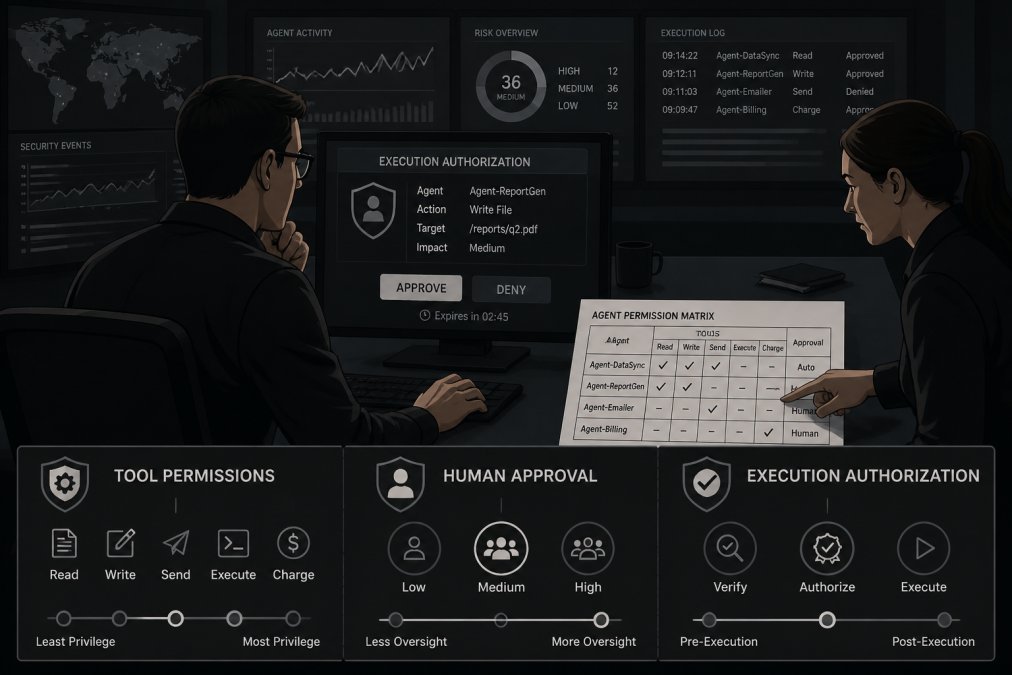
Three controls carry the weight:
- Tool permissions. Each agent gets an explicit allowlist of tools and parameters. No wildcard scopes.
- Human approval. Consequential actions pause for a person. Define "consequential" in writing, not in vibes.
- Execution authorization. Verify the payload at the moment of execution, not just at planning time.
That last one is the gap. An agent can plan a safe action and execute a different one if the payload changes between the two. Authorization at the execution boundary closes it.
This is the problem AI Modularity addresses.
Building Your Defense Roadmap With AI Modularity
Prompt injection defense is a program, not a purchase. Sequence it in this order:
- Inventory every agent, its tools, and its data access
- Constrain permissions to least privilege
- Layer input filtering, output validation, and instruction hierarchy
- Authorize consequential actions at execution
- Test with red teaming and track attack success rate
- Monitor with audit logs and anomaly detection
- Rehearse incident response before you need it
Skip step one and everything after it is guesswork. Most teams we talk to cannot list their agents' tool scopes from memory. That is the first thing to fix.
Residual risk never reaches zero. Language models will keep confusing instructions with data, and attackers will keep noticing. Your job is to make the gap between a successful injection and real damage as small as possible.
Frequently Asked Questions
What is prompt injection in an AI agent?
Prompt injection is an attack where text hidden in content the agent processes, such as a web page, email, or retrieved document, is treated as instructions by the underlying large language model. In an agent, the damage goes beyond a bad answer: the injected instructions can trigger tool calling, data exfiltration, or unauthorized actions. That is why prompt injection defense has to cover the whole execution path, not just the model's output.
Can prompt injection attacks be fully prevented?
No single control eliminates prompt injection. Models cannot reliably separate instructions from data, so the practical goal is to limit blast radius rather than assume perfect input filtering. Layer instruction hierarchy, input and output validation, least privilege tool permissions, human approval for consequential actions, and audit logs. Then measure residual risk with AI agent security testing so you know your attack success rate instead of assuming it is zero.
How should AI agents handle untrusted input?
Treat every external source, including web browsing results, email bodies, RAG chunks, and uploaded files, as untrusted input by default. Keep it clearly delimited from the system prompt, strip or quarantine hidden instructions, and never let retrieved content grant new permissions. Route any action that touches sensitive data or money through an explicit authorization step, so a malicious instruction in a document cannot become an executed transaction.
What security controls limit the impact of a successful prompt injection?
The controls that matter most are least privilege scoped to each tool, sandboxing for code execution, human approval for high-value actions, output validation before responses leave the agent, anomaly detection on tool-call patterns, and complete audit logs. Pair these with cryptographic authorization at execution time so a compromised agent cannot silently perform a consequential action, even if the model was successfully manipulated upstream.
The hard truth is that a clever prompt will eventually get through. What decides the outcome is whether your agent had permission to act on it. AI Modularity gives you verification before deployment, cryptographic authorization at execution, and full attribution after, so an injection becomes a logged event instead of a loss. Get started with AI Modularity and put a verifiable boundary between your agents and the actions they take.