 comparison
AI Security Alternatives to Traditional Methods
Table of Contents
- Why Traditional Security Tools Fall Short for Autonomous AI
- AI Security vs Traditional Cybersecurity: Key Differences
- Comparison of AI Security Alternatives
- AI Execution Trust Frameworks: Verifying Agent Behavior
- Autonomous AI Agent Security Best Practices
- Cost-Benefit Analysis of Migrating from Traditional Security
- Frequently Asked Questions
Last Updated: September 14, 2026
Why Traditional Security Tools Fall Short for Autonomous AI
Signature-based detection assumes yesterday's attack resembles tomorrow's. Autonomous AI breaks that assumption entirely. When an agent rewrites its own action sequence mid-task, no static rule set can describe what "normal" looks like, which is why security teams are actively evaluating alternatives to traditional AI security methods. This guide from AI Modularity breaks down platforms and frameworks worth your evaluation time.
The core problem is architectural, not incremental. Traditional controls inspect traffic, endpoints, and identities. Autonomous agents operate through reasoning, tool calls, and delegated permissions, so the attack surface shifts from the network layer to the decision layer.
NIST AI Risk Management Framework formalizes this shift, treating AI-specific risks like data exfiltration through model outputs as a distinct category requiring new controls. Most legacy stacks simply were not built for it.
AI Security vs Traditional Cybersecurity: Key Differences
AI security protects the reasoning layer, while traditional cybersecurity protects the transport and access layers. That single distinction drives every tooling decision that follows.
Traditional controls rely on threat signatures, known-bad indicators, and perimeter enforcement. AI security depends on behavioral analysis, anomaly detection, and predictive modeling of agent intent. A firewall blocks a port; an execution trust framework verifies whether an agent should be calling a payment API at all.

The practical consequences show up in three places:
- Detection basis: signatures and heuristics versus behavioral baselines
- Response model: manual triage versus automated response with human-in-the-loop review
- Coverage: infrastructure and endpoints versus agent workflows, prompts, and model artifacts
This is where most strategies fall apart. A mature cybersecurity posture can score well on every traditional metric and still leave autonomous financial actions completely unverified.
Comparison of AI Security Alternatives
Alternatives to traditional AI security methods for autonomous agent deployments include platforms that address different layers: execution trust, supply chain, adversarial testing, code scanning, and open-source LLM probing. The table below maps some of them before the detailed breakdown.
| Platform | Primary Focus | Best For | Pricing Model |
|---|---|---|---|
| AI Modularity | Execution trust for autonomous agents | Regulated, high-consequence agent deployments | Contact for quote |
| Protect AI | AI/ML supply chain security | MLOps teams managing model lifecycles | Enterprise licensing |
| Mindgard | Automated AI red-teaming | Continuous adversarial testing programs | Subscription |
| Snyk | Developer-first code scanning | Teams shipping AI-generated code | Free tier; paid per developer |
| Garak | Open-source LLM scanning | Deep-dive LLM vulnerability research | Open source |
How to Evaluate These Platforms
Before comparing features, decide which layer of the AI attack surface you actually need to cover. Most teams discover they need two or three of these categories, not one. A useful framework is to score each platform against four criteria:
- Timing: Does it act before execution, during execution, or after the fact? Pre-execution authorization is the only category that stops a harmful action rather than logging it.
- Scope: Does it cover model artifacts, runtime agent behavior, or both? Supply chain tools rarely see runtime decisions; runtime tools rarely inspect model weights.
- Integration surface: Does it plug into your existing CI/CD, SIEM, and identity provider, or does it require a parallel stack?
- Attribution: Can it tell you which agent produced which outcome? This matters for incident response and for board-level reporting.
AI Modularity: Execution Trust Infrastructure
AI Modularity secures autonomous AI at the point where trust matters most: execution. Its ecosystem verifies agents before deployment, cryptographically authorizes consequential actions before they run, and attributes outcomes afterward, combining Agent Verify™, A2SPA™, A2EA™, and CryptoValidity™.
What separates it from monitoring-only tools is timing. Verification happens before the action, not after the incident report. The chain-agnostic architecture matters if you run agents across multiple cloud providers and on-premises infrastructure, since you are not locked into a single execution environment.
Pros:
- Full autonomous lifecycle coverage, from deployment through economic attribution
- Payload authorization at the point of execution, not post-hoc logging
- Financial control integration for autonomous finance use cases
Cons:
- Pricing is quote-based.
Protect AI: AI/ML Supply Chain Security
Protect AI scans models and pipelines for malicious code and vulnerabilities across the AI/ML supply chain. Model scanning and adversarial attack detection integrate into existing CI/CD pipelines, which shortens the path from finding to fix. Rigorous validation of these automated workflows ensures that security protocols remain effective even as sophisticated actors experiment with new methods for avoiding AI detection.
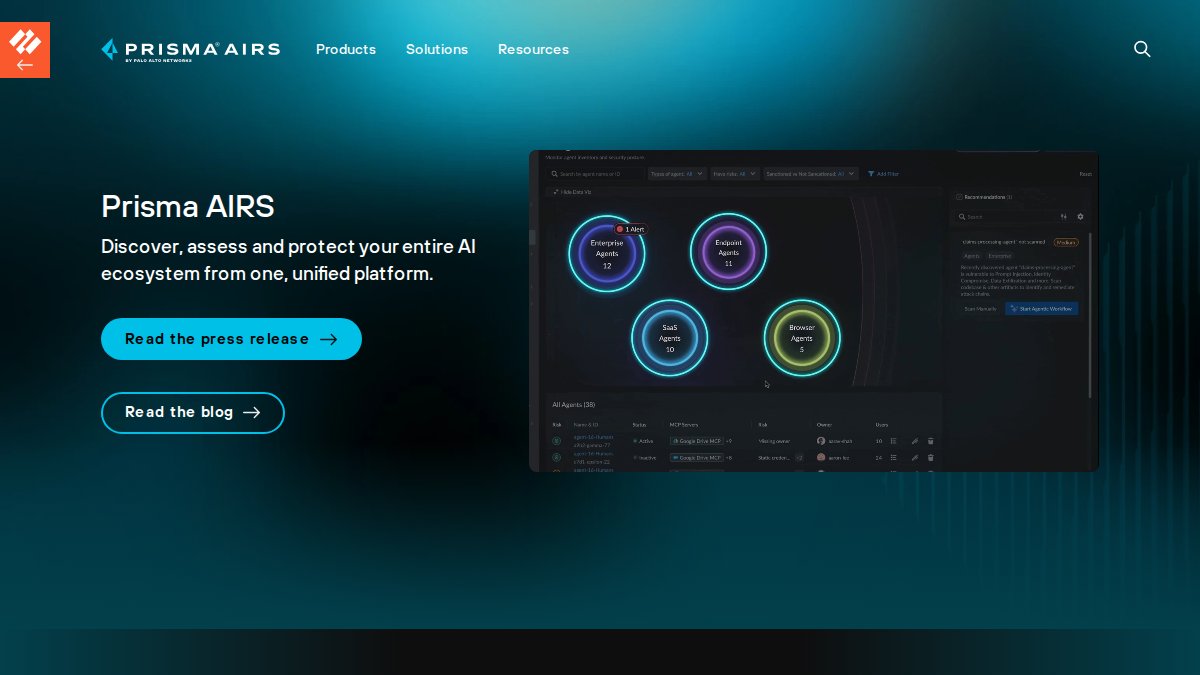
The drawback is configuration overhead. Complex environments need significant tuning before the scanning output is trustworthy, and it focuses on artifacts rather than runtime agent behavior. A common pattern is to pair it with a runtime control so that a clean model is not assumed to be a safe agent.
Mindgard: Automated AI Red-Teaming
Mindgard automates red-teaming and continuous adversarial simulation against AI models. It reduces reliance on manual penetration testing and keeps a running view of your security posture as models change.
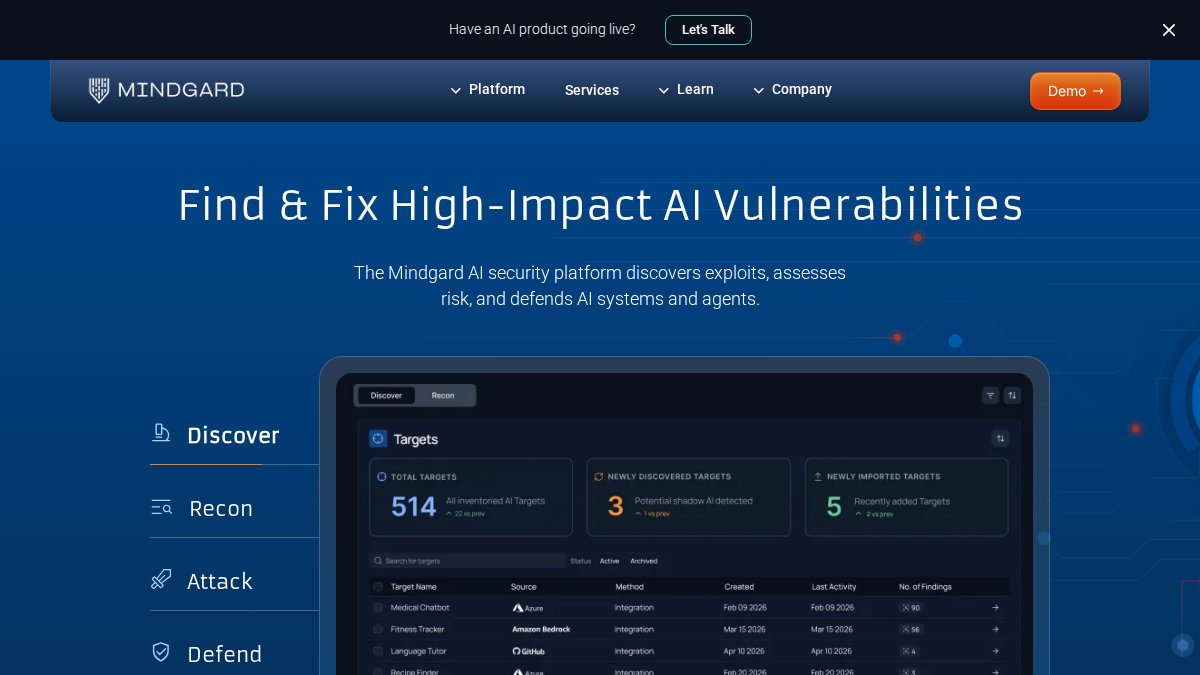
Where it falls short: it is primarily a testing platform. It surfaces vulnerabilities well but does not block a malicious action at runtime, so pair it with an execution-layer control. Teams that treat red-teaming output as a one-time report rather than a continuous signal tend to regress within a quarter.
Snyk: Developer-First AI Code Scanning
Snyk scans AI-generated code and open-source dependencies for flaws, with IDE and pipeline integrations that developers actually keep enabled. Its vulnerability database is extensive and the free tier lowers the barrier to trying it.
The limitation is scope. It is general application security with AI-aware scanning, so specialized model runtime protection still requires another tool. It is strongest when AI-generated code is the primary risk vector, and weakest when the risk lives in agent behavior after deployment.
Garak: Open-Source LLM Vulnerability Scanner
Garak probes LLMs for prompt injection, hallucination, and data leakage through a command-line interface. It is free, open source, and highly specialized for LLM-specific attack vectors.
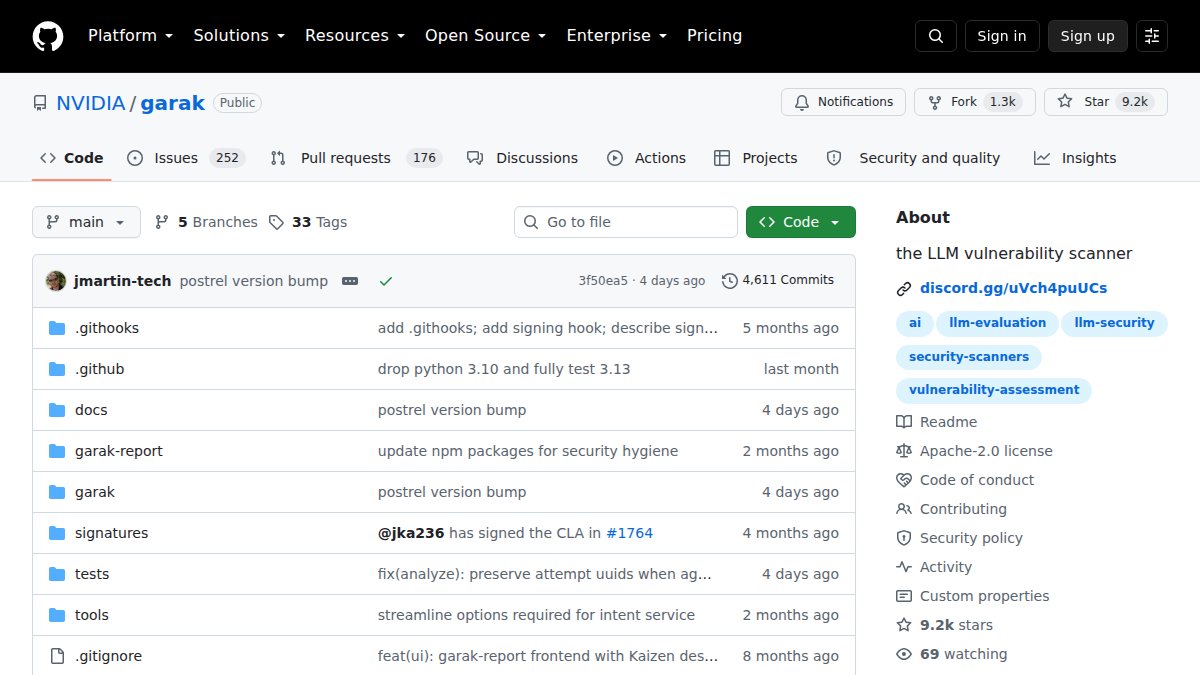
The trade-off is enterprise readiness. It lacks the management, reporting, and orchestration features that security teams need at scale, which makes it a research tool rather than a platform. It is often used to validate findings from commercial scanners rather than as a primary control.
Explore Ecosystem Government Contracting →
What the Comparison Misses
None of these platforms, on their own, answers the question a risk officer will ask: which agent caused which outcome, and was that action authorized at the moment it ran? Supply chain scanning, red-teaming, and code review all reduce the probability of a bad action, but only execution-layer authorization prevents one. That is why the strongest deployments combine two or three of the tools above with a pre-execution control, rather than betting on a single platform.
AI Execution Trust Frameworks: Verifying Agent Behavior
An AI execution trust framework is a control layer that verifies agent identity, authorizes specific actions before they execute, and produces an attributable record of what happened. It sits between your agent and the systems it touches.
That placement is deliberate. Prompt-level guardrails filter inputs; execution trust frameworks validate the payload itself. If an agent requests a wire transfer, the framework checks whether that specific action is authorized for that specific agent under that specific policy, then cryptographically records the decision.
Knowing an action was blocked is useful; knowing which agent generated which economic outcome is what lets risk officers defend the deployment to a board.
Autonomous AI Agent Security Best Practices
Start with least-privilege scoping per agent, then add verification at every consequential boundary. Autonomous AI agent security best practices share one theme: assume the agent will behave unexpectedly and design controls that hold anyway.
A workable sequence for most teams:
- Inventory every agent, its tools, and its permissions
- Classify actions by consequence level (read, write, transact)
- Require pre-execution authorization for transact-level actions
- Establish behavioral baselines and alert on drift
- Log outcomes with enough detail for post-incident attribution
- Run adversarial testing on a recurring schedule
CISA guidance on securing AI systems emphasizes defense-in-depth for AI, which maps cleanly onto this layered approach.
Cost-Benefit Analysis of Migrating from Traditional Security
Migration cost is real, but so is the cost of an unverified autonomous action. This section gives you a framework you can take to a CFO, not just a list of considerations.
The Cost Side: Three Line Items
Budget for three categories, in this order of typical magnitude:
- Integration engineering time. Legacy SIEM, endpoint, and identity tools may require significant engineering time for integration. Integration complexity can vary, especially when bridging on-premises firewalls with cloud-hosted agents.
- Parallel running. You will run legacy controls alongside the new layer for at least one full audit cycle. This is a real cost, not a formality, because it doubles tooling spend and analyst attention during the overlap.
- Staff training and workflow change. Signature-based alert triage and behavioral-baseline triage are different skills. Analysts who are excellent at the first are not automatically effective at the second, and the transition takes months of supervised practice.
The Benefit Side: Four Measurable Returns
- Reduced verification overhead. Pre-execution authorization can reduce manual review of consequential actions. The savings can scale with agent volume.
- Fewer false positives. Behavioral baselines can help reduce noise alerts compared to signature rules tuned for a static environment, though the initial period of baseline formation may involve adjustments.
- Attributable ROI per agent. When every action is cryptographically recorded, you can measure which agents produce value and which produce risk. That measurement is what justifies expansion.
- Compliance documentation. This is the benefit most teams undervalue. Frameworks such as the NIST AI RMF expect documented controls over AI-specific risks, and legacy tooling cannot produce that documentation. The compliance mapping alone often justifies the project in regulated environments.
A Simple ROI Calculation
A framework for ROI calculation can include:
Annual benefit = (avoided incident cost × probability reduction) + (analyst hours saved × loaded hourly rate) + (compliance audit cost avoided)
Payback period = total migration cost ÷ annual benefit
When calculating ROI, it can be helpful to use a range for incident costs and consider a pessimistic estimate. If the project demonstrates a reasonable payback period even with conservative estimates, it may be a strong candidate for implementation or a pilot program.
Compliance Mapping: Where Legacy Tooling Falls Short
The NIST AI Risk Management Framework organizes AI risk work into govern, map, measure, and manage functions. Legacy security stacks can partially support measure and manage, but they produce almost nothing for govern and map, because those functions require documented AI-specific controls and an inventory of AI systems with their risk classifications.
A practical mapping exercise is to take each framework function and ask which tool produces the evidence. If the answer is "a spreadsheet maintained by one person," that is a finding, not a control. Execution trust infrastructure produces the evidence natively because every authorization decision is recorded.
Timeline Reality
A focused pilot covering one high-consequence agent workflow can be implemented in weeks. Expanding from there, teams can pilot narrowly, measure benefits, and use pilot data to justify broader rollout.
Frequently Asked Questions
Why are traditional security methods insufficient for autonomous AI?
Traditional security relies on static rules, known threat signatures, and perimeter defenses. Autonomous AI agents make dynamic decisions, interact with external systems, and execute financial transactions without human intervention. These agents can be manipulated through prompt injection or model poisoning, which signature-based detection cannot identify. Traditional tools also lack visibility into agent decision-making and cannot verify whether an action was authorized before it executes. This gap requires AI security alternatives that focus on execution-time verification and behavioral analysis.
What is the difference between AI security and AI-powered security?
AI-powered security uses machine learning to enhance traditional cybersecurity tasks like anomaly detection, threat intelligence, and automated response. AI security, by contrast, focuses on protecting AI systems themselves, including models, data pipelines, and autonomous agents. It addresses AI-specific threats such as adversarial machine learning, prompt injection, and data exfiltration. Organizations need both: AI-powered tools to improve defense, and AI security frameworks to protect the AI systems making decisions.
How does execution trust differ from traditional perimeter security?
Perimeter security assumes threats come from outside a trusted network. Execution trust assumes the agent itself may be compromised or misconfigured, so every consequential action must be verified at the point of execution. This means cryptographically authorizing payloads before they run, verifying agent code and permissions before deployment, and attributing outcomes after execution. Execution trust frameworks like those from AI Modularity address risks that perimeter tools miss, especially for autonomous financial actions and cross-chain operations.
What are the primary risks of relying on legacy security for AI agents?
Legacy security tools cannot detect prompt injection, jailbreaking, or specification gaming because these attacks exploit the agent's logic rather than a software vulnerability. They also lack mechanisms to verify agent behavior before execution, leaving organizations exposed to unauthorized financial transactions or data exfiltration. Additionally, legacy tools often cannot integrate with cloud-native or chain-agnostic environments where agents operate. The result is false confidence: the perimeter looks secure, but the agent's actions remain unverified.
How can organizations verify AI agent actions before deployment?
Verification before deployment involves scanning agent code and workflows for vulnerabilities, validating permissions against intended use cases, and testing for adversarial inputs. Platforms like Protect AI and Mindgard offer model scanning and automated red-teaming. For execution-time verification, AI Modularity provides Agent Verify™ to validate agent behavior and A2SPA™ to authorize payloads before they execute. Combining pre-deployment verification with runtime authorization reduces the risk of unsafe execution paths and ensures only approved actions run.