 how-to
Automating Secret Rotation for AI Agent Workflows
Table of Contents
- Why Secret Rotation Matters for AI Agent Security
- How Automated Secret Rotation Works
- Best Practices for API Key Rotation in Agent Workflows
- Secrets Management for AI Agents: Core Implementation Strategies
- Securing AI Agent Execution Environments
- Handling Zero-Downtime Rotation and Rollback Strategies
- Compliance, Cost, and Operational Impact
- Conclusion
- Frequently Asked Questions
Last Updated: September 28, 2026
Why Secret Rotation Matters for AI Agent Security
Automating secret rotation for AI agent workflows is no longer optional for enterprises deploying autonomous systems. When an AI agent holds API keys, database credentials, or authentication tokens, those secrets become high-value targets. A compromised credential doesn't just expose one transaction, it can unlock access to entire systems, financial operations, and sensitive data pipelines.
At scale, manual rotation fails. A fleet of 100 agents means hundreds of credentials to manage. Teams either rotate too slowly or skip it entirely.
Automated rotation injects new secrets without downtime and revokes old ones immediately, shrinking the blast radius from system-wide access to minutes.
How Automated Secret Rotation Works
Automated secret rotation for AI agent workflows differs fundamentally from traditional infrastructure rotation because agents operate in two distinct credential modes: long-lived operational secrets (database credentials, service-to-service tokens) and ephemeral request-scoped credentials (LLM API keys, temporary authorization tokens).
For long-lived secrets, the rotation system follows a standard pattern:
- Generates a new credential in your key management service (AWS Secrets Manager, Azure Key Vault, HashiCorp Vault)
- Injects the new secret into running agents through secure channels (environment variable injection, in-memory vault client, sidecar pattern)
- Monitors agent acknowledgment and adoption
- Sets a grace period (typically 5-15 minutes for standard operations, 30-60 seconds for high-frequency agents) where both old and new secrets remain valid
- Revokes the old secret after the grace period expires
- Logs the entire rotation event for compliance auditing
AI agents require ephemeral credentials for LLM and external API calls, short-lived tokens tied to specific operations, diverging from traditional rotation patterns.
Ephemeral credential rotation: agents request scoped tokens from a broker for each operation; tokens expire automatically after completion. The long-lived API key rotates separately on a daily or weekly schedule. This two-tier approach limits blast radius, scoped tokens expire immediately, and long-lived keys are compromised only until the next rotation.
Rotation cadence depends on your threat model and operational constraints:
- High-risk environments (financial services, healthcare): Rotate long-lived secrets every 4-8 hours; ephemeral tokens expire within seconds
- Standard enterprise: Rotate long-lived secrets daily; ephemeral tokens expire within minutes
- Development/testing: Rotate weekly or on-demand
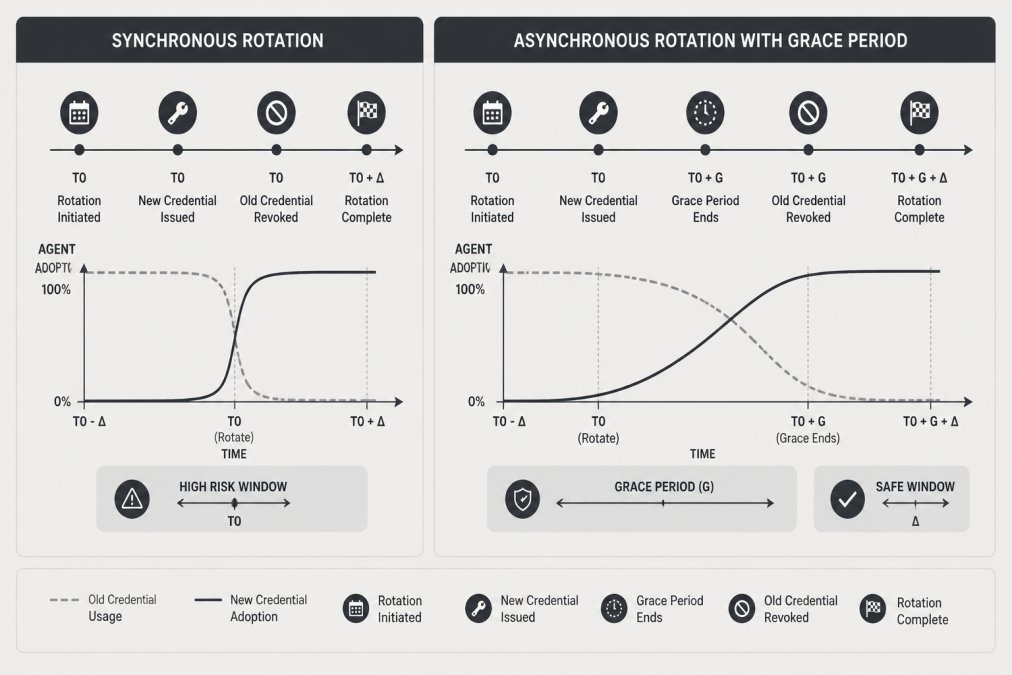
Synchronous rotation waits for agent acknowledgment before retiring old secrets (safer, slower). Asynchronous rotation retires immediately (faster, requires careful retry logic).
Most production fleets use a hybrid approach with grace periods: new secrets are injected while old ones remain valid temporarily, allowing agents to adopt gradually before revocation.
Multi-agent orchestration requires either centralized rotation (control plane rotates all simultaneously) or eventual consistency (independent rotation with retry logic and grace periods).
Grace periods protect in-flight requests, old credentials remain valid long enough for ongoing operations to complete before revocation.
Best Practices for API Key Rotation in Agent Workflows
API key rotation requires more care than generic secret rotation because keys often live in multiple places: agent code, configuration files, external service integrations, and cached memory. Missing even one location breaks the rotation.
Start by mapping where each key lives. Document every place an agent accesses a secret. This includes:
- Environment variables passed at agent startup
- Secrets fetched from a vaulting service at runtime
- Hardcoded defaults (which should be removed immediately)
- Cached values in agent memory
- Third-party integrations that use the key
Once you've mapped the landscape, implement secret injection instead of storage. Rather than storing keys in agent code or config files, agents should request secrets from a central vault at runtime. This single point of truth makes rotation trivial: update the vault, and all agents get the new key on their next request.
For CI/CD pipelines, integrate rotation into your deployment workflow. When a rotation happens, trigger a fresh deployment of affected agents. This ensures agents pick up new credentials immediately rather than waiting for a manual restart.
Explore Ecosystem Government Contracting →
Test rotation failures before they happen in production. Simulate scenarios where an agent can't access the new secret, or where the old secret gets revoked before agents adopt the new one. Build fallback logic that lets agents retry with exponential backoff rather than failing immediately.
Secrets Management for AI Agents: Core Implementation Strategies
Automating secret rotation for AI agent workflows requires a secrets management platform that understands agent-specific constraints. Generic vaulting tools designed for human operators often fall short because they don't account for the scale, speed, and automation needs of autonomous systems.
A proper secrets management strategy for AI agents includes:
- Dynamic secrets generation: Create short-lived credentials on demand rather than reusing static keys. Each agent request gets a unique credential tied to that specific operation.
- Automatic credential lifecycle management: Track when each secret was created, when it was last used, and when it expires. Retire unused secrets aggressively.
- Policy enforcement: Define rotation policies at the agent level. Different agents can have different rotation cadences based on their risk profile and operational requirements.
- Audit logging: Record every secret access, rotation, and revocation. This creates an immutable chain of custody for compliance and forensics.
The implementation itself varies by infrastructure. Cloud-native setups use managed key services like AWS Secrets Manager or Azure Key Vault. On-premises deployments might use HashiCorp Vault or similar tools. The key is choosing a system that integrates tightly with your agent orchestration platform. Standardizing these secret management protocols provides the necessary foundation for scaling AI automation services across complex enterprise environments.
One common mistake: storing rotation credentials separately from operational credentials. If an attacker compromises an agent, they can use it to fetch the rotation credentials and bypass your entire rotation system.
Securing AI Agent Execution Environments
The execution environment, the runtime where your agent actually runs, is where secrets live most vulnerably. An agent in memory, processing requests, needs access to secrets. That's the moment when credentials are most exposed to compromise.
Harden execution environments by:
- Isolating agent processes: Run each agent in its own container or sandbox. If one agent is compromised, the attacker can't easily pivot to other agents or shared infrastructure.
- Limiting secret visibility: Inject secrets into agent memory only when needed, then clear them immediately after use. Don't let secrets persist in logs, error messages, or debug output.
- Monitoring secret access: Log every time an agent requests or uses a secret. Unusual access patterns (an agent requesting 100 secrets in 10 seconds, or accessing credentials it shouldn't need) trigger alerts.
- Enforcing least privilege: Each agent should have access only to the specific secrets it needs for its specific operations. A financial transaction agent shouldn't have access to database admin credentials.
Handling Zero-Downtime Rotation and Rollback Strategies
Zero-downtime rotation means retiring old secrets while agents continue processing requests without interruption. This is harder than it sounds because agents might be in the middle of long-running operations when rotation happens.
Compliance, Cost, and Operational Impact
Compliance frameworks increasingly require documented secret rotation. SOC 2 requires evidence that you rotate credentials regularly. HIPAA mandates rotation for healthcare-related access. Financial services regulations often specify rotation cadence (The Fed). Automated rotation gives you audit logs proving you're compliant.
Conclusion
Automating secret rotation for AI agent workflows is the foundation of secure autonomous systems. Without it, you're hoping that leaked credentials never get exploited, that no one forgets to rotate credentials manually, and that your audit logs will somehow prove compliance after a breach.
| Rotation Strategy | Best For | Key Benefit |
|---|---|---|
| Synchronous rotation | Critical systems requiring zero risk | All agents confirm new secret before old revokes |
| Asynchronous rotation | High-throughput agent fleets | Fast rotation with grace period for adoption |
| Dynamic secrets | Short-lived operations | New credential per request, automatic expiration |
| Policy-driven rotation | Compliance-heavy environments | Audit trail proving rotation cadence |
Pro Tips for Implementation:
Frequently Asked Questions
Why is secret rotation critical for AI agent security?
Secret rotation limits the window of exposure if credentials are compromised. When API keys, tokens, or service account credentials remain unchanged, a leaked credential can grant an attacker indefinite access to your agent's resources and downstream systems. Rotating secrets regularly, especially in high-risk financial or infrastructure workflows, reduces blast radius and ensures that even if a credential is exposed, it becomes useless after a set expiration window. Automated rotation means this happens continuously without manual intervention or downtime.
How does automated secret rotation differ from manual rotation?
Manual rotation requires your team to generate new credentials, update every system that uses them, test the changes, and coordinate timing across multiple agents and services. This process is error-prone, time-consuming, and often delayed, leaving credentials active far longer than security policy requires. Automated rotation eliminates human error, enforces consistent cadence (hourly, daily, or per your policy), and can synchronously or asynchronously update credentials without stopping agent execution. This approach also provides audit trails and compliance evidence automatically.
What are the main risks of hardcoded credentials in AI workflows?
Hardcoded credentials in agent code, configuration files, or infrastructure-as-code repositories create permanent security liabilities. Once committed to version control, they persist in history even if deleted later. If an agent is compromised, an attacker gains access to those credentials indefinitely. Hardcoded secrets also make credential rotation impossible without redeploying code, which introduces operational friction and often leads to credentials being left unchanged for months or years. This violates security standards and creates compliance violations in regulated industries.
How does secret rotation impact AI agent uptime and availability?
Synchronous rotation (where credentials change instantly) can cause brief connection failures if agents don't gracefully handle the transition. Asynchronous rotation (where old and new credentials coexist temporarily) prevents downtime by allowing agents to switch credentials during their next operation window. Zero-downtime rotation strategies include dual-credential support, where agents accept both old and new credentials during the overlap period, and automated credential injection at runtime rather than deployment. Proper implementation ensures agents maintain availability while security posture improves.