 listicle
Best Practices for Agent Security: 7 Essential Controls
Table of Contents
- Why Agent Security Matters: The Risk Landscape
- 1. Implement Zero Standing Access and Least Privilege
- 2. Authentication and Identity Management for Agents
- 3. AI Agent Access Control Best Practices
- 4. Data Privacy and Sensitive Information Handling
- 5. Blast Radius Limitation and Containment
- 6. How to Secure Autonomous AI Agents: Human-in-the-Loop Approval Gates
- 7. Continuous Monitoring, Logging, and Incident Response
Last Updated: August 27, 2026
Why Agent Security Matters: The Risk Landscape
Autonomous AI agents are moving from experimental deployments to mission-critical operations in financial services, government, and enterprise environments. This shift creates a new attack surface: agents that can execute transactions, modify data, access sensitive systems, and make autonomous decisions without human oversight.
Compromised agents don't just expose data, they can drain accounts, corrupt databases, or trigger cascading failures across integrated systems. The stakes are highest in regulated industries. Financial institutions deploying agents for trading or fraud detection face regulatory scrutiny around agent behavior attribution and audit trails. Government agencies using agents for decision-making need verifiable, attributable execution. Healthcare systems integrating agents into workflows require proof that agent actions comply with data privacy regulations.

Best practices for agent security address this by establishing controls at every stage of the agent lifecycle: before deployment (verification), during execution (authorization and monitoring), and after execution (attribution and incident response). Organizations that implement these practices see faster approval cycles, reduced security review overhead, and confidence that autonomous operations remain within defined risk boundaries.
1. Implement Zero Standing Access and Least Privilege
Zero standing access means agents never hold permissions continuously. Instead, they request access only when needed for a specific action, and permissions expire immediately after use. This dramatically reduces the blast radius if an agent is compromised.
Least privilege is the operational foundation. An agent that processes refunds needs permission to read transaction records and issue refunds, not access to customer databases, payment routing tables, or system administration functions (nist.gov). Implementing this requires defining the minimum set of actions each agent needs, mapping those actions to specific API endpoints or database tables, and granting permissions only for those specific resources, not parent categories or wildcards.
The technical implementation depends on your infrastructure. In cloud environments, use identity and access management (IAM) policies that grant time-bound credentials. For on-premises systems, implement service accounts with scoped permissions that refresh on each request.
2. Authentication and Identity Management for Agents
Agents need cryptographic identity separate from human users. Each agent must have unique credentials, API keys, certificates, or tokens that identify it distinctly in logs and authorization decisions. Without this, you cannot attribute actions to specific agents or distinguish between agent behavior and compromised credentials.
The standard approach is API key pairs (public and private), mutual TLS certificates, or OAuth tokens with restricted scopes. The critical vulnerability is credential leakage. If an agent's API key is exposed in code, logs, or configuration files, attackers can impersonate that agent. Best practices require credential management systems like HashiCorp Vault or AWS Secrets Manager that store secrets separately from code, rotate credentials regularly, and audit access.
For financial or high-consequence agents, consider certificate-based authentication using mutual TLS. Both the agent and the service it calls authenticate each other cryptographically, making credential compromise harder.
Identity management also means tracking which agent performed which action. Every API call, database modification, or external service invocation should include the agent's identity in logs. This enables audit trails, compliance reporting, and incident investigation.
3. AI Agent Access Control Best Practices
Access control for AI agents requires three layers: what resources the agent can access, under what conditions it can access them, and what actions it can perform on those resources.
The first layer is resource-level access control. Define which databases, APIs, files, or systems each agent can reach. An agent that processes customer support tickets should access the support ticket database and customer communication history, but not the payroll system.
The second layer is conditional access. An agent can access a resource only if certain conditions are met. For example, an agent can approve refunds only if the refund amount is below a threshold, or only during business hours.
The third layer is action-level access control. Even if an agent has access to a resource, it may only perform specific actions. An agent might read customer records but not modify them.
4. Data Privacy and Sensitive Information Handling
Agents frequently access sensitive data: customer information, financial records, health data, or proprietary business information. The security challenge is ensuring agents access only the data they need and that data is not leaked through agent responses, logs, or side channels.
Data minimization is the starting principle. If an agent needs to process a customer refund, it needs the transaction ID, refund amount, and payment method, not the customer's full profile. Use database views or API endpoints that return only the fields the agent needs.
Sensitive data handling also means preventing data exfiltration through agent outputs. Before an agent returns data to a user or external system, filter out sensitive fields or mask them. A response might include a customer's name and email but mask the account number as "****1234".
For regulated data, implement additional controls. Log which agent accessed which records and when to enable compliance reporting. Ensure agents don't store or transmit payment card data in violation of PCI-DSS standards (pcisecuritystandards.org). If agents handle health information, ensure HIPAA compliance for access logging and data protection.
Data encryption in transit and at rest is foundational. Agents should communicate with databases and APIs over encrypted channels (TLS). Sensitive data should be encrypted in databases so that even if an attacker gains database access, they cannot read the data without decryption keys.
5. Blast Radius Limitation and Containment
Blast radius is the scope of damage an attacker can cause if they compromise an agent. A well-designed agent has blast radius limited to a specific function, data set, or financial amount.
Limiting blast radius requires multiple controls. First, restrict what an agent can do. An agent that approves refunds should not be able to modify refund policies or delete transaction history. Second, restrict the scale of what an agent can do through financial limits. An agent might approve individual refunds but not bulk refunds above a threshold (cisa.gov). Third, restrict the time window. An agent might operate only during business hours or only in response to specific triggers.
Financial limits are a practical blast radius control. An agent that processes refunds might have a daily limit (max $50,000 in refunds per day) or per-transaction limit (max $5,000 per refund). If the agent attempts to exceed the limit, the action is blocked.
Implementation requires enforcing these limits at the authorization layer, not inside the agent. The agent itself cannot be trusted to enforce its own limits.
6. How to Secure Autonomous AI Agents: Human-in-the-Loop Approval Gates
Human-in-the-loop approval means certain agent actions require human review and approval before execution. This ensures high-consequence decisions have human oversight.
Explore Ecosystem Government Contracting →
Define which actions require approval. Low-risk actions (reading data, generating reports) typically don't require approval. Medium-risk actions (modifying non-critical data) might require approval from a designated reviewer. High-risk actions (financial transactions, policy changes, data deletion) require approval from multiple reviewers or a specific role.
The approval workflow should be asynchronous. An agent prepares an action, submits it for approval, and waits for human review. The human reviewer can see the action, the agent's reasoning, relevant context, and any policy violations. The reviewer approves or rejects the action.
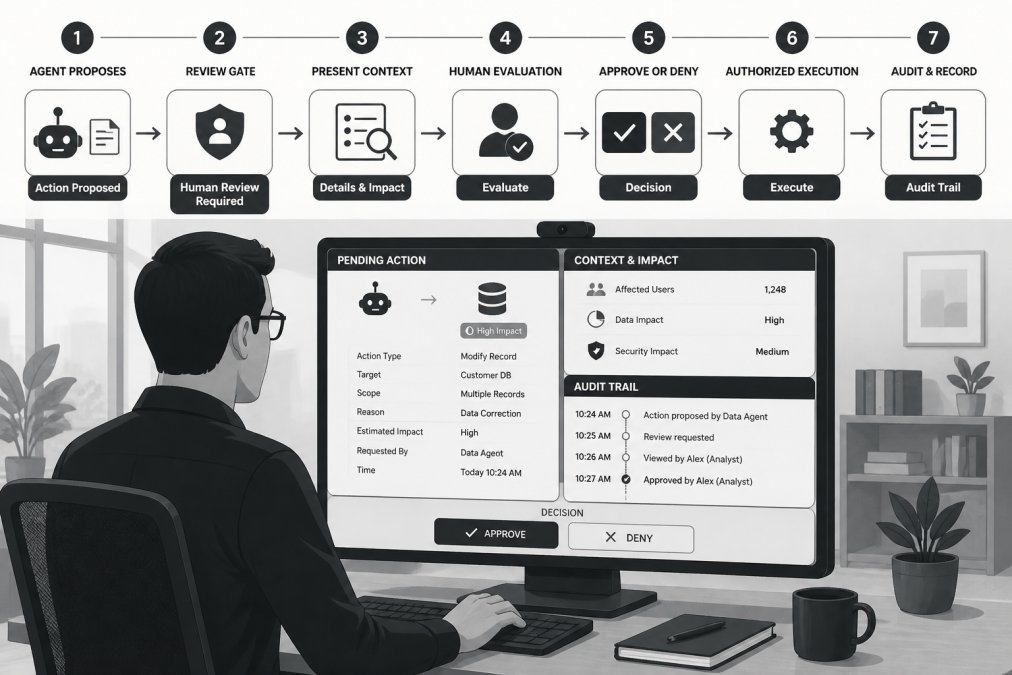
Critical details make this work. First, the approval request must include context so reviewers can make informed decisions. Second, approval decisions should be audited. Log who approved what, when, and whether the action was executed as approved. Third, approval should be time-bound. If an action isn't approved within a reasonable time, it should be rejected or escalated.
The dry-run mode is a related control. Before executing a consequential action, the agent simulates it in a non-production environment to verify the action would succeed and produce expected results. Only after dry-run verification do humans approve the real execution.
7. Continuous Monitoring, Logging, and Incident Response
Monitoring and logging are how you detect when an agent is behaving abnormally or has been compromised. Without visibility into agent behavior, you cannot respond to incidents or investigate security breaches.
Audit logs should capture every significant agent action: API calls made, data accessed, permissions used, decisions made, and outcomes. Each log entry should include the timestamp, the agent's identity, the action, the resource affected, and the result. For financial or regulated agents, logs should be immutable and retained for compliance periods.
Continuous monitoring means analyzing logs in real time to detect anomalies. Normal agent behavior follows patterns. Anomalies, an agent accessing a database it doesn't normally access, performing actions outside its normal time window, or attempting unauthorized actions, indicate potential compromise or misconfiguration.
Monitoring should trigger alerts when anomalies are detected. Security teams should have runbooks for responding to different alert types: investigate, isolate the agent, review recent actions, and determine if the agent was compromised or misconfigured.
Incident response for compromised agents requires a clear process. First, isolate the agent by revoking its credentials and preventing further execution. Second, review audit logs to determine what the agent did while compromised. Third, assess impact: what data was accessed, what actions were taken, what systems were affected. Fourth, remediate by restoring affected systems from backups if necessary and updating access controls. Fifth, conduct post-incident analysis to determine how the agent was compromised and implement preventive controls.
Best practices for agent security transform autonomous AI from a risk to a controlled capability. By implementing zero standing access, strong authentication, granular access control, data privacy protections, blast radius limits, human approval gates, and continuous monitoring, organizations can deploy agents with confidence that they'll operate safely and remain within defined boundaries.
The organizations moving fastest on agent deployment are those that built security in from the start, not those that tried to retrofit it later. If you're planning agent deployments, start with these practices now. If you're already running agents without these controls, prioritize them in your next security review.
At AI Modularity, we've built our execution trust ecosystem specifically to make these practices operationable at scale. Our Agent Verify™ technology enables you to verify agent code and workflows before deployment, catching security issues before they reach production. A2SPA™ and A2EA™ provide cryptographic authorization of agent actions at the point of execution, ensuring agents can only do what they're explicitly authorized to do. CryptoValidity™ enables attribution of outcomes, so you can trace every consequential action back to the agent that performed it and the authorization that allowed it.
Explore how AI Modularity helps organizations secure autonomous agents across enterprise, government, and regulated environments. Learn more about secure agent execution
| Control | Purpose | Implementation | Risk if Missing |
|---|---|---|---|
| Zero Standing Access | Minimize permissions held continuously | Time-bound credentials, request-based access | Compromised agent retains broad permissions |
| Authentication & Identity | Attribute actions to specific agents | API keys, certificates, OAuth tokens | Cannot distinguish agent actions from compromised credentials |
| Access Control | Restrict what agents can access and modify | IAM policies, API gateway rules, database permissions | Agent can access unintended systems or data |
| Data Privacy | Prevent sensitive data exposure | Data minimization, output sanitization, encryption | Data exfiltration, compliance violations |
| Blast Radius Limits | Bound damage from compromise | Financial limits, operational limits, scope restrictions | Unlimited damage from single agent compromise |
| Human Approval | Ensure oversight of high-consequence actions | Approval workflows, dry-run mode, audit trails | Unauthorized or unintended actions execute |
| Monitoring & Logging | Detect anomalies and investigate incidents | Continuous monitoring, anomaly detection, incident response | Compromise goes undetected, damage compounds |
=== FAQ ANSWERS (audit these too, same rules) ===
[1] Q: What are the primary security risks associated with autonomous AI agents? A: Autonomous AI agents face multiple threats: prompt injection attacks that manipulate agent behavior, unauthorized access through compromised credentials, privilege escalation enabling agents to exceed intended permissions, data exfiltration exposing sensitive information, and uncontrolled mutations of critical systems. Without proper controls, agents can execute unintended actions, bypass compliance requirements, or cause financial losses. Threat modeling identifies these risks early, allowing security teams to implement targeted controls like input validation, least privilege access, and continuous monitoring before agents reach production.
[2] Q: How do you implement zero-trust architecture for AI agents? A: Zero-trust for agents starts with zero standing access, agents receive privileges only when executing specific tasks, then those privileges are revoked immediately after. Combine this with cryptographic authorization: agents must prove their identity and intent before executing consequential actions. Require authentication at every step, validate all inputs for prompt injection or malicious payloads, and use dry-run modes to test agent behavior before production execution. Implement continuous monitoring to detect anomalous activity. This architecture assumes every agent action is potentially risky and verifies it before allowing execution.
[3] Q: What is the role of cryptographic authorization in agent security? A: Cryptographic authorization ensures that only authorized agents can execute specific actions, and that those actions are immutable and auditable. Before an agent executes a consequential action, such as transferring funds or modifying critical data, the system cryptographically signs the action, creating a verifiable record that cannot be forged or altered. This ties each action to the specific agent, timestamp, and payload, enabling attribution and accountability. If an agent is compromised or acts outside its intended parameters, cryptographic verification catches the unauthorized action before execution, preventing damage and creating forensic evidence for incident response.
[4] Q: How can organizations verify AI agent behavior before deployment? A: Verification begins with code analysis: review the agent's logic, API calls, and data access patterns before it runs in production. Use threat modeling to identify potential attack vectors, prompt injection, privilege escalation, data exfiltration, and validate that controls mitigate them. Run agents in non-production environments with dry-run modes that simulate execution without making real changes. Test agents against known attack scenarios and monitor their responses. Establish clear approval gates requiring human review of high-risk actions. Document expected behavior and create baseline logs so anomalies are immediately visible. Continuous verification throughout the agent lifecycle catches drift and emerging risks.
[5] Q: What should organizations do if an AI agent is compromised? A: Incident response for agent compromise requires speed and isolation. First, immediately revoke the compromised agent's access and credentials to prevent further unauthorized actions. Activate dry-run mode or sandbox the agent to contain its blast radius and prevent mutations of production systems. Review audit logs to identify what actions the agent took, what data it accessed, and when the compromise began. Assess the scope: did it exfiltrate sensitive data, modify records, or execute unauthorized transactions? Notify relevant teams (security, compliance, affected business units) and begin forensic analysis. Implement compensating controls for future deployments, such as enhanced monitoring, stricter approval gates, and cryptographic verification. Document the incident for compliance reporting and threat intelligence.
Frequently Asked Questions
What are the primary security risks associated with autonomous AI agents?
Autonomous AI agents face multiple threats: prompt injection attacks that manipulate agent behavior, unauthorized access through compromised credentials, privilege escalation enabling agents to exceed intended permissions, data exfiltration exposing sensitive information, and uncontrolled mutations of critical systems. Without proper controls, agents can execute unintended actions, bypass compliance requirements, or cause financial losses. Threat modeling identifies these risks early, allowing security teams to implement targeted controls like input validation, least privilege access, and continuous monitoring before agents reach production.
How do you implement zero-trust architecture for AI agents?
Zero-trust for agents starts with zero standing access, agents receive privileges only when executing specific tasks, then those privileges are revoked immediately after. Combine this with cryptographic authorization: agents must prove their identity and intent before executing consequential actions. Require authentication at every step, validate all inputs for prompt injection or malicious payloads, and use dry-run modes to test agent behavior before production execution. Implement continuous monitoring to detect anomalous activity. This architecture assumes every agent action is potentially risky and verifies it before allowing execution.
What is the role of cryptographic authorization in agent security?
Cryptographic authorization ensures that only authorized agents can execute specific actions, and that those actions are immutable and auditable. Before an agent executes a consequential action, such as transferring funds or modifying critical data, the system cryptographically signs the action, creating a verifiable record that cannot be forged or altered. This ties each action to the specific agent, timestamp, and payload, enabling attribution and accountability. If an agent is compromised or acts outside its intended parameters, cryptographic verification catches the unauthorized action before execution, preventing damage and creating forensic evidence for incident response.
How can organizations verify AI agent behavior before deployment?
Verification begins with code analysis: review the agent's logic, API calls, and data access patterns before it runs in production. Use threat modeling to identify potential attack vectors, prompt injection, privilege escalation, data exfiltration, and validate that controls mitigate them. Run agents in non-production environments with dry-run modes that simulate execution without making real changes. Test agents against known attack scenarios and monitor their responses. Establish clear approval gates requiring human review of high-risk actions. Document expected behavior and create baseline logs so anomalies are immediately visible. Continuous verification throughout the agent lifecycle catches drift and emerging risks.
What should organizations do if an AI agent is compromised?
Incident response for agent compromise requires speed and isolation. First, immediately revoke the compromised agent's access and credentials to prevent further unauthorized actions. Activate dry-run mode or sandbox the agent to contain its blast radius and prevent mutations of production systems. Review audit logs to identify what actions the agent took, what data it accessed, and when the compromise began. Assess the scope: did it exfiltrate sensitive data, modify records, or execute unauthorized transactions? Notify relevant teams (security, compliance, affected business units) and begin forensic analysis. Implement compensating controls for future deployments, such as enhanced monitoring, stricter approval gates, and cryptographic verification. Document the incident for compliance reporting and threat intelligence.
This article was written using GrandRanker