 listicle
Enterprise AI Agent Governance Tools: 2026 Guide
Table of Contents
- What Enterprise AI Agent Governance Tools Actually Do
- Quick Comparison: Top AI Agent Governance Platforms
- AI Modularity: Execution Trust and Financial Authorization
- Building an AI Risk Management Framework for Autonomous Systems
- AI Agent Monitoring Tools: Runtime Guardrails and Audit Trails
- Enterprise AI Compliance Checklist: What Your Platform Must Cover
- How to Choose the Right Governance Platform for Your Agents
- Conclusion
Last Updated: August 15, 2026
What Enterprise AI Agent Governance Tools Actually Do
Enterprise AI agent governance tools secure autonomous systems at the point where trust matters most: execution. These platforms verify agent behavior before deployment, authorize consequential actions cryptographically, and attribute outcomes after execution completes. Without this layer, organizations deploying autonomous agents face unchecked execution paths, unverifiable decisions, and financial exposure they can't trace back to specific agent actions.

The core problem they solve is straightforward: autonomous agents operate at machine speed across systems humans can't manually audit. A single misconfigured agent can execute thousands of transactions, trigger API calls across your entire tech stack, or make decisions affecting customer data before anyone notices. AI agent governance tools insert verification, authorization, and observability at every stage of the agent lifecycle.
Consider the difference between traditional application governance and agent governance. Legacy systems execute code paths humans wrote and tested. Autonomous agents write their own execution paths based on prompts, training, and real-time context. This means you're not just governing code, you're governing behavior that emerges at runtime. The best platforms address this by combining pre-execution verification (does this agent's code match our security standards?), runtime authorization (is this specific action permitted right now?), and post-execution attribution (which agent made this decision, and why?).
At AI Modularity, we've seen organizations move from treating agent governance as a security afterthought to treating it as a core operational layer. The platforms that work best don't just flag risk, they make safe execution the path of least resistance for developers.
Quick Comparison: Top AI Agent Governance Platforms
| Platform | Best For | Key Differentiator | Ecosystem Focus |
|---|---|---|---|
| AI Modularity | Execution trust across chains | Cryptographic authorization before execution | Chain-agnostic |
| Zenity | Agent discovery and runtime control | Shadow agent detection and behavior guardrails | Multi-cloud SaaS |
| OneTrust AI Governance | Compliance-first organizations | Pre-built regulatory policy packs | Enterprise GRC |
| IBM watsonx.governance | Hybrid AI environments | Full AI lifecycle risk management | IBM + third-party |
| Rencore Governance | Microsoft ecosystem users | Unified Microsoft 365 and Copilot governance | Microsoft-native |
The right choice depends on your deployment topology and compliance requirements. If you're running agents across multiple blockchain networks or cloud providers, you need chain-agnostic infrastructure. If you're entirely within Microsoft's ecosystem, Rencore's native integration eliminates middleware overhead. If compliance reporting is your bottleneck, OneTrust's pre-built policy frameworks accelerate audit readiness.
AI Modularity: Execution Trust and Financial Authorization
AI Modularity addresses a specific gap in the governance landscape: cryptographic authorization of consequential actions before they execute. Most governance platforms focus on monitoring what agents do after the fact. AI Modularity shifts the model by making authorization a prerequisite to execution.
The platform combines four core capabilities. Agent Verify™ scans agent code and workflows for security vulnerabilities and policy violations before deployment. A2SPA™ (Agent-to-Service Provider Authorization) cryptographically authorizes API calls and financial transactions at the point of execution, meaning an agent can't initiate a payment, transfer funds, or trigger a critical workflow without explicit cryptographic approval. A2EA™ handles authorization between autonomous agents themselves, preventing unauthorized agent-to-agent communication. CryptoValidity™ creates immutable execution records, so every decision an agent makes is attributed, timestamped, and auditable.
This architecture matters for regulated industries and financial operations. If your agent initiates a transaction worth $50K, you need proof that the action was authorized before it executed, not just logged after the fact. Traditional governance catches unauthorized actions in audit logs. AI Modularity prevents them from executing in the first place.
The chain-agnostic design means you deploy the same governance layer across Ethereum, Solana, private blockchains, or traditional cloud infrastructure without rewriting authorization logic. This matters for enterprises running heterogeneous agent deployments, you get unified governance without vendor lock-in.
Building an AI Risk Management Framework for Autonomous Systems
An effective AI risk management framework starts with categorizing agent actions by impact. Not every agent decision carries equal risk. Categorizing by financial exposure, data access, and operational scope lets you apply proportional controls.
Start with a simple matrix: map each agent's potential actions against three dimensions. Financial impact (can this agent move money, modify transactions, or affect revenue?). Data scope (does this agent access PII, customer records, or proprietary information?). Operational reach (can this agent modify other systems, trigger workflows, or affect production?). Agents scoring high on any dimension need pre-execution authorization. Agents with low scores on all three can operate with runtime monitoring only.
Next, implement delegated authority rules. Define which agents can authorize which actions. A financial approval agent might authorize payment processing, but not data deletion. A customer service agent might access records but not modify pricing. This prevents privilege escalation where a compromised agent abuses permissions meant for other tasks.
Runtime monitoring should focus on detecting deviation from expected behavior. Most agents operate within predictable patterns, they process similar data types, call the same APIs, and complete actions within known timeframes. When an agent suddenly attempts actions outside its normal pattern, that's a signal. Modern governance platforms use behavioral baselines to flag anomalies without requiring manual rule definition.
Include a human-in-the-loop (HITL) workflow for high-impact decisions. Don't automate this away entirely. For critical financial transactions, sensitive data access, or policy exceptions, require a human review step. This isn't about bottlenecking every agent action, it's about maintaining human oversight for decisions that matter most. The platform should make HITL review fast (seconds, not hours) so it doesn't become a process blocker.
AI Agent Monitoring Tools: Runtime Guardrails and Audit Trails
Effective agent monitoring operates at two levels: real-time guardrails that prevent violations, and audit trails that prove what happened.
Guardrails are active controls. They intercept agent actions before execution and check them against policies. Rate limiting prevents an agent from making thousands of API calls in seconds. Token usage controls cap spend on LLM inference. Action allowlists restrict agents to approved operations. These aren't suggestions, they're hard stops. An agent violating a guardrail doesn't proceed until the violation is resolved.
Zenity specializes in this layer. Their platform discovers agents across your environment (including shadow agents deployed without governance oversight), applies runtime guardrails to actions and tool use, and maintains continuous audit logs. For security teams, this solves the visibility problem, you know what agents exist and what they're doing in real time.
Audit trails create accountability. Every agent action should be logged with context: what did the agent do, when did it happen, what data did it access, who authorized it (if applicable), and what was the outcome? These trails serve multiple purposes. They prove compliance during audits. They enable incident investigation, if something went wrong, the audit trail shows exactly what the agent did and why. They create accountability by making every action traceable.
The best audit implementations use immutable logging. Logs are written once and never modified, often with cryptographic signatures to prevent tampering. This matters for regulated industries where audit trails are evidence. A log that could be edited after the fact isn't evidence, it's just a story.
Include audit trail analysis in your monitoring strategy. Raw logs are data; insights are actionable. Look for patterns: agents accessing unusual data, executing actions outside normal hours, or triggering exception paths repeatedly. These patterns often signal misconfiguration or attack. Automated analysis flags them before they become incidents.
Enterprise AI Compliance Checklist: What Your Platform Must Cover
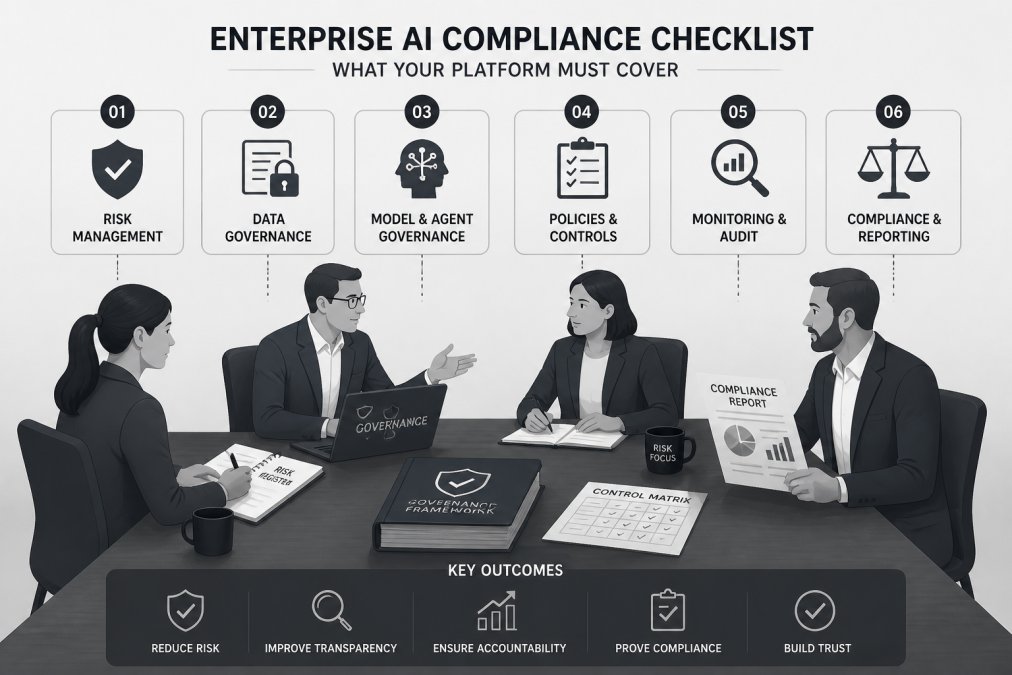
Regulatory frameworks for AI are still evolving, but certain requirements are converging across jurisdictions. Your governance platform should address these core areas.
Explore Ecosystem Government Contracting →
Data Residency and Sovereignty: Verify where agent data is processed and stored. If you're subject to GDPR, customer data must stay within the EU. If you're in financial services, transaction data may need to remain on-premises. Your platform should enforce these constraints and prove compliance in audit reports.
Model Transparency and Explainability: Document what models your agents use, where they come from, and how they make decisions. Regulators increasingly require explainability, you need to explain why an agent made a specific decision, not just that it did. Governance platforms should maintain model inventories and decision logs.
Bias and Fairness Testing: Before deploying agents in customer-facing roles, test for bias. Does the agent treat different user groups differently? Does it make decisions that correlate with protected characteristics? Document your testing methodology and results.
Access Control and Identity Management: Implement role-based access control (RBAC) for agent management. Who can deploy agents? Who can modify agent behavior? Who can access audit logs? Principle of least privilege applies, agents and humans should have only the permissions they need.
Incident Response Procedures: Define what happens when an agent behaves unexpectedly. Who gets notified? What's the escalation path? Can the agent be paused or rolled back? Document these procedures and test them regularly.
Policy Enforcement and Version Control: Maintain versioned policies and audit which policy version governed each agent action. If you change a policy, you need to know which agents operated under the old rules and which under the new ones. This matters for compliance investigations.
Regulatory Alignment: Map your governance controls to specific regulatory requirements. If you're in financial services, align to relevant parts of the Gramm-Leach-Bliley Act. If you're in healthcare, align to HIPAA. If you're in government contracting, align to NIST AI Risk Management Framework. Your platform should support this mapping and generate compliance reports automatically.
OneTrust AI Governance and IBM watsonx.governance both excel at this layer. They provide pre-built policy templates aligned with major regulations, automate compliance workflows, and generate audit-ready documentation. This reduces the manual effort of proving compliance.
How to Choose the Right Governance Platform for Your Agents
Start by defining your deployment topology. Are you running agents on a single cloud provider, across multiple clouds, on-premises, or on blockchain networks? Chain-agnostic platforms like AI Modularity work everywhere. Ecosystem-specific platforms like Rencore Governance optimize for their native environment but struggle with heterogeneous deployments.
Next, assess your compliance requirements. If you're in a regulated industry, prioritize platforms with pre-built compliance frameworks and audit reporting. OneTrust and IBM watsonx excel here. If compliance is less critical and you need lightweight monitoring, Zenity's focus on agent discovery and runtime guardrails may be sufficient.
Evaluate your team's integration capacity. Can your developers integrate a new platform in weeks, or do you need something that plugs into existing infrastructure with minimal customization? Some platforms offer tighter integrations for their respective ecosystems. Others require more configuration but offer broader flexibility.
Consider your cost structure. Some platforms charge per agent, others per transaction, others per organization. Without published pricing, request a quote based on your agent count and transaction volume. AI Modularity's pricing depends on your deployment scale and authorization requirements, contact their team for specifics.
Test with a pilot deployment before committing organization-wide. Deploy one non-critical agent through the platform, run it for two weeks, and evaluate: Did it catch issues? Did it slow down development? Did the audit trails prove useful? This real-world test beats any demo.
Finally, assess vendor stability and roadmap alignment. Is the vendor investing in agent governance, or is it a checkbox feature in a larger platform? AI Modularity's entire platform is built around agent execution trust. That focus matters, they're solving this problem as their core business, not as an afterthought.
Conclusion
Enterprise AI agent governance isn't optional anymore. As organizations deploy autonomous agents for critical operations, the ability to verify behavior before execution, authorize consequential actions cryptographically, and attribute outcomes afterward becomes essential. The platforms that matter most are those that move beyond monitoring what agents do after the fact to preventing unsafe execution before it happens.
AI Modularity's approach, combining pre-execution verification, cryptographic authorization, and immutable attribution, addresses the core trust problem in autonomous systems. If your organization is deploying agents for financial operations, regulated workflows, or mission-critical processes, explore how AI Modularity's execution trust ecosystem can reduce risk while accelerating agent deployment. Learn more about AI governance frameworks from NIST for regulatory alignment guidance, and start your pilot with a single non-critical agent to validate the platform's fit for your environment.
Frequently Asked Questions
What is AI agent governance and why does it matter for enterprises?
AI agent governance is the set of policies, controls, and oversight mechanisms that ensure autonomous AI systems operate safely, compliantly, and according to business intent. For enterprises, it matters because uncontrolled agents can execute unsafe actions, violate regulations, incur unexpected costs, or create security vulnerabilities. Governance platforms provide verification before deployment, authorization at execution, and attribution after actions complete, reducing risk of unsafe execution paths and enabling verifiable accountability across autonomous workflows.
How do AI agent monitoring tools differ from traditional security tools?
Traditional security tools monitor network traffic and system access. AI agent monitoring tools track agent behavior, decisions, and actions in real time. They detect shadow AI deployments, enforce runtime guardrails to prevent unauthorized tool use, record audit trails of every agent decision, and evaluate continuous drift or bias. This runtime observability is essential because agents can act autonomously without human intervention, you need to see what they're doing, catch problems before they cause damage, and generate audit-grade evidence for compliance.
What should be included in an enterprise AI risk management framework?
A robust framework covers the full autonomous lifecycle: verification of agent code and workflows before deployment, authorization controls that cryptographically confirm consequential actions, identity and access management for who can deploy or modify agents, audit logging for every action and decision, bias and drift detection, incident response procedures, and cost governance for token usage and agent sprawl. It should align with NIST AI Risk Management Framework guidance and map to your regulatory requirements, whether GDPR, SOX, or industry-specific standards. The framework bridges technical controls with business intent and legal obligations.
How does an enterprise AI compliance checklist help with regulatory alignment?
An enterprise AI compliance checklist ensures your governance platform covers the specific regulatory requirements your industry faces. It should verify that your platform supports audit trails, data residency controls, model transparency documentation, access control policies, and incident response workflows. Platforms like OneTrust and Credo AI include pre-built policy packs for NIST AI RMF, ISO 42001, and industry standards. By working through the checklist before deployment, you confirm your platform can generate the evidence auditors and regulators expect, reducing compliance risk and accelerating approval for autonomous financial actions or sensitive operations.
Can AI agent governance tools work across multiple cloud providers and on-premises environments?
Yes, but it depends on the platform's architecture. Chain-agnostic platforms like AI Modularity are designed to work across different execution environments and blockchain networks without lock-in. Others like Rencore Governance and Microsoft Purview are optimized for their native ecosystems (Microsoft 365, Azure) but may have limitations for multi-cloud deployments. Before selecting a tool, verify it supports your actual infrastructure, whether that's AWS, Azure, GCP, on-premises, or hybrid environments. Ask vendors directly about interoperability limitations to avoid discovering incompatibilities after implementation.
This article was written using GrandRanker