 how-to
Enterprise AI Security Demo: What to Ask & Evaluate
Table of Contents
- Why an Enterprise AI Security Demo Matters
- Key Components of AI Security Posture to Verify in a Demo
- Critical AI Security Demo Questions to Ask Vendors
- Enterprise AI Security Checklist for Vendor Evaluation
- Evaluating AI Security Vendors: Beyond the Demo
- Cost-Benefit Analysis: What Enterprise AI Security Implementation Requires
- Next Steps: From Demo to Deployment
- Conclusion
Last Updated: August 12, 2026
Why an Enterprise AI Security Demo Matters
Deploying autonomous AI agents in enterprise environments means accepting real financial and operational risk. Every agent that executes without proper verification creates exposure: unvalidated code paths, uncontrolled financial transactions, unattributed outcomes. A security demo is your opportunity to verify that a platform can actually prevent the failures you've already experienced or fear most.
The stakes are highest in financial services and government contracting, where autonomous agents handle consequential actions. A single misconfigured agent can authorize transfers, modify permissions, or execute workflows that create audit nightmares or regulatory violations. An enterprise AI security demo focuses on execution trust: the ability to verify what an agent will do before it runs, authorize specific actions at the point of execution, and prove what happened afterward.
AI Modularity helps security architects and CTOs evaluate AI security platforms by providing a framework for testing what actually matters. The right demo questions expose whether a vendor's platform delivers verifiable security or just monitoring dashboards. Below, we'll show you exactly what to evaluate during a demo and which questions separate platforms that genuinely reduce risk from those that simply report on it after the fact.
Key Components of AI Security Posture to Verify in a Demo
An enterprise AI security posture rests on three technical pillars: verification of what agents will do, authorization of consequential actions, and attribution of outcomes. During a demo, you need to see each component working in your environment, not in a sanitized test case.
Verification of Agent Code and Workflows
Verification means cryptographically confirming that an agent's code matches what you expect before it executes. This happens before execution, not after like monitoring or logging. During a demo, ask the vendor to show you how they verify agent code integrity and detect unauthorized modifications to workflows.
A solid verification system should let you see exactly what code the agent will execute, flag any deviations from approved versions, and prevent execution if verification fails. Ask them to demonstrate this with a real agent binary or workflow, not a theoretical example. Show them a modified agent binary and ask how quickly the system detects it and prevents execution.
Authorization and Financial Controls
Authorization means cryptographically signing off on specific actions before an agent executes them. If an agent is designed to transfer funds, authorize payment terms, or modify access controls, you need proof that each action was explicitly approved by a human or governance policy before execution happens.
During the demo, ask the vendor to show you how authorization works for a financial transaction. Can they require multi-party approval for high-value actions? Can they enforce spending limits per agent, per day, per transaction? Can they tie authorization to specific blockchain networks or execution environments if you're running agents across multiple chains?
The key question: does authorization happen at execution time or before? If it's before, the agent can't execute anything you haven't explicitly approved.
Threat Detection and Incident Response Capabilities
Threat detection identifies when an agent is behaving outside its normal parameters or executing suspicious workflows. Incident response means you can quarantine that agent, audit what happened, and prevent recurrence without bringing down your entire agent infrastructure.
Ask the vendor to walk you through a real incident scenario. An agent suddenly tries to execute a workflow it's never run before. Does the system detect the anomaly? How long does detection take? Can you quarantine the agent while you investigate? Can you roll back executed transactions if needed?
Critical AI Security Demo Questions to Ask Vendors
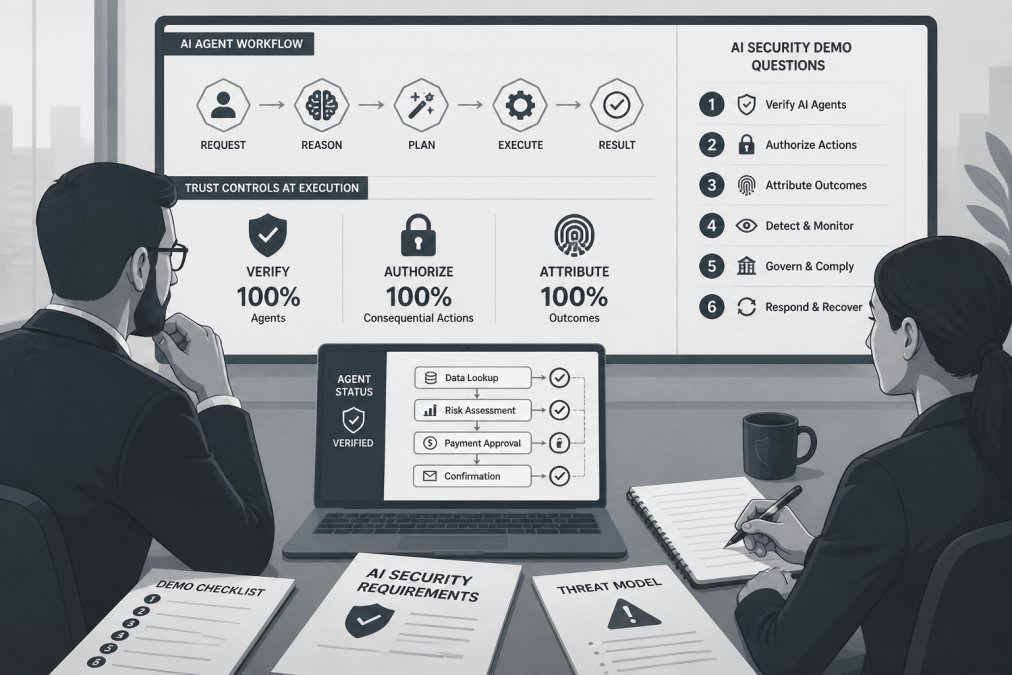
The questions you ask during a demo determine whether you understand what the platform actually does. Specific technical questions expose gaps.
Chain-Agnostic Execution and Integration
Ask whether the platform works across all the execution environments you actually use. Many vendors claim chain-agnostic support but only truly support Ethereum or a single cloud provider. Ask directly: does your platform work on Solana, Polygon, and Ethereum? Does it work on AWS, GCP, and Azure simultaneously? Does it work on premises?
Ask them to show you an agent running on one chain and another agent running on a different chain, both managed through the same control plane. Then ask about integration with your existing SIEM or SOAR platform. Can you pull alerts into Splunk or Datadog? Can you trigger workflows in your existing automation tools based on agent behavior?
Compliance and Governance Framework Support
Ask the vendor which compliance frameworks they support: SOC 2, FedRAMP, HIPAA, PCI-DSS, or others relevant to your industry. Ask for proof, certification documents, audit reports, and customer references.
Then ask about governance. Can the platform enforce role-based access control for who can approve agent deployments? Can it enforce that agents running financial transactions require multi-party authorization? Can it generate audit logs that satisfy your compliance requirements?
A critical question: does the platform support the EU AI Act or NIST AI Risk Management Framework? If you're in regulated industries or government contracting, this matters.
Implementation Timeline and Resource Requirements
Ask the vendor for a realistic timeline. How long does initial deployment take? How long does agent integration take? Ask for reference customers with similar scale and ask them directly about timeline.
Then ask about resource requirements. How many of your engineers need to learn their platform? Do you need specialized security expertise, or can your existing DevOps team handle it? If the vendor says you need to hire new people or spend six months on integration, that's a cost you need to factor in.
Explore Ecosystem Government Contracting →
Enterprise AI Security Checklist for Vendor Evaluation
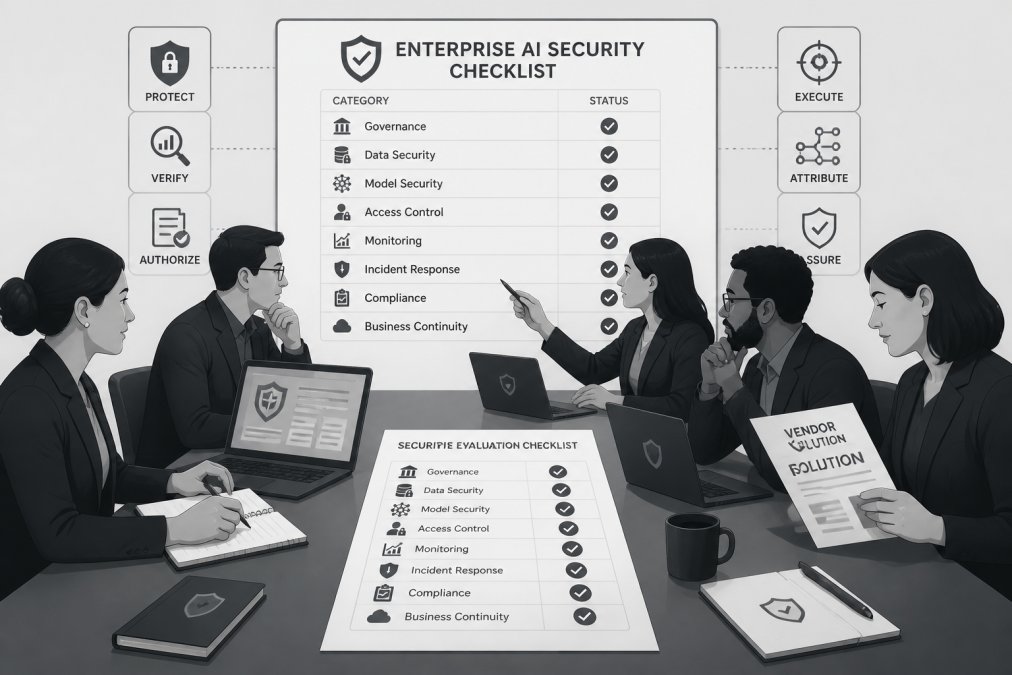
Use this checklist during and after your demo to evaluate whether a vendor's platform actually addresses your security requirements.
| Evaluation Criteria | What to Verify | Pass/Fail |
|---|---|---|
| Code Verification | Cryptographic verification of agent binaries before execution; demonstration with modified code detection | |
| Authorization Controls | Multi-party approval workflows; per-agent and per-transaction spending limits; real-time authorization at execution | |
| Threat Detection | Behavioral anomaly detection; real-time alerting; quarantine capabilities without service interruption | |
| Chain-Agnostic Support | Works across Ethereum, Solana, Polygon; works across AWS, GCP, Azure; on-premises support demonstrated | |
| Compliance Certification | SOC 2 Type II, FedRAMP, or relevant certifications; audit reports available; compliance mapping to your requirements | |
| NIST AI RMF Alignment | Platform supports risk classification, mapping to NIST categories; audit trails for governance | |
| SIEM/SOAR Integration | APIs for Splunk, Datadog, or your existing tools; alert forwarding; workflow triggering | |
| Incident Response | Audit logs; transaction rollback capability; quarantine without service impact; investigation tools | |
| Implementation Timeline | Realistic deployment timeline; reference customers at your scale; integration with your tech stack | |
| Resource Requirements | Training time; required expertise; staffing needs; integration effort in person-weeks |
A vendor that scores high on all these criteria has a mature platform. One that scores high on some and deflects on others is selling you a partial solution.
Evaluating AI Security Vendors: Beyond the Demo
A demo is a curated experience. To evaluate a platform fairly, you need to see how it performs in real conditions with your actual agents, your actual data, and your actual failure modes.
Assessing Real-World Deployment Capability
Ask the vendor for a proof-of-concept engagement. Run one of your actual agents through their platform in a staging environment. Use your code, your workflows, your data pipelines. See what breaks. See how long integration actually takes.
During the POC, measure what matters: Does verification slow down your agent? Is that acceptable? Does authorization introduce unacceptable latency? Can you approve transactions fast enough to keep your workflows running?
Ask the vendor for reference customers at your scale and in your industry. Call them directly. Did the implementation take as long as the vendor promised? What surprised them? If the vendor won't provide references or references are evasive, that's a red flag.
Understanding Shadow AI Mitigation and Risk Classification
Shadow AI means agents running in your environment that you don't know about or haven't approved. A mature platform helps you discover and classify these agents by risk level.
Ask the vendor how they discover shadow AI. Can they scan your infrastructure and identify agents you didn't formally deploy? Can they classify those agents by risk? Can they enforce governance on shadow agents, requiring them to go through approval workflows before executing?
Cost-Benefit Analysis: What Enterprise AI Security Implementation Requires
Enterprise AI security implementation requires investment across multiple dimensions: platform licensing, integration and deployment labor, ongoing operations, and training. Understanding the full cost picture matters because the cheapest platform often becomes the most expensive when integration and operations are included.
A realistic cost-benefit analysis starts with your current risk exposure. What's the financial impact if an agent executes a malicious or incorrect transaction? What's the regulatory cost of an audit failure? Compare those costs to the investment required to deploy a security platform.
For most enterprises, the ROI is clear: the cost of a single prevented incident exceeds the annual cost of the platform. Ask reference customers directly: has this platform prevented a real incident? What would have happened without it?
Next Steps: From Demo to Deployment
After evaluating vendors and selecting a platform, start with a limited scope: pick one critical agent or agent workflow and run it through the full security lifecycle. Verify the code. Test authorization workflows. Validate that incident response works. Only after success with one agent should you expand to others.
Assign clear ownership. Who owns agent security in your organization? This person needs to be involved from the demo through deployment and understand the platform deeply enough to make decisions about risk tolerance and approval workflows.
Plan for integration with your existing tools. Build the integration plan before you start. Don't assume the vendor's integration will work seamlessly with your setup; test it in your environment with your data.
Set clear success metrics. What does success look like? Faster agent deployment? Fewer security incidents? Reduced audit burden? Define these before you deploy so you can measure whether the platform actually delivers.
Enterprise AI security demos are your opportunity to verify that a platform can actually reduce the risks you face. The vendors who can show you code verification, execution-time authorization, and real-world incident response deserve your attention. Those who can't are selling you monitoring, not security. Ask the hard questions, run a proof-of-concept, and talk to reference customers.
At AI Modularity, we've built our execution trust ecosystem specifically to address these verification and authorization challenges. Our Agent Verify™ technology provides cryptographic code verification before execution, while A2SPA™ and A2EA™ enable authorization of consequential actions at the point of execution. If you're evaluating platforms for enterprise AI security, explore how execution trust works with AI Modularity's ecosystem to see whether chain-agnostic, verifiable security fits your deployment model. For government contracting and regulated industries, our approach to compliance and attribution may address gaps you're currently managing manually.
Frequently Asked Questions
What should be included in an enterprise AI security demo?
A comprehensive enterprise AI security demo should cover agent verification before deployment, authorization controls at execution, threat detection capabilities, compliance framework integration, and real-world deployment examples. The vendor should demonstrate how their platform verifies agent code, enforces access controls, detects anomalies in agent behavior, and maintains audit logs for accountability. Request a walkthrough of their risk classification system and how they handle shadow AI discovery across your infrastructure. Ask to see integration with your existing security tools and cloud environments.
How do I evaluate AI security vendors for my organization?
Start by assessing whether the vendor's solution covers your full AI lifecycle: from deployment through execution to post-execution attribution. Verify that their platform is chain-agnostic and works across your cloud providers and on-premises infrastructure. Check their compliance credentials against relevant standards like NIST AI RMF and industry-specific regulations. Ask for case studies from organizations similar to yours, especially in financial services or government. Evaluate their incident response capabilities, integration with your SIEM/SOAR platforms, and the resource commitment required for implementation. Request a pilot program with a subset of your agents before full rollout.
What are the key compliance standards for enterprise AI security?
Organizations deploying AI agents should align with NIST AI Risk Management Framework (AI RMF), which provides guidance on AI governance, risk classification, and security controls. The EU AI Act, though focused on European organizations, is increasingly referenced by enterprises for compliance best practices. Industry-specific standards apply: financial institutions follow SEC and FINRA requirements for algorithmic trading and autonomous actions; government agencies must comply with FISMA and OMB AI governance directives. Your AI security platform should support audit logging, data privacy protections, and role-based access controls to meet these frameworks.
What questions should I ask during an AI security software demo?
Ask how the platform verifies agent behavior before production deployment and whether it prevents prompt injection and model poisoning attacks. Inquire about their approach to identity governance and access control for autonomous actions. Request specifics on threat detection latency and incident response workflows. Ask whether they provide automated discovery of shadow AI and how they classify risk across your agent inventory. Clarify the implementation timeline and whether integration with existing security orchestration tools is included. Finally, ask for transparent pricing models and what support is included post-deployment.
This article was written using GrandRanker