 ultimate-guide
Is Automated AI Agent Authorization Worth It?
Table of Contents
- The Autonomy vs. Security Paradox: Why Authorization Matters
- Authentication vs. Authorization for AI Agents
- Cryptographic Authorization for AI: Moving Beyond Passwords
- AI Agent Security Best Practices: Implementing Human-in-the-Loop
- AI Agent Governance and Compliance: Navigating Regulations
- Cost-Benefit Analysis: Is Automated Authorization Worth It?
- Revocation and Kill-Switch Protocols: The Missing Piece
- Conclusion: Making the Strategic Choice
- Frequently Asked Questions
Last Updated: September 27, 2026
The Autonomy vs. Security Paradox: Why Authorization Matters
Autonomous AI agents now negotiate contracts, move funds, and provision infrastructure without a human watching. That capability creates a specific problem: the more autonomy you grant an agent, the more damage a compromised or misaligned agent can do. AI agent authorization is the control layer that answers the question every security team eventually asks: should this agent, right now, be allowed to take this specific action?
This guide from AI Modularity examines whether automated authorization is worth the investment, where it fits in your stack, and how to implement it without stalling your deployment roadmap. The short answer: for agents touching money, customer data, or production systems, yes. For read-only research agents, probably not yet.
The paradox is simple. An agent that cannot act independently delivers little value. An agent that can act independently without a verifiable permission boundary is a liability. Authorization resolves the tension by making autonomy conditional rather than absolute.
Authentication vs. Authorization for AI Agents
Authentication proves who the agent is. Authorization determines what that verified agent may do. Confusing the two is the most common architectural mistake in agentic deployments.
Authentication for a non-human entity typically means verifying a cryptographic identity: a signed token, a workload certificate, or a hardware-backed key. Authorization is the separate decision about scope, timing, and context. An agent can authenticate successfully and still be denied the action it requested.
| Layer | Question Answered | Typical Mechanism | Failure Mode |
|---|---|---|---|
| Authentication | Who is this agent? | Signed tokens, certificates | Spoofed or stolen credentials |
| Authorization | May it do this, now? | Policy engines, scoped tokens | Over-permissioned agent |
| Attribution | What did it actually do? | Audit trails, signed logs | Untraceable actions |
Most breaches in agentic systems are authorization failures, not authentication failures. The agent was who it claimed to be.
Cryptographic Authorization for AI: Moving Beyond Passwords
Passwords and static API keys were designed for humans and long-lived services. Autonomous agents call tools hundreds of times per hour, often across multiple systems, and a static credential grants permanent access the moment it leaks.
AI Agent Security Best Practices: Implementing Human-in-the-Loop
Human-in-the-loop (HITL) is not a fallback for immature systems. It is a deliberate control placed at the highest-consequence decision points. The goal is not to review everything, which defeats the purpose of autonomy, but to route only irreversible or high-value actions to a human approver.
Effective HITL design follows three rules:
- Define thresholds, not vibes. A payment above a set amount, a deletion of production data, or a new counterparty triggers review. Everything else proceeds.
- Make approval fast. If the human review takes longer than the agent's task, teams route around the control.
- Log the decision. Every approval and rejection becomes training data for tightening policy later.
AI Agent Governance and Compliance: Navigating Regulations
AI agent governance and compliance is the set of policies, roles, and evidence trails that let you demonstrate to a regulator or auditor that your agents operated within defined limits. In regulated sectors, that evidence is not optional.
Cost-Benefit Analysis: Is Automated Authorization Worth It?
Automated AI agent authorization is worth it when the expected cost of unauthorized agent actions exceeds the fully loaded cost of the control. That sounds obvious, but most teams never actually run the numbers, they either skip authorization to ship faster or over-build it and stall the roadmap. The framework below turns the decision into arithmetic instead of instinct.
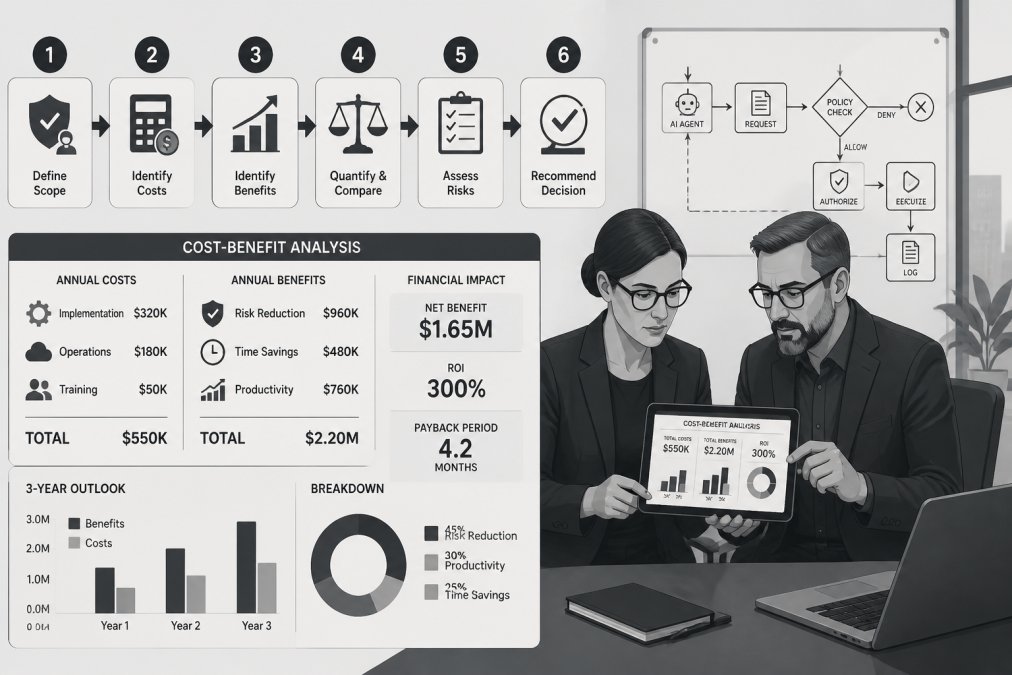
Step 1: Estimate expected loss without authorization
Expected loss = (probability of an unauthorized action per period) × (average cost per incident).
Explore Ecosystem Government Contracting →
- Tier 1, money movement, production writes, customer PII, external communications. A single incident can trigger regulatory notification, remediation engineering, customer credits, and legal review. Practitioners in financial services typically treat a single material incident as a multi-week engineering and compliance event, not a one-day fix.
- Tier 2, internal systems, non-production data, reversible actions. Incidents are annoying and expensive in aggregate but rarely existential.
- Tier 3, read-only research, summarization, drafting. An unauthorized action here is usually a data-hygiene problem, not a breach.
Step 2: Estimate the cost of the control
Three line items dominate:
- Implementation engineering. Integrating a policy engine, issuing scoped credentials, and wiring audit logging into the agent runtime. For a single well-defined agent, this is typically measured in engineer-weeks, not engineer-months. For a fleet of heterogeneous agents across multiple clouds, multiply accordingly.
- Ongoing policy maintenance. Every new tool, endpoint, or data source the agent can reach needs a policy entry. Budget for this as a recurring cost, not a one-time build.
- Added latency per action. A local policy check adds negligible overhead. A remote authorization call to a centralized service adds network round-trip time to every tool invocation. For agents making hundreds of calls per hour, that compounds, which is why caching short-lived grants and batching decisions matters.
Step 3: Compare against the cost of the alternative
The alternative to authorization is not "no cost." It is manual review, hard-coded allowlists, or unrestricted autonomy. Each has a price:
- Manual review scales linearly with agent activity and burns senior reviewer time on low-value approvals.
- Hard-coded allowlists break every time the agent's task changes and create a maintenance backlog that quietly becomes the real bottleneck.
- Unrestricted autonomy is cheap until the first incident, at which point the entire autonomous program typically gets frozen pending review, a cost that dwarfs the control.
A simple decision rule
If a single unauthorized action in a given agent's scope would require executive escalation, customer notification, or a regulatory filing, authorization is worth it. If the worst realistic outcome is a bad draft or a wasted API call, a lighter control, scoped credentials with short expiry and good logging, is usually sufficient. Determining the appropriate level of oversight becomes even more complex when the output shifts from functional task execution to the creative nuances of AI generated content, where the threshold for acceptable risk often requires a different framework for evaluation.
Revocation and Kill-Switch Protocols: The Missing Piece
Revocation is the control most teams forget until they need it. An authorization system that cannot instantly revoke an agent's access is a system that trusts every agent forever, and "forever" is exactly the window an attacker or a misaligned agent needs.
Three revocation speeds, three different mechanisms
1. Immediate, kill all active grants for an agent. This is the true kill switch. It must terminate in-flight work, not just prevent new work. Practically, that means the agent runtime checks a revocation signal before each consequential action, and the signal propagates in seconds, not minutes. If your revocation path depends on a human paging another human, it is not immediate, it is a meeting.
Design rules that make revocation actually work
- Bind grants to the payload, not just the agent. A grant approved for a specific transfer amount and counterparty should be useless for any other amount or recipient. This turns a leaked grant into a nuisance instead of a backdoor.
- Keep a revocation registry that the runtime consults on the hot path. If the check is optional or asynchronous, it will be skipped under load.
- Log every revocation with a reason code. "Revoked by operator," "expired," and "policy violation" are different events and should be distinguishable in the audit trail.
- Separate the kill switch from the deploy pipeline. If disabling an agent requires a code change and a release, you have not built a kill switch, you have built a backlog item.
Test the kill switch before you need it
A kill-switch protocol that has never been exercised is a hypothesis, not a control. Run a revocation drill on a regular cadence, quarterly is a common baseline for Tier 1 agents, and measure two things: how long from trigger to confirmed halt, and whether any in-flight action completed after the trigger. If disabling an agent takes more than a few minutes, or if any action slipped through after the signal, the protocol is not ready.
Conclusion: Making the Strategic Choice
The question is not whether autonomy is coming to your stack. It is whether you will govern it or react to it. Automated authorization is the difference between deploying agents with confidence and deploying them with hope.
Frequently Asked Questions
What are the primary risks of deploying AI agents without authorization protocols?
Without authorization protocols, AI agents can execute unauthorized actions, leading to data breaches, financial loss, and compliance violations. For example, an agent might approve a fraudulent transaction or leak sensitive data. Implementing AI agent authorization ensures every action is verified against policies, reducing these risks and providing audit trails for accountability.
How does automated authorization differ from standard AI authentication?
Authentication verifies an agent's identity, while authorization determines what actions it can perform. Automated authorization goes further by dynamically evaluating each action against policies in real time, using cryptographic proofs. This prevents privilege escalation and ensures agents only execute approved tasks, which is critical for AI agent security best practices.
Can automated AI agent authorization prevent unauthorized financial transactions?
Yes. By cryptographically authorizing each transaction before execution, automated systems can block unauthorized transfers. For instance, an agent attempting to move funds without proper approval would be stopped. This is a core component of AI agent governance and compliance, helping organizations meet regulatory requirements and avoid financial losses.
Is automated authorization scalable for large enterprise AI deployments?
Yes, when designed with scalability in mind. This scalability makes automated AI agent authorization worth it for enterprises with high transaction volumes.