 comparison
Palo Alto Networks AI Alternatives: 2026 Comparison
Table of Contents
- Quick Comparison: Palo Alto Networks AI Alternatives
- AI Modularity: Execution Trust for Autonomous Agents
- Wiz: Agentless Cloud Security Posture Management
- Fortinet FortiGate: AI-Driven Network Security
- Google Security Operations: AI-Powered Threat Intelligence
- AI Agent Security Platforms: Key Capabilities to Evaluate
- Cryptographic Authorization for AI Agents: The Execution Layer
- Enterprise AI Security Best Practices: TCO, Migration, and Compliance
- Frequently Asked Questions
Last Updated: September 16, 2026
Quick Comparison: Palo Alto Networks AI Alternatives
Evaluating Palo Alto Networks AI alternatives starts with one question: what are you actually trying to secure? The market has split into distinct categories, cloud posture, network perimeter, threat analytics, and the execution layer where autonomous agents act. This guide from AI Modularity compares four credible options, with the trade-offs most vendor pages skip.
Here's the short version before the detail:
| Platform | Primary Focus | Best For | Watch Out For |
|---|---|---|---|
| AI Modularity | Execution trust for autonomous agents | Regulated, agent-heavy deployments | Narrower scope than full CNAPP suites |
| Wiz | Agentless cloud security posture | Multi-cloud visibility | Limited on-premises coverage |
| Fortinet FortiGate | AI-driven network security | Perimeter and SD-WAN protection | Complex management interface |
| Google Security Operations | AI-powered threat intelligence | High-volume telemetry analysis | Requires deep configuration expertise |
Most comparison content treats these as interchangeable. They aren't. A cloud posture tool and an execution trust layer solve different problems, and buying the wrong category wastes budget regardless of product quality.
AI Modularity: Execution Trust for Autonomous Agents
AI Modularity secures autonomous AI at the point where trust matters most: execution. It verifies agents before deployment, cryptographically authorizes consequential actions before they run, and attributes outcomes afterward. For teams deploying agents that move money or touch regulated systems, that lifecycle coverage is the differentiator.
The stack combines Agent Verify™ for pre-deployment validation, A2SPA™ and A2EA™ for authorization and attribution, and CryptoValidity™ for cryptographic proof of execution. It is chain-agnostic, so teams running agents across multiple clouds and on-premises infrastructure are not locked into one execution environment.

Where it falls short: it is not a network firewall or cloud posture scanner. For perimeter defense, look at Fortinet; for agent execution trust, this is the strongest option here.
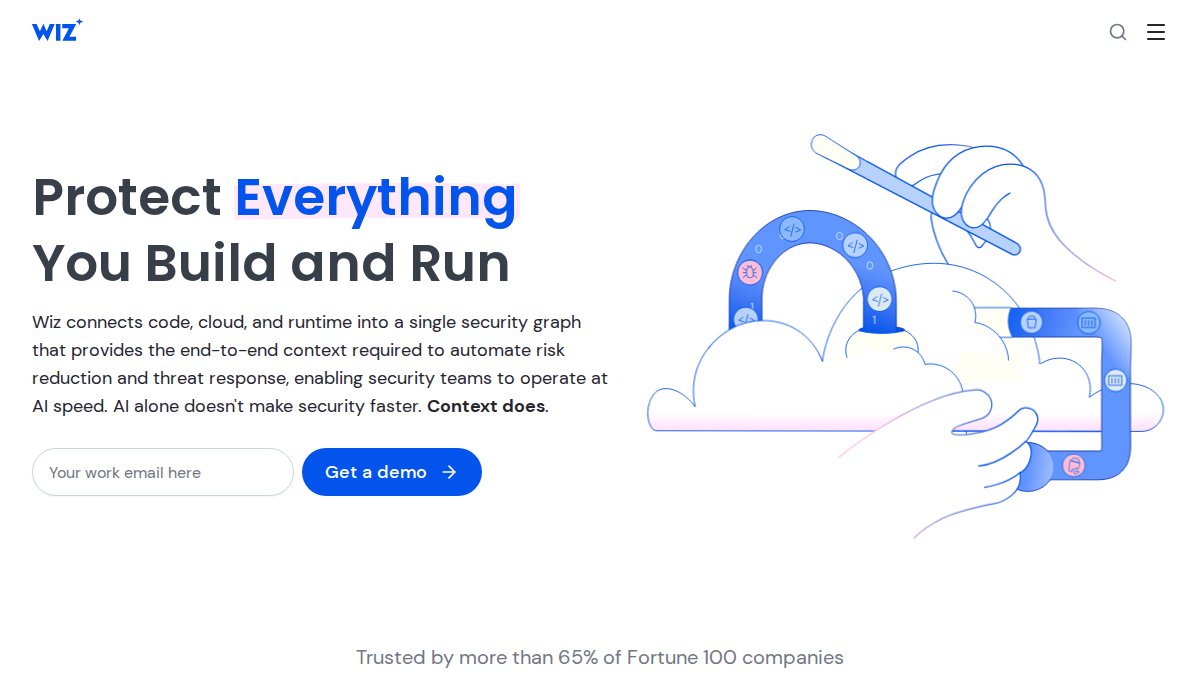
Wiz: Agentless Cloud Security Posture Management
Wiz takes an agentless approach to cloud security posture management, scanning AWS, Azure, and GCP without deploying software on individual workloads. Deployment is fast, and the graph-based risk visualization is intuitive for teams drowning in alerts. Vulnerability management, compliance reporting, and CI/CD pipeline integration come standard.
The limitation is scope. Wiz is built for cloud environments, not on-premises hardware, so hybrid estates need a second tool. It also does not address what an AI agent does at runtime. You get visibility into cloud misconfigurations, not authorization of agent payloads.
Fortinet FortiGate: AI-Driven Network Security
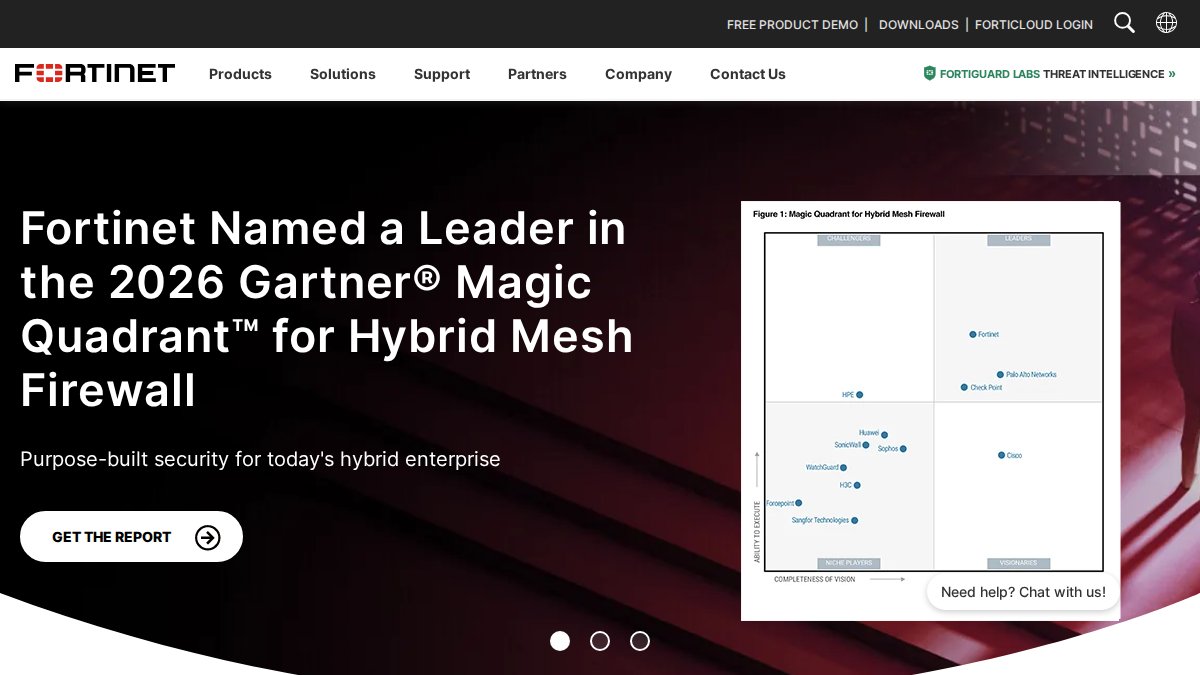
FortiGate is a next-generation firewall using FortiGuard AI-powered services for real-time threat intelligence. Custom ASIC acceleration handles high-throughput inspection, and SD-WAN plus SASE are integrated rather than bolted on. For perimeter-focused organizations, it remains a strong price-to-performance option.
The management interface is the friction point. Non-specialists find FortiManager complex, and the broad product portfolio means configuration decisions multiply quickly. FortiGate protects the network path; it does not govern how an autonomous agent behaves once it is inside.
Google Security Operations: AI-Powered Threat Intelligence
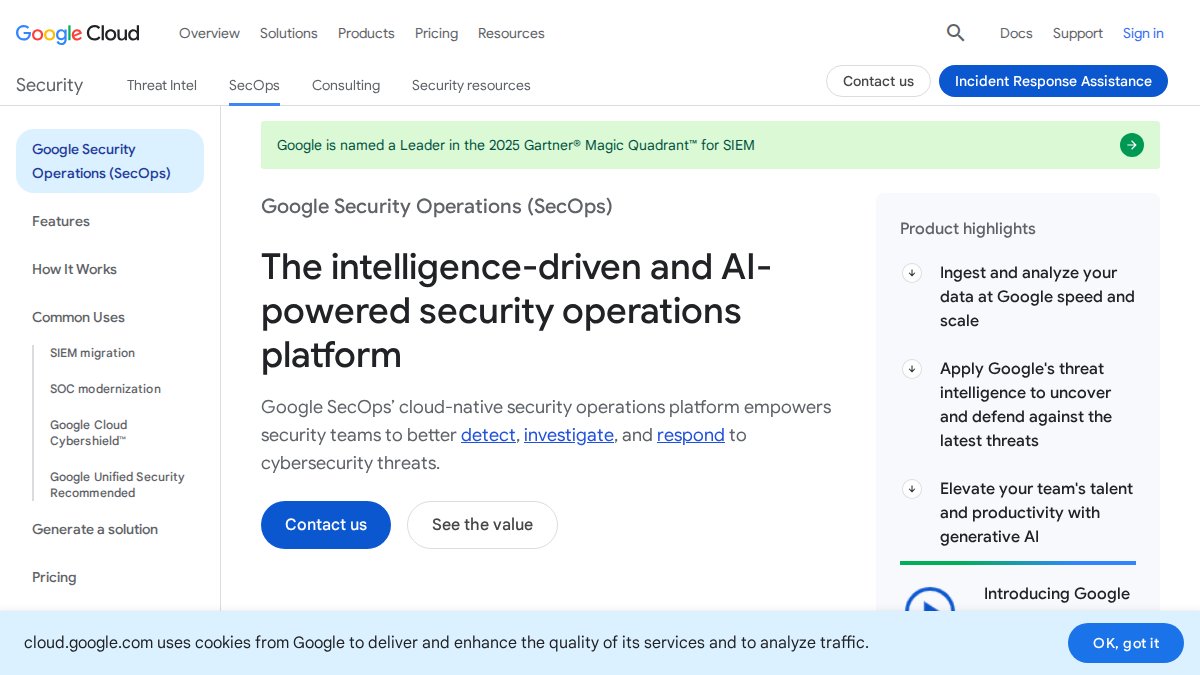
Google Security Operations combines SIEM and SOAR with AI-driven threat hunting. It ingests and searches at a scale few competitors match, drawing on Google Cloud's global threat intelligence, with native multi-cloud and hybrid support.
The trade-off is expertise. Configuration and tuning demand significant security engineering time, and smaller teams often underuse the platform's capability. It excels at detecting and investigating threats across telemetry; it is not designed to authorize agent execution or attribute economic outcomes.
AI Agent Security Platforms: Key Capabilities to Evaluate
AI agent security platforms verify, authorize, and monitor autonomous agents across their operational lifecycle. The category is distinct from traditional security tooling, and evaluation criteria differ accordingly. A feature list is not enough: two platforms can check the same box and still produce very different outcomes in production. Effective oversight requires deep visibility into the underlying AI data security protocols that govern how these autonomous systems interact with sensitive information during their execution cycles.
A weighted scorecard is more useful. Score each candidate 1 to 5 on the criteria below, then weight them against your risk profile: a regulated financial services team should weight execution-time authorization and attribution heavily, while a cloud-native SaaS team may weight environment coverage and interoperability higher. The weights matter more than the raw scores.
Evaluation criteria and what to actually test
- Pre-deployment verification: Does it validate agent code, permissions, and tool access before production? Ask for a live demo against one of your own agent manifests. A platform that cannot ingest your manifest in a demo will not ingest it in a pilot.
- Execution-time authorization: Can it block a consequential action before it runs, or only log it after the fact?
How the categories actually differ
Traditional platforms cover one or two criteria.
Deployment model trade-offs
Cloud-delivered platforms typically reach production in days to weeks with less internal infrastructure.
A note on cost-benefit
License cost is the smallest line item in most AI agent security budgets; integration engineering, tuning, and false positives usually dominate.
Cryptographic Authorization for AI Agents: The Execution Layer
Cryptographic authorization for AI agents requires a verifiable cryptographic proof before an agent's action is permitted to execute, shifting security from after-the-fact detection to pre-execution enforcement.
Enterprise AI Security Best Practices: TCO, Migration, and Compliance
Enterprise AI security best practices increasingly center on three factors vendor comparisons ignore: total cost of ownership, migration friction, and compliance mapping.
A TCO framework you can actually run
- License and subscription: The quoted annual or multi-year cost, including any per-agent, per-workload, or per-decision metering.
- Integration engineering: Internal hours to connect the platform to your SIEM, SOAR, identity provider, and CI/CD pipeline. A common pattern is 200 to 600 engineering hours for a mid-size enterprise, varying with the number of integrations.
- Ongoing tuning: Analyst time to reduce false positives and adjust policies. Budget for the first 90 days at roughly double the steady-state rate.
- Operational cost of false positives: Every blocked legitimate action has a cost, a delayed transaction, a stalled workflow, an on-call page. Estimate this from your current incident volume.
- Exit cost: What it would take to leave. This is the bucket almost nobody models, and it is the one that compounds.
Migration path and technical friction
- Inventory and mapping: Document every agent, policy, and integration tied to the incumbent platform. Identify which controls are enforced at execution time versus which are only logged. The logged-only controls are the ones you can migrate without breaking production.
- Parallel run: Run the new platform alongside the old one on a subset of agents. Compare decisions on the same traffic. Divergences are your migration risk, and they surface here rather than in production.
- Cutover: Move enforcement authority, not just visibility. This is the step where fail-open versus fail-closed behavior matters most. Schedule it during a low-traffic window and have a rollback plan.
- Decommission: Remove the old platform's agents, connectors, and credentials. Leaving them in place is a common source of audit findings.
Vendor lock-in risks and interoperability
Lock-in is a spectrum from fully portable to fully proprietary.
Regulatory compliance mapping
Map each platform to the frameworks your regulators enforce before the pilot, not after.
Putting it together
Run the TCO model, walk the migration path on paper, and map compliance evidence before running a pilot.
Frequently Asked Questions
What are the primary security risks when deploying autonomous AI agents?
Autonomous AI agents introduce risks such as unauthorized actions, data leakage, and unsafe execution paths. Without proper controls, agents can perform financial transactions or access sensitive data without verification. Cryptographic authorization and execution trust platforms help mitigate these risks by verifying agent behavior and permissions before actions execute, reducing the chance of incidents.
How do AI security alternatives compare to Prisma Cloud?
Prisma Cloud focuses on cloud security posture management and workload protection, while alternatives like Wiz offer agentless visibility and AI Modularity provides execution trust for AI agents. The right choice depends on whether you need broad cloud coverage or specialized agent security. Many organizations use a combination to address different layers of their security stack.
What is the role of execution trust in AI security?
Execution trust ensures that AI agents are verified before deployment and that their actions are cryptographically authorized at the point of execution. This prevents unauthorized or malicious actions and provides attributable records for compliance. Platforms like AI Modularity use execution trust to secure autonomous financial actions and other high-risk operations.
Are there specialized alternatives for securing AI agent workflows?
Yes, AI Modularity is a specialized alternative that focuses on the full lifecycle of autonomous agents, from verification to economic attribution. Unlike traditional network security providers, it offers chain-agnostic execution trust and cryptographic authorization, making it suitable for enterprises deploying agents across multiple environments.
How does AI Modularity differ from traditional network security providers?
Traditional providers like Palo Alto Networks focus on network perimeter and cloud security, while AI Modularity secures the execution layer of AI agents. It verifies agent code, authorizes payloads, and attributes outcomes, which is critical for autonomous operations. This approach complements network security by addressing risks that firewalls and SASE cannot cover.
Deploying autonomous agents into production without execution-level controls leaves your risk posture dependent on hope. AI Modularity closes that gap with verification before deployment, cryptographic authorization at the point of execution, and full attribution afterward, all through a chain-agnostic architecture built for enterprise and government operations. Explore the AI Modularity ecosystem and get your agents secured with verifiable, attributable execution trust.