 listicle
Secure AI Agent Deployment Solutions: 2026 Guide
Table of Contents
- What Secure AI Agent Deployment Solutions Do
- AI Agent Security Framework: Core Components
- Top Secure AI Agent Deployment Platforms
- Autonomous Agent Risk Management Best Practices
- Regulatory AI Compliance Requirements for Agent Deployment
- Incident Response Playbooks for AI Agent Failures
- Integration with Existing Security Infrastructure
- Conclusion
Last Updated: August 20, 2026
What Secure AI Agent Deployment Solutions Do
Autonomous agents are moving from experimental to operational, and that's where risk accelerates. A secure AI agent deployment solution verifies agent behavior before execution, cryptographically authorizes consequential actions in real time, and creates permanent attribution trails for every decision. When agents control financial transactions, data access, or critical operations, failure is a business crisis.

Traditional security frameworks were built for static applications. Agents are dynamic, they learn, adapt, and make context-based decisions you didn't explicitly program. Secure deployment requires trust controls at three points: before execution (verification), during execution (authorization), and after decisions (attribution). Without these layers, you're running unsupervised code in production.
A proper solution starts with verification: Can you prove the agent code is safe before it touches live data? Can you cryptographically sign off on specific actions before execution? Can you trace every outcome back to the agent's decision logic?
AI Agent Security Framework: Core Components
An effective framework rests on three non-negotiable components: verification before execution, cryptographic authorization at runtime, and attribution after the fact.

Verification Before Execution
Before any agent touches production data, verify that code, model weights, and workflow logic are safe. This is cryptographic proof that the agent you're deploying is exactly what you tested.
A strong process generates a cryptographic hash of the agent's complete configuration, code, model, weights, and rules. This hash becomes your proof. If anything changes, deployment fails.
Cryptographic Authorization at Runtime
Verification stops an agent before it runs. Authorization controls what happens while it's running. When an agent decides to execute a financial transaction, modify access controls, or delete data, that decision needs cryptographic authorization. The agent requests permission from an authorization layer that validates the action against policy, context, and risk thresholds. The authorization is cryptographically signed, creating an immutable record.
This matters because agents make decisions based on incomplete information. An authorization layer can intercept decisions, validate them against real-time risk models, and approve or reject them.
Attribution and Audit Trails
Verification and authorization are preventive. Attribution is forensic. Every consequential action needs to be logged with full context: what decision did the agent make, what data informed it, what authorization was required, who approved it, and what was the outcome? This creates an immutable, cryptographically verifiable audit trail.
Attribution is critical in regulated industries. If an agent approves a loan that defaults, regulators want to know exactly why. Attribution trails make this possible.
Top Secure AI Agent Deployment Platforms
1. AI Modularity, Execution Trust Across Chains
AI Modularity verifies and authorizes agents at the point of execution rather than monitoring after deployment. The platform combines Agent Verify™ (pre-deployment verification), A2SPA™ (cryptographic sign-off on consequential actions), A2EA™ (tracking financial outcomes), and CryptoValidity™ (cryptographic proof of decisions).
What separates AI Modularity: it prevents unsafe execution paths before they happen and cryptographically authorizes actions before execution. The chain-agnostic architecture means you're not locked into a specific chain or vendor.
Pros:
- Verification and authorization at point of execution
- Chain-agnostic infrastructure
- Full lifecycle coverage from deployment through economic attribution
- Cryptographic proof of agent decisions
Cons:
- Requires integration with agent orchestration environments
- Organizations unfamiliar with cryptographic authorization may need training
Best for: Enterprises and government agencies deploying autonomous financial agents, organizations requiring verifiable security and economic attribution.
2. IBM watsonx.governance, Regulated Lifecycle Management
IBM watsonx.governance targets the full AI lifecycle from development through retirement, emphasizing compliance automation and regulatory alignment for heavily regulated industries.
The platform provides centralized model inventory, automated drift and bias detection with real-time dashboards, and a regulatory library aligned with the EU AI Act, NIST AI Risk Management Framework, and ISO 42001. It integrates with IBM OpenPages for governance, risk, and compliance workflows.
Where watsonx.governance excels: organizations already using IBM's broader GRC infrastructure. Integration with OpenPages creates unified governance workflows and largely automates compliance documentation.
Pros:
- Comprehensive lifecycle management for traditional ML and generative AI
- Strong regulatory alignment with EU AI Act, NIST, ISO 42001
- Native integration with IBM OpenPages
- Automated compliance documentation
Cons:
- Setup complexity and multi-month integration timelines
- Limited code-level provenance tracking
Best for: Regulated industries already using IBM tools, organizations needing automated compliance documentation.
3. DataRobot AI Governance, Hybrid Environment Control
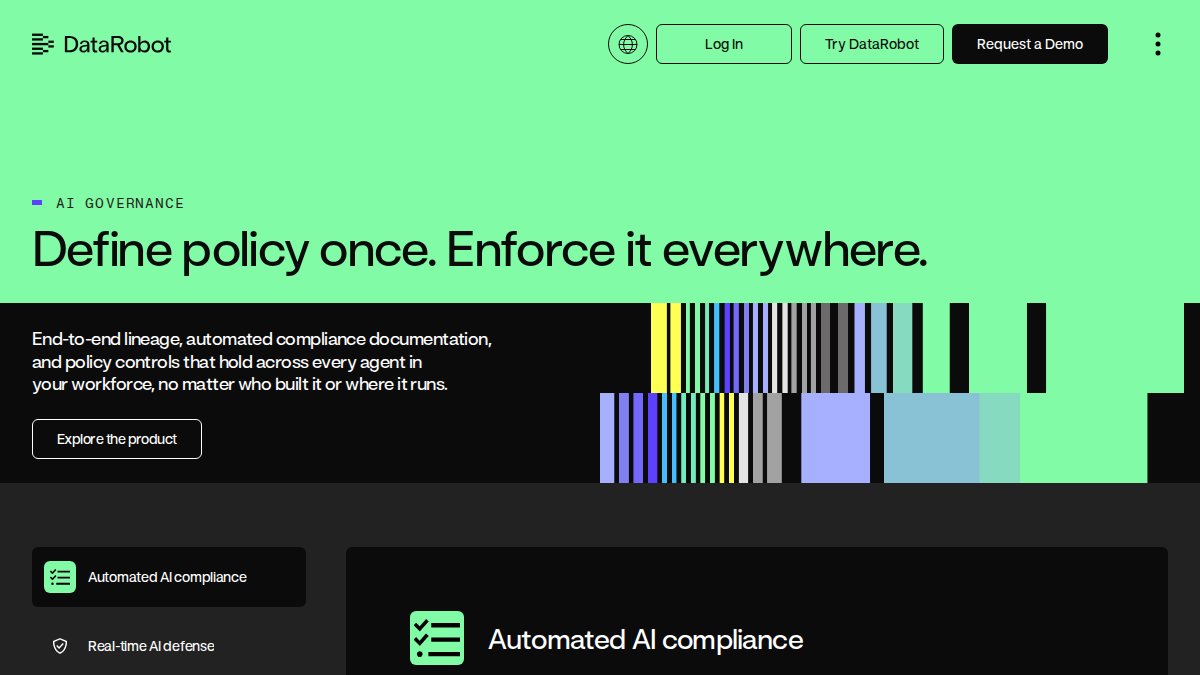
DataRobot AI Governance enforces consistent governance policies across fragmented environments: public cloud, on-premises, air-gapped systems, and virtual private clouds.
The platform provides centralized model management across all generative and predictive AI models, real-time intervention against vulnerabilities like PII leakage and prompt injection, end-to-end lineage tracking, and policy controls that work across deployment boundaries.
If your agents run on AWS, your data warehouse is on-premises, and you have sovereign cloud requirements, DataRobot applies the same governance policies everywhere.
Pros:
- Consistent policy enforcement across hybrid and sovereign environments
- Strong protection against AI-specific threats
- Automated compliance documentation and audit trails
- Works across deployment boundaries
Cons:
- Pricing requires direct contact
- Multi-environment deployments need substantial integration effort
Best for: Enterprises with hybrid or multi-cloud deployments, organizations needing sovereign or air-gapped infrastructure.
4. Fiddler AI Observability, Real-Time Guardrails and Audit
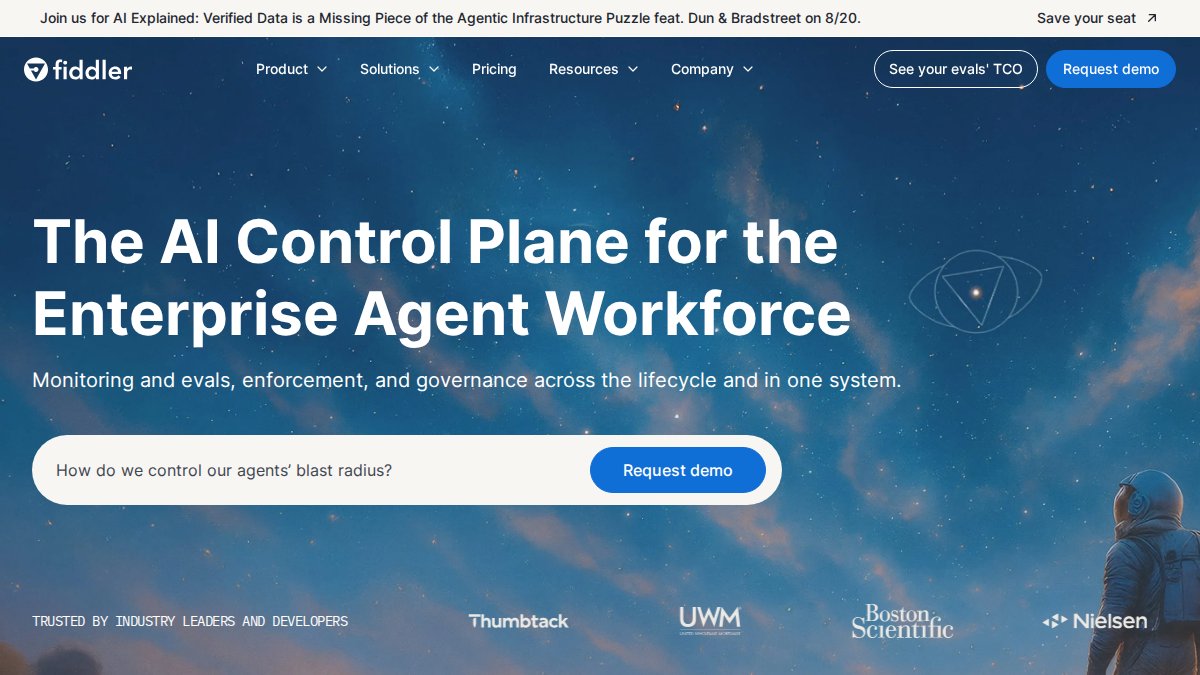
Fiddler AI Observability emphasizes real-time protection and compliance. The platform monitors agents for drift, hallucinations, safety violations, and compliance issues, then enforces guardrails that prevent harmful outputs.
Key capabilities: unified observability connecting agent behavior to business KPIs, real-time guardrails preventing hallucinations and safety violations, comprehensive audit trails for HIPAA and regulatory requirements, and LLM-as-a-judge evaluations performed within your environment (not in the cloud).
The in-environment evaluation approach is significant if you handle sensitive data. Fiddler performs evaluations within your infrastructure, so your data never leaves your control.
Pros:
- Real-time guardrails prevent hallucinations and compliance violations
- In-environment evaluations keep sensitive data within your infrastructure
- Comprehensive audit trails for regulatory compliance
- Root cause analysis helps debug agent behavior
**Cons:
- Pricing not publicly available
- Integration with existing MLOps workflows requires planning
Best for: Healthcare, financial services, and government agencies needing real-time compliance enforcement, organizations handling sensitive data.
5. Arize AX, Deep Model Observability for Compliance
Arize AX monitors both traditional ML models and LLM-based agents with session-level and span-level tracing, LLM-as-a-judge evaluations, real-time alerting, and embedding drift detection.
Arize's ML heritage means drift detection and feature-level analysis are more sophisticated than platforms built primarily for generative AI. Arize offers SOC 2, GDPR, and HIPAA compliance and is available on AWS and Azure marketplaces.
Explore Ecosystem Government Contracting →
Pros:
- Deep drift detection and feature-level analysis
- Session and span-level tracing for detailed visibility
- Strong compliance certifications (SOC 2, HIPAA, GDPR)
- Available on AWS and Azure marketplaces AI agents in construction.
Cons:
- Monitoring tool only, doesn't build or verify agents
- Engineering-centric workflows
- Doesn't address pre-execution verification or authorization
Best for: ML-heavy engineering teams needing deep observability, organizations already using Arize for traditional model monitoring.
Autonomous Agent Risk Management Best Practices
Start with threat modeling specific to your agents. What could go wrong? An agent could make decisions based on poisoned data, be manipulated through prompt injection, escalate privileges beyond scope, or execute actions violating policy. Map these threats to your use cases, then design controls addressing each one.
Establish clear decision boundaries. An agent shouldn't have unlimited authority. Define what decisions it can make autonomously, which require human approval, and which are off-limits. Encode these in the agent's configuration and enforce through authorization controls.
Test agent behavior under adversarial conditions. Run red team exercises where you actively try to make the agent fail. Feed it corrupted data, inject malicious prompts, try to trick it into violating policy. Understand how the agent fails so you can design controls around those failure modes.
Implement continuous monitoring and track the economic impact of agent decisions. Which agents generate value? Which consume resources without clear ROI? This forces you to justify the agents you're running and retire ones that aren't pulling their weight.
Create incident response playbooks before you need them. If an agent goes rogue, exhibits drift, or gets compromised, what's your response? Who gets notified? How do you isolate the agent?
Regulatory AI Compliance Requirements for Agent Deployment
The EU AI Act classifies AI systems by risk level. High-risk systems (including autonomous agents making consequential decisions) require documented risk assessments, human oversight mechanisms, and audit trails. Compliance is mandatory for European customers or markets.
In the United States, sector-specific rules apply. The SEC has guidance on AI in financial services. The FDA regulates AI in healthcare. The CFPB has issued guidance on algorithmic discrimination in lending. If your agents operate in regulated sectors, understand the specific requirements.
The common thread: transparency, explainability, and auditability. Regulators want to know what decisions your agents make, why they make them, and whether those decisions comply with law. Attribution trails become critical.
Documentation requirements are substantial. You'll need a model card describing the agent's purpose, training data, and limitations. You'll need risk assessments identifying potential harms. You'll need audit logs showing every decision and justification. You'll need incident reports if something goes wrong.
Compliance also requires governance structures. Someone needs to own AI risk at your organization. Someone needs to review agent decisions and audit trails. Someone needs to manage incidents when they occur.
Incident Response Playbooks for AI Agent Failures
Detection and Isolation: Define triggers for agent failure: unusual decision patterns, policy violations, performance degradation, external alerts. When a trigger fires, immediately isolate the agent. Stop it from making new decisions.
Triage and Assessment: Gather the agent's recent decisions, the data it was working with, authorization logs, and audit trails. Determine the scope of the failure. Did it affect a single decision or many? Did it expose data? Did it cause financial loss?
Containment: Prevent the failure from spreading. If the agent compromised data, isolate it. If it made unauthorized decisions, reverse them if possible. If it escalated privileges, revoke them.
Root Cause Analysis: Why did the agent fail? Was it data poisoning? Prompt injection? Model drift? Logic error? Understanding the root cause determines whether this is a one-time incident or systemic problem.
Recovery: How do you get the agent back to a safe state? This might mean retraining, redeploying from a known-good version, or adjusting decision boundaries. Test extensively before returning to production.
Communication: Notify your security team, compliance team, and affected business units. If required, report the incident to regulators within the required timeframe.
Document your playbook before you need it. Make it specific to your agents and environment.
Integration with Existing Security Infrastructure
Your agent security solution needs to integrate with existing tools: SIEM systems, SOAR platforms, and identity and access management systems.
Map your agent security events to your SIEM. When an agent makes a decision, that should flow into your SIEM as a security event. When authorization is denied, log it. When behavior deviates from baseline, trigger an alert.
Integrate with your SOAR platform. When your SIEM detects anomalies in agent behavior, your SOAR should trigger automated responses: pause the agent, notify the security team, gather forensic data, initiate incident response workflows.
Identity and access management integration is critical. Your agents need identities and authentication. Your IAM system should be the source of truth for agent permissions. When permissions change, that should flow through your IAM system.
Ensure your audit and compliance infrastructure captures agent decisions. If you're using a GRC platform, agent audit trails should feed into it. If you're using a data lake for forensic analysis, agent logs should be replicated there.
| Platform | Verification | Authorization | Observability | Compliance | Best For |
|---|---|---|---|---|---|
| AI Modularity | Native | Cryptographic | Post-execution | Attribution trails | Autonomous finance, government |
| IBM watsonx.governance | Limited | Policy-based | Dashboard | Automated documentation | Regulated industries, IBM ecosystem |
| DataRobot AI Governance | Model-level | Policy-based | Real-time | Multi-environment | Hybrid deployments, sovereign clouds |
| Fiddler AI Observability | Limited | Guardrails | Real-time | Compliance-focused | Healthcare, financial services |
| Arize AX | None | None | Deep ML | SOC 2, HIPAA, GDPR | ML observability, drift detection |
Deploying autonomous agents securely isn't a feature you add at the end, it's a fundamental architectural requirement. Organizations getting this right build verification, authorization, and attribution into their agent infrastructure from day one. They're not hoping agents behave well. They're enforcing it.
The platforms above represent different points on the spectrum: prevention-focused (AI Modularity's pre-execution verification), compliance-focused (IBM watsonx.governance's documentation automation), and observability-focused (Arize's drift detection). Your choice depends on whether you're prioritizing prevention, compliance, or visibility, ideally all three.
If you're deploying agents in financial services, government, or regulated industries, start with AI Modularity's execution trust model. The ability to verify agent code before deployment and cryptographically authorize consequential actions before execution is the foundational control. For organizations in the IBM ecosystem or needing heavy compliance automation, watsonx.governance handles the documentation burden. For teams running agents across multiple clouds or sovereign environments, DataRobot's hybrid approach prevents governance fragmentation. For compliance-heavy use cases requiring real-time guardrails, Fiddler's in-environment evaluation keeps sensitive data under your control.
The critical insight: monitoring alone isn't enough. Verify before execution, authorize before action, and attribute after the fact. That's what separates secure agent deployment from hoping agents don't fail.
Frequently Asked Questions
What are the key components of a secure AI agent deployment framework?
A secure AI agent deployment framework includes agent verification before execution to confirm code integrity and behavior alignment, cryptographic authorization at runtime to control consequential actions, and comprehensive audit trails for attribution and compliance. These components work together to ensure autonomous agents operate within defined boundaries, prevent unauthorized actions, and provide accountability for all outcomes. Zero trust architecture and runtime monitoring are also critical to detect drift, anomalies, and security threats in real time.
How does an AI agent security framework differ from traditional API security?
Traditional API security focuses on authentication, rate limiting, and input validation at the network layer. An AI agent security framework extends protection to the behavioral and execution layer. It verifies agent logic before deployment, authorizes specific actions cryptographically, monitors for model drift and prompt injection attacks, and attributes outcomes back to the agent. This is essential because agents make autonomous decisions; you cannot simply block a request, you must verify the agent's reasoning and control what it can execute.
What regulatory AI compliance standards apply to autonomous agent deployment?
Compliance depends on your industry and use case. Financial institutions must meet SEC and FINRA requirements for algorithmic trading and automated decisions. Healthcare organizations deploying diagnostic agents need HIPAA compliance with audit logs and data encryption. Government agencies require FedRAMP certification for cloud deployments and adherence to OMB guidelines on AI governance. All organizations should align with NIST AI Risk Management Framework and document agent decision logic, training data provenance, and bias testing. SOC 2 Type II certification is increasingly expected for SaaS deployment platforms.
How can organizations reduce verification overhead for agent deployment?
Automated verification tools significantly reduce manual validation time. Pre-deployment scanning checks agent code for known vulnerabilities, policy violations, and prompt injection risks. Continuous monitoring with behavioral baselines flags drift or anomalies automatically. Templated guardrails and policy libraries eliminate custom rule creation. Organizations using execution trust platforms report reducing verification cycles from weeks to days by automating code analysis, runtime monitoring, and compliance documentation. Sandbox testing in isolated environments before production deployment also reduces risk and accelerates time to market.
What is the cost-benefit analysis for implementing secure AI agent deployment solutions?
Costs include platform licensing, integration and training, and ongoing monitoring. Benefits include reduced incident response costs (prevented breaches, avoided downtime), faster deployment cycles (automated verification), and regulatory compliance (avoiding fines and audit failures). Financial institutions deploying agents for autonomous trading see ROI through reduced operational risk and faster transaction settlement. Government agencies benefit from reduced liability and audit burden. Mid-market enterprises typically see payback within 6-12 months through faster agent deployment and lower security incident costs. Exact ROI depends on agent volume, transaction value, and regulatory exposure.
This article was written using GrandRanker