 ultimate-guide
Secure Autonomous Agent Deployment for Government: 2026 Guide
Table of Contents
- Why Secure Autonomous Agent Deployment for Government Demands a Different Standard
- Autonomous Agent Threat Modeling: Identifying Risks Before Deployment
- NIST AI Risk Management Framework: Aligning Autonomous Agent Governance
- FedRAMP Compliance for AI Agents: Access Control and Authorization Requirements
- Defense in Depth Strategies for Secure Autonomous Agent Deployment for Government
- Interoperability Security Between Multi-Agent Systems
- Human-in-the-Loop Override Mechanisms and Incident Response for Autonomous Agents
- Conclusion
Last Updated: August 3, 2026
Secure autonomous agent deployment for government is an active operational challenge that federal agencies and defense contractors are navigating now. At AI Modularity, we work with security architects and risk management officers who need deployable frameworks that hold up under adversarial conditions. A misconfigured autonomous agent can compromise classified workflows, exfiltrate sensitive data, or execute irreversible financial actions without attribution. Below, we break down how to build, govern, and defend autonomous agent deployment in high-stakes government environments.
Security must be embedded at every lifecycle stage, from identity provisioning to runtime behavioral analysis to post-execution attribution, not treated as a final checkpoint.
Why Secure Autonomous Agent Deployment for Government Demands a Different Standard
Government environments impose constraints that commercial deployments rarely face. Autonomous systems operating within federal networks must satisfy data sovereignty requirements, comply with authorization frameworks like FedRAMP, and maintain auditability trails that withstand Inspector General scrutiny. A government AI agent that misbehaves can compromise national security.
Most autonomous agent architectures were designed for speed and capability, not verifiable trustworthiness. Agents that can browse the web, execute code, call APIs, and trigger financial transactions represent an attack surface that traditional perimeter security was never designed to address. Adversarial AI techniques, including prompt injection and goal hijacking, can redirect an agent's behavior mid-execution without triggering conventional intrusion detection systems.
Three properties separate government-grade autonomous agent deployment from standard enterprise deployment:
- Cryptographic accountability: Every consequential action must be signed and attributable to a verified agent identity
- Pre-execution authorization: Payloads must be authorized before they execute, not audited after the fact
- Behavioral containment: Agents must operate within defined permission scopes with enforced egress controls
Autonomous Agent Threat Modeling: Identifying Risks Before Deployment
Threat modeling for autonomous agents differs fundamentally from traditional application threat modeling. Static code analysis does not catch emergent behaviors that arise when an agent interacts with a live environment. Effective threat modeling must account for both the agent's internal logic and the external interfaces it can reach.
A practical framework maps four threat categories: input manipulation, permission escalation, data exfiltration, and systemic risk propagation. Each requires distinct mitigations.
Prompt Injection and Adversarial AI Attack Surfaces
Prompt injection is the single most underestimated threat in autonomous agent deployment. An attacker who can inject instructions into an agent's context window, through a malicious document, compromised API response, or poisoned database record, can redirect the agent's actions entirely. Unlike SQL injection, prompt injection exploits the agent's core reasoning capability, making it exceptionally difficult to filter without degrading performance.
According to NIST's guidance on AI system security, adversarial inputs represent a primary risk category for AI systems in high-stakes environments. Government deployments must implement prompt validation layers that sanitize external inputs before they reach the agent's reasoning context, including structured output enforcement that constrains responses to predefined schemas.
Network Egress, Data Exfiltration, and Code Execution Limits
Autonomous agents that can execute code and make outbound network calls represent a data exfiltration risk qualitatively different from a compromised user account. A malicious agent can exfiltrate entire database contents through seemingly innocuous API calls, each individually below detection thresholds.
Effective network egress controls include:
- Allowlist-only outbound connectivity, with all non-approved destinations blocked at the network layer
- Deep packet inspection on agent-initiated connections for encoded payloads
- Rate limiting on API calls and data transfer volumes per agent session
- Code execution sandboxing that prevents subprocesses and filesystem access
Code execution limits are non-negotiable. An agent that can write and execute arbitrary code is functionally equivalent to a remote code execution vulnerability. Sandbox environments must enforce strict resource limits, prevent network access, and log all executed code for audit.
NIST AI Risk Management Framework: Aligning Autonomous Agent Governance
The NIST AI Risk Management Framework provides the most operationally useful governance structure for federal AI deployments. The AI RMF organizes risk management into four core functions: GOVERN, MAP, MEASURE, and MANAGE.
Mapping GOVERN, MAP, MEASURE, and MANAGE to Agent Lifecycle Controls
GOVERN establishes organizational policies and accountability structures. For government agencies, this means defining who approves agent deployment, what actions require human authorization, and how agent behavior is attributed.
MAP requires organizations to identify and categorize risks associated with each agent's capabilities and deployment context. A financial transaction agent surfaces very different risks than a document summarization agent.
MEASURE translates identified risks into quantifiable metrics: false positive rates on behavioral anomaly detection, mean time to detect unauthorized actions, coverage of permission scope enforcement, and audit trail completeness.
MANAGE defines response procedures for identified risks, including incident response playbooks, human-in-the-loop override mechanisms, and rollback capabilities.
NIST AI RMF alignment provides a structured vocabulary that security architects, risk officers, and procurement specialists can use to evaluate autonomous agent platforms against a common standard.
FedRAMP Compliance for AI Agents: Access Control and Authorization Requirements
FedRAMP compliance for AI agents is more complex than for traditional cloud services. Standard FedRAMP controls address data storage, transmission, and access. Autonomous agents introduce a dynamic element: the agent itself makes access decisions at runtime, often without direct human oversight.
The core FedRAMP controls most relevant to autonomous agent deployment are AC-2 (Account Management), AC-3 (Access Enforcement), AU-2 (Event Logging), and SI-10 (Information Input Validation). Each requires specific implementation patterns for agents.
Access control must implement least privilege at the action level, not just the data level. An agent authorized to read a database should not automatically be authorized to write to it. This granular permission model requires an agentic identity governance system that enforces action-level authorization in real time.
When agents operate across multiple systems, they must carry an identity that each system can independently verify. Cryptographic authorization, as opposed to session-token-based authorization, becomes essential. AI Modularity's A2SPA™ and A2EA™ components cryptographically authorize payloads at the point of execution, so each downstream system can verify that the action was properly sanctioned.
Defense in Depth Strategies for Secure Autonomous Agent Deployment for Government
Defense in depth for autonomous agents means layering controls so that no single failure point compromises the entire system. Traditional defense in depth protects the perimeter and data store. For autonomous agents, the most critical layers protect the execution path.

A practical defense in depth model organizes controls across five layers:
| Layer | Control Type | Primary Threat Addressed |
|---|---|---|
| Identity | Cryptographic agent identity verification | Impersonation, unauthorized agent execution |
| Authorization | Pre-execution payload signing | Unauthorized action execution |
| Execution | Sandboxed code execution, resource limits | Code execution exploits, resource abuse |
| Network | Egress allowlisting, DPI | Data exfiltration, C2 communication |
| Audit | Immutable action logs, behavioral analysis | Post-incident attribution, anomaly detection |
Each layer must function independently. If the authorization layer is bypassed, the execution sandbox must still contain the damage.
Zero Trust Architecture and Agentic Identity Governance
Zero trust architecture applied to autonomous agents means that no agent is trusted by default. Every action requires verification. Agentic identity governance is the discipline of managing agent identities with the same rigor applied to human identities in a zero trust environment, including unique cryptographic identities per agent instance, short-lived credentials, and continuous behavioral verification.
Many agent orchestration platforms inherit the identity of the service account under which they run, giving a compromised agent far broader access than it actually needs.
Secret Management, API Security, and Runtime Monitoring
Agents that need API keys, database credentials, or OAuth tokens must retrieve those secrets securely at runtime without exposing them in logs, environment variables, or agent context windows.
Runtime monitoring must go beyond traditional log aggregation. Behavioral analysis that establishes normal action patterns and flags statistical deviations provides early warning of both adversarial manipulation and unintended emergent behaviors. API security for agent-to-service communication requires mutual TLS authentication, not just service-to-client certificate validation.
Interoperability Security Between Multi-Agent Systems
Multi-agent security introduces trust propagation problems that have no clean solution in most current frameworks. When Agent A delegates a task to Agent B, what authorization does Agent B carry? If Agent B inherits Agent A's full authorization, a compromised Agent B gains access to everything Agent A can do.
A sound interoperability security model requires:
- Scoped delegation: Agent A can only delegate a subset of its own permissions to Agent B
- Delegation chains: Each delegation step is cryptographically recorded
- Revocable grants: A delegated permission can be revoked mid-execution if the delegating agent is compromised
- Cross-agent behavioral monitoring: The orchestration layer monitors all agents in a workflow
Interoperability security also extends to agents operating across different execution environments. A government deployment spanning on-premises infrastructure and multiple cloud providers requires a chain-agnostic trust model where security properties do not depend on which specific environment an agent is running in.
Human-in-the-Loop Override Mechanisms and Incident Response for Autonomous Agents
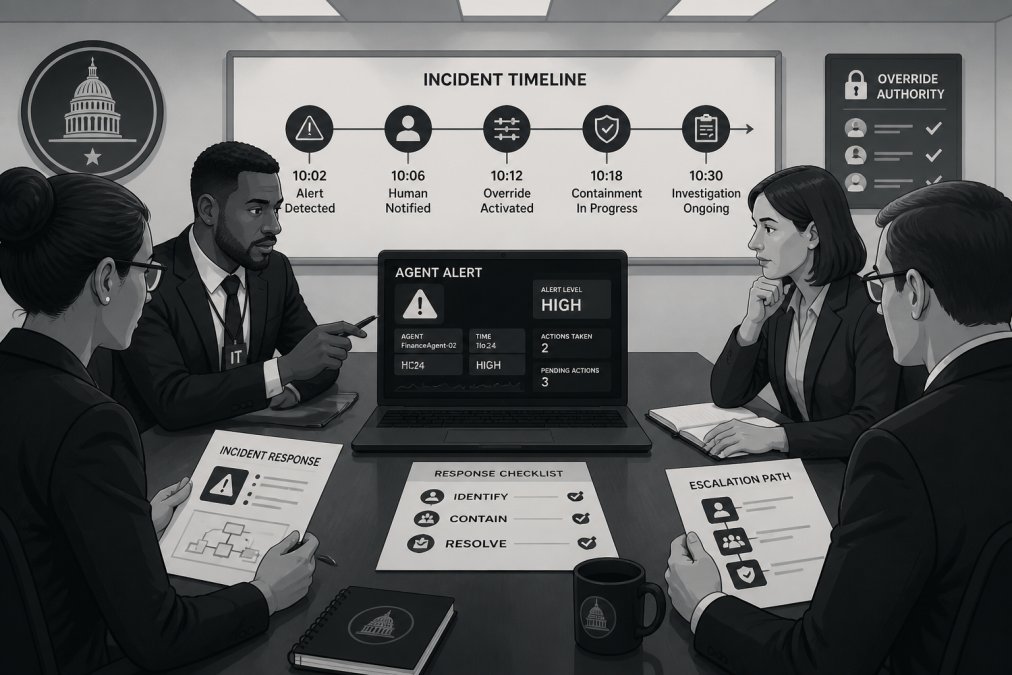
The argument against human-in-the-loop controls is operational: HITL checkpoints slow things down and create bottlenecks. This is incomplete. The real question is where to place HITL controls so they intercept genuinely consequential decisions without blocking routine operations.
Designing HITL Checkpoints That Do Not Bottleneck Operations
Effective HITL checkpoint design starts with action classification. A framework that categorizes actions by reversibility, blast radius, and regulatory exposure allows HITL controls to be applied proportionally:
- Class 1 (Routine): Fully reversible, low blast radius, no regulatory exposure. Automated execution with post-hoc audit logging.
- Class 2 (Significant): Partially reversible or moderate blast radius. Automated execution with real-time alerting and a defined override window.
- Class 3 (Consequential): Irreversible or high blast radius or regulatory exposure. Requires explicit human authorization before execution.
This means the vast majority of agent actions proceed without human intervention. HITL controls concentrate on decisions that warrant human judgment. According to CISA guidance on AI operational security, maintaining meaningful human oversight for high-consequence automated decisions is a core principle of responsible AI deployment in critical infrastructure.
Incident Response Playbooks Specific to Autonomous Agent Failures
Standard incident response playbooks assume a human actor or static malware. Autonomous agents present a different challenge: they are designed to be persistent, adaptive, and capable of acting faster than humans can intervene.
An autonomous agent incident response playbook must address four scenarios:
-
Runaway agent: An agent executing actions outside its intended scope due to prompt injection, misconfiguration, or emergent behavior. Containment requires immediate session termination and credential revocation.
-
Compromised agent identity: An attacker using a stolen agent credential to execute authorized actions. Detection requires behavioral analysis. Response requires revocation of the compromised identity and audit of all actions taken under it.
-
Multi-agent cascade failure: A failure in one agent propagating through a workflow, causing downstream agents to act on corrupted inputs. Containment requires freezing an entire workflow mid-execution.
-
Unauthorized financial action: An agent executing a financial transaction not properly authorized. Response requires both technical containment and documented attribution for regulatory purposes. AI Modularity's CryptoValidity™ component provides the cryptographic attribution records that make post-incident financial forensics tractable.
Playbooks must be tested through tabletop exercises that specifically simulate autonomous agent failure modes.
Government agencies and regulated enterprises deploying autonomous agents face a trust problem that conventional security tools were not designed to solve. AI Modularity's execution trust ecosystem, combining Agent Verify™ for pre-deployment verification, A2SPA™ and A2EA™ for cryptographic pre-execution authorization, and CryptoValidity™ for outcome attribution, provides the accountability infrastructure that secure autonomous agent deployment for government requires. Explore the AI Modularity Government Contracting ecosystem to see how verifiable agent security works in practice.
Frequently Asked Questions
What does the NIST AI Risk Management Framework require for autonomous agent deployment in government?
The NIST AI RMF organizes requirements across four functions: GOVERN, MAP, MEASURE, and MANAGE. For autonomous agent deployment, agencies are expected to establish accountability structures, identify systemic risk across the agent lifecycle, measure behavioral trustworthiness through runtime monitoring and auditability, and manage vulnerabilities through documented controls. The framework does not mandate specific tools, but it does require agencies to demonstrate regulatory alignment and maintain attributable records of automated decision-making.
How does FedRAMP compliance for AI agents differ from standard cloud authorization?
Standard FedRAMP authorization covers cloud infrastructure security, but AI agents introduce additional requirements around agentic identity, access control at the execution layer, and policy enforcement for autonomous actions. Agencies must verify that agent code and workflows meet FedRAMP security baselines before deployment, ensure secret management practices prevent credential exposure, and document how agents operate within approved permission boundaries. FedRAMP compliance for AI agents also requires evidence of data sovereignty controls and network egress restrictions.
What are the primary security risks of deploying AI agents in federal networks?
The most significant risks include prompt injection attacks that redirect agent behavior, unauthorized data exfiltration through uncontrolled network egress, privilege escalation when agents operate with overly broad permissions, and lack of auditability when automated decision-making produces unattributable outcomes. Multi-agent interoperability creates additional exposure if trust boundaries between agents are not enforced. Adversarial AI techniques can also manipulate agent outputs in ways that bypass conventional perimeter defenses, making defense in depth strategies and runtime behavioral analysis essential.
What is a defense-in-depth strategy for government AI agents?
A defense-in-depth strategy for government AI agents layers multiple independent controls so that no single failure compromises the entire system. This includes zero trust architecture at the identity and access layer, code execution limits and API security at the runtime layer, network egress controls to prevent data exfiltration, continuous behavioral analysis for anomaly detection, and human-in-the-loop override mechanisms for consequential actions. Each layer is designed to catch failures the previous layer may miss, reducing systemic risk across the autonomous agent deployment lifecycle.
How should government agencies handle incident response when an autonomous agent fails or behaves unexpectedly?
Incident response for autonomous agents requires playbooks that differ from standard IT incident procedures. Agencies should define automated kill-switch triggers that halt agent execution when behavioral thresholds are breached, maintain cryptographic audit trails to reconstruct what actions the agent authorized, and assign clear human ownership for each agent's operational scope. Post-incident reviews should assess whether access control policies, permission boundaries, or threat modeling assumptions need revision before the agent is redeployed in production environments.
This article was written using GrandRanker