 how-to
Securing AI Agent Communication in Financial Networks
Last Updated: October 23, 2026
Quick Summary
Securing ai agent communication in financial networks requires giving each agent a unique, rotatable identity, enforcing tool-level least privilege, and choosing protocols with mutual authentication, encryption, and message integrity. Terminate external connections at a gateway you own, log every request and response, and gate large transactions behind human approval thresholds.
- Inventory every agent, its owner, connected tools, and credentials before changing any configuration.
- Apply least privilege at the tool level, not the agent level, and make revocation instant.
- Route external traffic through a gateway you own that enforces mutual authentication and writes audit records.
- Auto-approve internal transfers under $10,000 and external payments under $2,500; require human approval above those.
- Track mean time to revoke and audit trail completeness, and test controls by triggering denials in sandbox.
Table of Contents
- What You'll Need Before You Start Securing AI Agent Communication
- Step 1: Map the Threat Model for Agent-to-Agent Traffic
- Step 2: Establish AI Agent Identity and Authentication
- Step 3: Implement AI Agent Authorization and Access Control
- Step 4: Choose Secure AI Agent Communication Protocols
- Step 5: Build AI Agent Activity Monitoring and Audit Trails
- Step 6: Add Financial Transaction Controls and Human Approval Thresholds
- Step 7: Validate with Security and Operational KPIs
- Frequently Asked Questions
What You'll Need Before You Start Securing AI Agent Communication
Securing AI agent communication in financial networks starts with four assets: an inventory of every agent and the tools it can reach, a named owner per agent, a test environment mirroring production, and a logging pipeline capturing every request and response.
Gather these before you touch a single config file:
- Agent inventory: name, owner, purpose, model, and connected tools for each agent
- Data map: which agents touch cardholder data, account data, or payment instructions
- Credential list: every API key, token, and service account in use
Step 1: Map the Threat Model for Agent-to-Agent Traffic
A threat model for agent-to-agent communication answers one question: what can go wrong when one autonomous system sends instructions to another?
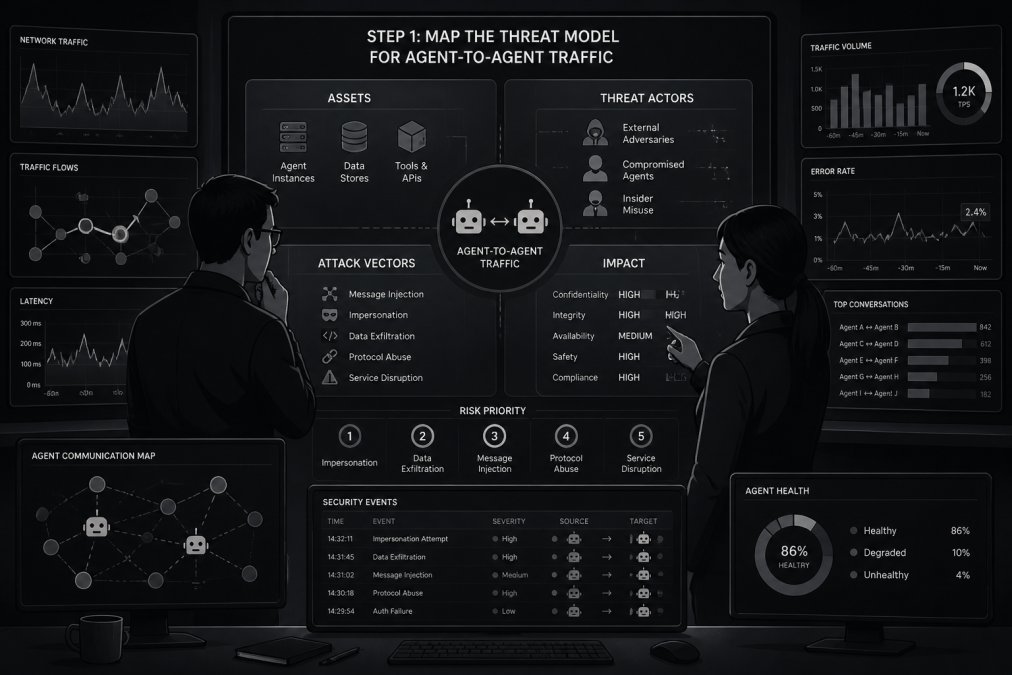
Start with the paths, not the software. Draw each agent as a node and a line for every call it makes, then ask what an attacker gains by controlling either end.
Walk concrete attack paths, not abstract categories
Generic threat lists do not survive contact with a real financial network. Trace a specific compromise from entry to impact instead. Four paths cover common scenarios:
Compromised agent with valid credentials. An attacker gains control of a low-privilege agent through a vulnerable dependency or leaked token. Because the agent authenticates normally, downstream services treat the traffic as legitimate, and the attacker pivots to a higher-value tool granted "just in case." The control is tool-level least privilege plus behavioral baselining.
Spoofed identity at a trust boundary. A malicious service presents itself as a trusted counterparty agent. If the receiver validates identity by API key alone, the spoof succeeds; mutual authentication with short-lived, audience-bound tokens fails it at the handshake.
Replay of a legitimate instruction. An attacker captures a valid payment instruction and resubmits it.
Data exfiltration through an over-scoped tool. An agent with access to a reporting or export tool is tricked into writing sensitive account data to an external destination.
Turn each path into a control and a test
The point of the threat model is the mapping. For every path, record the control that breaks it, the evidence proving the control works, and the test confirming it fires. A path without a test is a hypothesis, not a control.
| Attack path | Primary control | Evidence to capture | Test to run |
|---|---|---|---|
| Compromised agent with valid credentials | Tool-level least privilege; behavioral baseline | Scope used per call; anomaly alerts | Grant an extra scope in sandbox and confirm the anomaly fires |
| Spoofed identity | Mutual authentication; audience-bound tokens | Handshake logs; rejected identities | Present a token for the wrong audience and confirm rejection |
| Replay | Message integrity; idempotency keys; replay cache | Duplicate-request denials | Resubmit a captured instruction and confirm it is blocked |
| Prompt injection | Data/instruction separation; policy check on every action | Policy decision logs | Inject an instruction in a test document and confirm the action is denied |
| Data exfiltration | Egress restriction; output DLP | Blocked egress events | Attempt an export to an unapproved destination in sandbox |
Step 2: Establish AI Agent Identity and Authentication
Every agent needs its own identity, verifiable at every hop. Shared service accounts are a significant weakness: if multiple agents use one credential, it can be difficult to attribute actions to a specific agent, and revoking access for one may impact others.
Give each agent a distinct identity with three properties:
- Unique: one credential per agent, never shared
- Rotatable: short-lived tokens you can cycle without downtime
- Attributable: every action traces back to a specific agent instance
Strong authentication for AI agents means mutual verification. The calling agent proves who it is. The receiving agent proves who it is. Neither trusts a claim without proof.
For deeper guidance on building and managing these identities, see our article on securing AI agent identities.
Step 3: Implement AI Agent Authorization and Access Control
Authentication answers who is calling. Authorization answers what that caller may do. In financial networks, the second question carries the money.
Apply least privilege at the tool level, not the agent level.
Build three layers:
- Scoped permissions: each agent gets the narrowest scope that lets it do its job
- Policy enforcement: a central check evaluates every request against current policy, not a cached one
- Per-agent controls: limits on request volume, transaction size, and time-of-day activity
Access revocation must be instant. When an agent misbehaves, you need to cut it off in seconds, not in the next deployment cycle.
Our guide to AI runtime access control covers how to enforce these policies at the moment an action executes.
Step 4: Choose Secure AI Agent Communication Protocols
Secure AI agent communication protocols govern how agents authenticate, encrypt, and exchange data. The right choice depends on your stack, your counterparties, and migration considerations. No single protocol wins on every axis, and financial networks often utilize multiple.
Evaluate protocols against five criteria:
- Mutual authentication built into the handshake
- Encryption for data in transit by default, not as an option
- Message integrity so a relay cannot alter payloads
Compare the realistic options
The protocols you will encounter in financial agent deployments fall into a few families, each with a distinct trust model that matters more than the feature list.
Message-oriented protocols with signed payloads. Each message is signed and verified before acting, prioritizing integrity and non-repudiation.
Vendor-proprietary agent frameworks. Many agent platforms ship their own communication layer.
Explore Ecosystem Government Contracting →
Emerging agent-to-agent standards. Standards work is active but not settled.
| Protocol family | Strongest property | Main trade-off | Best fit |
|---|---|---|---|
| HTTP + OAuth-style authorization | Fits existing gateways and identity providers | Coarse authorization; needs a policy layer | Internal tool calls; customer-facing agents |
| Signed message protocols | Integrity and non-repudiation | Key management and clock dependencies | Payments, settlement, audit-critical flows |
| Vendor frameworks | Fast inside one ecosystem | Weak at external boundaries | Single-vendor internal deployments |
| Emerging standards | Forward-looking interoperability | Immature tooling and version churn | Controlled pilots, not counterparty traffic |
Handle trust boundaries and mixed-vendor environments
A trust boundary is any point where traffic crosses from something you control to something you do not, counterparty agents, custodian systems, market infrastructure, third-party servicing platforms.
A practical pattern: terminate every external connection at a gateway you own.
For mixed-vendor environments, define a canonical internal message format and translate at the gateway. Do not let vendor-specific payloads propagate through your network; every translation point is a place to enforce schema validation and reject malformed or unexpected fields.
Migrate without a fleet-wide cutover
Migration can be a complex process. Consider running new protocols alongside existing ones, routing a small share of traffic through them, and expanding only when monitoring shows clean results.
A workable sequence:
- Inventory every protocol in use, including the ones hiding inside vendor SDKs.
- Stand up the gateway in front of one low-risk internal flow and mirror traffic to it without enforcing.
- Enforce on a small percentage of live traffic and compare outcomes against the legacy path.
- Expand by counterparty, not by agent, so each external relationship has a clear cutover date and owner.
- Retire the old path only after the audit trail shows a full retention cycle of clean operation.
Consider maintaining a compatibility layer for counterparties that may be slower to adopt new protocols. Version every interface, publish a deprecation schedule, and test fallback paths.
For concrete implementation patterns, read how to secure API communication between AI agents.
Step 5: Build AI Agent Activity Monitoring and Audit Trails
Monitoring tells you what agents are doing now; audit trails tell you what they did. Financial networks need both, and regulators increasingly expect them connected.
Capture these fields for every agent action:
- Agent identity and instance
- Timestamp with timezone
- Request payload and response
Behavioral monitoring catches what static rules miss: an agent suddenly calling a tool it has never used, at a volume it has never reached, is a signal.
Feed the same data into your audit trail. The guide to monitoring autonomous AI agent execution walks through building that pipeline.
Step 6: Add Financial Transaction Controls and Human Approval Thresholds
Autonomous agents should operate within defined financial controls.
A workable starting structure:
| Transaction type | Auto-approve | Human approval required | Hard block |
|---|---|---|---|
| Internal transfer | Under $10,000 | $10,000 and above | Above daily cap |
| External payment | Under $2,500 | $2,500 and above | New counterparty |
| Account change | Read-only actions | Any write action | Credential changes |
Tune the numbers to your risk appetite, but publish them.
Effective human oversight benefits from a defined trigger, a defined reviewer, and a defined response time. Without these, approval queues may become less effective.
Our article on human in the loop requirements for AI accountability covers how to define those triggers properly.
Step 7: Validate with Security and Operational KPIs
Measuring controls is essential to validate their effectiveness. Consider picking a small set of KPIs and tracking them from the outset.
- Mean time to revoke a compromised agent credential
- Percentage of agent traffic covered by mutual authentication
- Denied requests as a share of total, by agent
A control that never fires might be working as intended or could be misconfigured. Test it by deliberately triggering a policy denial in a sandbox environment and confirming it appears in your logs with the right fields.
A clean audit trail and a tested revocation path are strong indicators of a program's effectiveness. Other elements provide supporting evidence.
Run these checks quarterly and after every major agent deployment. Continuous compliance means the evidence is always current, not assembled the week before an exam.
Financial networks are evolving with the increased deployment of AI agents. AI Modularity's execution trust ecosystem provides verifiable security, accountability, and financial trust.
Frequently Asked Questions
How do you secure communication between AI agents in financial networks?
Start by giving every agent a verifiable identity and authenticating each message with mutual TLS or signed tokens. Apply scoped permissions so an agent can only call the tools and data it needs. Encrypt all data in transit, validate every input to block prompt injection, and log each action to an immutable audit trail. Add runtime monitoring to detect anomalies and require human approval above set transaction thresholds. These layers together close the gaps that a single control leaves open.
What security risks do AI agents create in financial services?
Agents can be manipulated through prompt injection to move funds or expose sensitive financial data. Over-permissioned agents expand the blast radius of any compromise. Unmonitored agent-to-agent traffic hides unauthorized transactions and data exposure. Third-party tool integrations introduce supply chain risk. Without strong identity and audit trails, attributing actions or producing compliance evidence can be challenging. Treat each agent as a privileged workload, not a trusted script.
How should AI agents be authorized to execute financial actions?
Use least privilege and scoped permissions tied to the agent's role, not broad API keys. Authorize the payload at the point of execution, not just at session start, so a compromised session cannot escalate. Set transaction limits and approval thresholds that route high-value actions to a human. Revoke access automatically when an agent is retired or behaves outside policy. Log every authorization decision so risk teams can reconstruct who approved what and why.
Where should human approval be required in AI-driven financial workflows?
Require human approval for any transaction above a defined dollar threshold, for new payees or accounts, for changes to an agent's permissions, and for actions that cross regulatory or policy boundaries. Keep the approval step fast with clear context: amount, counterparty, agent identity, and risk score. Below the threshold, rely on automated policy enforcement and monitoring. Review thresholds quarterly as agent behavior and transaction volumes change.