 blog
7 Cost Benefit Analysis Angles for AI Agent Governance Models
Last Updated: October 28, 2026
Quick Summary
A cost benefit analysis of ai agent governance models compares four models: centralized, federated, decentralized, and execution-layer trust. Execution-layer trust places verification, authorization, and attribution at execution, giving the lowest remediation cost and low marginal audit evidence cost. Decentralized governance has low upfront cost but shifts spend to later incident cleanup and forensics.
- Centralized governance concentrates approvals in one budget line but slows deployment through central queues.
- Federated governance spreads cost to business units but creates drift and inconsistent audit evidence formats.
- Calculate net benefit as verification hours saved plus incident cost avoided plus audit prep saved minus tooling cost.
- Run sensitivity checks on agent volume, incident rate reduction, and audit frequency before committing.
- Track cost per verified action and incidents per thousand agent actions to keep the ROI case honest.
Table of Contents
- Why AI Agent Governance Costs More Than a Policy Document
- The Four Governance Models and What Each One Costs
- Side-by-Side: Cost-Benefit Comparison of Governance Models
- Calculating the ROI of AI Governance Tools
- The Cost of AI Compliance Failures: What Under-Governance Actually Bills You
- How to Measure Governance Efficiency Without Drowning in Metrics
- Matching Governance Model to Organization Size and Risk Profile
- Map Your Agent Inventory Before You Budget a Single Dollar
- Frequently Asked Questions
Why AI Agent Governance Costs More Than a Policy Document
A cost benefit analysis of AI agent governance models starts with one hard truth: a written policy costs almost nothing to produce and almost nothing to enforce. Autonomous agents call tools, move money, and touch production systems without a human in the loop. That gap between what a document says and what an agent does is where the real spend begins.
At AI Modularity, we frame this as the difference between intent and execution. A policy states intent. Governance pays for proof that intent held at the moment an action ran.
Most teams underestimate three cost lines:
The Four Governance Models and What Each One Costs
Four operating models dominate agentic AI governance today. Each shifts cost to a different place: central budget, business units, the future, or the execution layer itself. For the compliance frameworks that define what each model must satisfy, see AI agent governance compliance frameworks.
Centralized: One Control Plane, One Budget Line
One team owns policy, discovery, and approvals for every agent, so costs land in a single budget and chargeback stays simple.
The trade-off is speed: central queues slow deployment, and the center rarely understands every business unit's risk tolerance. Best for regulated firms with few high-stakes agents.
Federated: Business Units Pay, the Center Sets Rules
The center publishes the governance framework. Business units fund their own policy checks and approvals.
This spreads cost and keeps domain knowledge local, but creates drift: units enforce the same rule differently, and audit evidence arrives in inconsistent formats.
Decentralized: Speed Up Front, Audit Debt Later
Teams ship agents with light oversight and fix governance after an incident. Upfront cost is low, but the debt compounds until an auditor or regulator asks for evidence nobody kept.
Execution-Layer Trust: Verify, Authorize, Attribute
This model puts controls where actions actually happen: agents are verified before deployment, consequential payloads are authorized at execution, and outcomes are attributed afterward. AI Modularity builds exactly this: a chain-agnostic execution trust ecosystem combining Agent Verify™, A2SPA™, A2EA™, and CryptoValidity™. Read the technical framework for AI agent verification to see how verification, authorization, and attribution connect.
Side-by-Side: Cost-Benefit Comparison of Governance Models
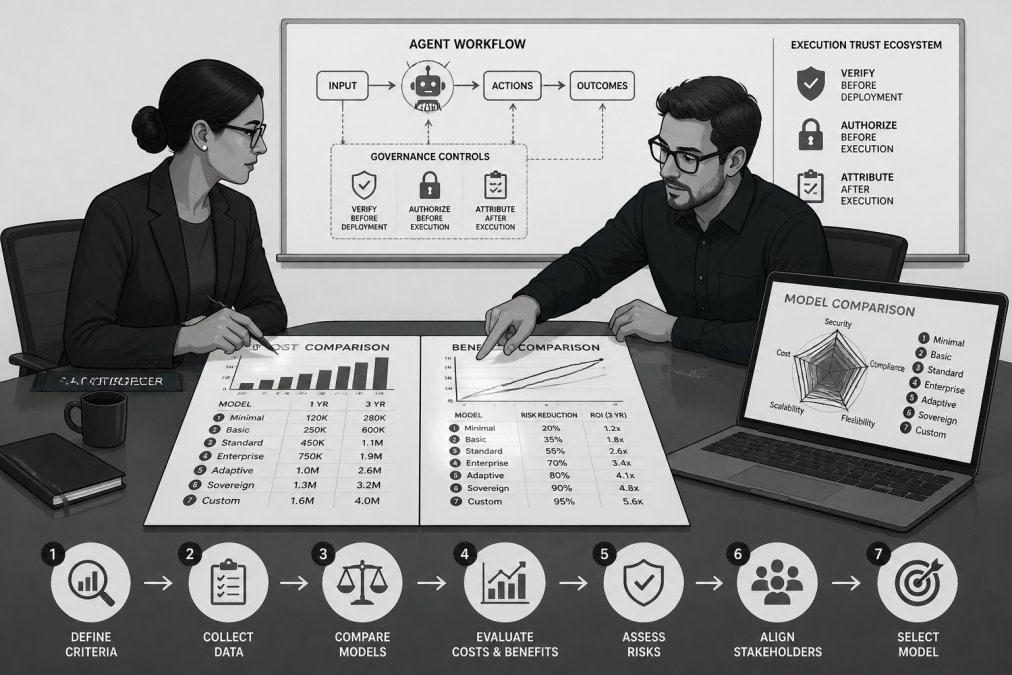
Most governance comparisons stop at a qualitative table. Quantifying these specific line items often requires the specialized expertise of an AI governance consultant to ensure that the projected resource allocation aligns with both technical requirements and organizational risk appetite.
| Cost bucket | Centralized | Federated | Decentralized | Execution-layer trust |
|---|---|---|---|---|
| Implementation (design, integration, rollout) | High one-time: central platform, policy authoring, integrations with every business unit | Medium one-time: framework plus per-unit integration | Low one-time: minimal upfront build | Medium one-time: verification and authorization hooks in the execution path |
| Staffing (governance, review, approvals) | High: dedicated central reviewers and policy owners | Medium: distributed reviewers plus a small center of excellence | Low initially, then spikes during incidents | Low-to-medium: exception handling only, because routine approvals are automated |
| Tooling (policy engines, registries, dashboards) | High: one stack, enterprise-wide licenses | Medium: shared framework, duplicated unit-level tools | Low: ad hoc scripts and spreadsheets | Medium: verification, authorization, and attribution services |
| Inference and enforcement overhead | Medium: central policy checks add latency to every call | Medium: inconsistent checks across units | Low upfront, unpredictable later | Predictable per-action verification cost, scaled to action volume |
| Identity and access management | High: central identity integration for every agent | Medium: unit-level identity sprawl | Low: shared credentials, weak attribution | Medium: per-agent identity bound to execution |
| Monitoring and audit evidence | Medium: consistent but centralized bottleneck | High: inconsistent formats require reconciliation | Very high after the fact: forensic reconstruction | Low marginal: evidence generated at execution |
| Remediation and incident cleanup | Medium: central team absorbs cleanup | Medium-to-high: unclear ownership across units | Highest: rollback, forensics, and rebuild under deadline | Lowest: attributable actions shorten rollback and root-cause work |
Three patterns fall out of this comparison.
First, decentralized governance can shift costs to later incident cleanup, forensics, and rework.
Second, centralized and federated models trade one cost for another. Centralized governance can concentrate approvals, while federated governance can distribute them across units.
Third, execution-layer trust places verification, authorization, and attribution at execution.
Cost of under-governance versus over-governance
Two failure modes dominate real budgets.
- Under-governance bills you through incident exposure and rework. Rollback, forensic reconstruction, remediation, and lost velocity are the visible lines. The invisible line is the deployment freeze after a public incident, which can cost more than every control you skipped.
- Over-governance bills you through approval delays, friction, and reduced agent utilization. When every action needs human sign-off, agents sit idle, engineers route around the process, and governance becomes a queue rather than a control.
The right target is proportional control: weigh the cost of a control against the expected cost of an incident and the consequence of the action.
Decision matrix by organization size and risk profile
The matrix below presents models by organization profile.
| Organization profile | Typical agent volume | Recommended model | Why |
|---|---|---|---|
| Small team, low-stakes agents | Dozens | Federated with light central rules | Keeps overhead proportional to risk |
| Mid-size firm, mixed risk | Hundreds | Centralized policy with execution-layer checks on high-risk actions | Balances consistency with cost |
| Large enterprise, critical operations | Thousands | Execution-layer trust with centralized reporting | Scales with action volume, not headcount |
| Government or regulated agency | Hundreds to thousands | Execution-layer trust plus full evidence retention | Produces attributable audit evidence by default |
For teams weighing automated authorization against manual review, our breakdown of whether automated AI agent authorization is worth it tests the payback directly.
Calculating the ROI of AI Governance Tools
A cost-benefit analysis of AI governance tools can consider inputs such as those below. The following sections provide a formula, a worked example with explicit assumptions, and a sensitivity check.
The formula
Use this structure for a 12-month view:
Net benefit = (Verification hours saved × Loaded hourly cost) + (Incident cost avoided) + (Audit prep hours saved × Loaded hourly cost) − (Tooling and enforcement cost)
Where:
Explore Ecosystem Government Contracting →
- Verification hours saved = hours your team currently spends validating agent behavior before production, multiplied by the share the tool automates.
- Incident cost avoided = expected annual incident cost under current controls, multiplied by the reduction in incident rate you can defend.
- Audit prep hours saved = hours spent assembling evidence per audit, multiplied by audit frequency, multiplied by the share the tool produces automatically.
- Tooling and enforcement cost = the costs of the tools and enforcement included in your analysis.
Payback period (months) = Implementation cost ÷ (Monthly net benefit)
Break-even agent volume = the number of agents or actions at which monthly net benefit crosses zero.
Worked example with stated assumptions
The numbers below are illustrative assumptions, not benchmarks. Replace them with your own figures before presenting.
Assume a mid-size firm with 200 agents, of which 40 perform write or financial actions.
- Verification: 600 hours per year today, 50% automated, loaded cost of $85 per hour → $25,500 saved.
- Incidents: two material incidents per year at $40,000 each in cleanup and lost velocity, with a defensible 50% reduction → $40,000 avoided.
- Audit prep: 120 hours per audit, two audits per year, 60% automated, $85 per hour → $12,240 saved.
- Tooling and enforcement: include your own cost assumptions.
Calculate net benefit and payback using your own assumptions. Results depend on the inputs used.
Sensitivity: what moves the answer
Run three sensitivities before you commit:
- Agent volume. Double and halve the agent count. If the case only works at high volume, say so explicitly.
- Incident rate reduction. Cut your assumed reduction in half. If the case still clears zero, it is robust.
- Audit frequency. Regulated firms often face more than two audits per year; model the upside and the downside.
A cost-benefit analysis can include both tool fees and labor. The long-term maintenance cost guide for AI agents covers the running side.
KPIs that keep the ROI case honest
Track these monthly so the model stays calibrated:
- Cost per verified action.
- Incidents per thousand agent actions.
- Audit evidence completeness.
- Share of actions authorized automatically.
- Time to approve a new agent.
Review cost per verified action alongside incidents per thousand actions when assessing the ROI case.
The Cost of AI Compliance Failures: What Under-Governance Actually Bills You
The cost of AI compliance failures can include financial and operational consequences.
Potential costs to consider include:
- Rollback work: unwinding actions an agent should never have taken.
- Forensic effort: reconstructing what happened without logs or attribution.
- Remediation projects: rebuilding controls under deadline pressure.
- Lost velocity: additional scrutiny of agents after a failure.
Governance decisions can weigh approval processes and engineering effort against the risk of each action.
If you are weighing what an assessment actually involves, our guide to an AI agent security audit covers scope, deliverables, and the questions to ask before hiring.
How to Measure Governance Efficiency Without Drowning in Metrics
Governance efficiency can be assessed using measures such as those below.
- Time to approve a new agent: falling is good.
- Share of actions authorized automatically: rising is good.
- Incidents per thousand agent actions: falling is good.
- Audit evidence completeness: target full coverage.
- Cost per verified action: falling is good.
These five measures can be tracked over time.
Matching Governance Model to Organization Size and Risk Profile
Organization size and the consequence of a wrong action are factors to consider when evaluating governance models. Policy documents state intent; authorization at the point of execution can control consequential actions.
Map Your Agent Inventory Before You Budget a Single Dollar
You cannot price governance for agents you have not found. Agent discovery comes first, always.
Start with a simple inventory:
- List every agent, owner, and environment
- Tag each agent by action risk: read-only, write, financial
- Record current controls and evidence gaps
- Rank agents by consequence of failure
- Budget controls against the ranked list, not evenly
This exercise can inform the budget conversation by identifying agents and their associated risks.
Frequently Asked Questions
What are the primary costs associated with implementing AI agent governance?
Potential cost categories to consider include tooling, engineering time, monitoring and audit evidence collection, and human oversight. The relative costs depend on the organization and its governance approach. A risk-tiered model is one approach to consider when allocating controls.
How do you calculate the ROI of AI governance tools?
A cost-benefit analysis can consider manual verification, incident response and remediation, audit preparation, blocked deployments, and other relevant costs or benefits. Compare estimated net benefits with total governance costs, and track when cumulative benefits equal cumulative costs. Results depend on the assumptions used.
What are the risks of deploying AI agents without a governance model?
Without appropriate governance, organizations may face risks related to agent permissions, consequential actions, and accountability. Potential costs to assess include remediation and operational disruption.
What is the difference between centralized and decentralized AI agent governance?
Governance models can differ in how they distribute policy, approvals, and operational responsibilities. The appropriate approach depends on an organization's needs and risk considerations.
The challenge is not choosing a model on paper. It is proving, action by action, that your agents did exactly what they were authorized to do. AI Modularity covers that full lifecycle: verification of agent code before deployment, cryptographic authorization of payloads at execution, and attribution of outcomes afterward, all chain-agnostic across your environments. Get started with AI Modularity and put your governance budget where it actually reduces risk.