 ultimate-guide
Chain-Agnostic AI Agent Security: A 2026 Guide
Table of Contents
- What Chain-Agnostic AI Agent Security Actually Means
- Why Multi-Agent Deployment Creates New Security Risks
- AI Agent Threat Modeling: Identifying Attack Surfaces Across Chains
- Implementing AI Agent Security Tools and Controls
- NIST AI Risk Management Framework for Autonomous Agents
- Zero-Trust Architecture for Agentic Workflows
- Post-Quantum Security and Incident Response for Autonomous Agents
- Governance, Compliance, and Regulatory Mapping
Last Updated: August 5, 2026
What Chain-Agnostic AI Agent Security Actually Means
Chain-agnostic AI agent security is the practice of securing autonomous AI agents across multiple execution environments, blockchain networks, and infrastructure platforms without requiring agents to be redesigned for each deployment target. It applies consistent verification, authorization, and accountability controls uniformly across heterogeneous environments.
Organizations deploying autonomous agents across multiple cloud providers, blockchain networks, and on-premises systems face a fragmented security landscape where each environment has different authentication models and audit capabilities. Chain-agnostic security abstracts away these differences and applies unified trust controls at the execution layer.
Why Multi-Agent Deployment Creates New Security Risks
Multi-agent systems introduce delegation chains: when one AI agent calls another across multiple execution environments, each handoff creates an opportunity for privilege escalation, session smuggling, or unauthorized action.
Consider a financial services scenario where a trading agent delegates position sizing to a risk management agent, which delegates compliance verification to an audit agent. If the trading agent doesn't cryptographically verify that the risk management agent is authorized to make sizing decisions, an attacker can inject unauthorized trades. Traditional network security doesn't prevent this because all three agents are legitimately communicating, the attack happens inside the authorization boundary.
The problem compounds across execution environments. An agent running on Ethereum might call a smart contract, which triggers an off-chain oracle agent, which reads from a private database. If each handoff uses different authentication mechanisms, the security chain is only as strong as its weakest link. Multi-agent systems also create opportunities for model drift and prompt injection attacks that propagate through entire delegation chains.
The fundamental issue is that multi-agent architectures require delegation verification: proving that the agent you're calling is authorized to make decisions on your behalf and that its decisions are attributable back to the original request.
AI Agent Threat Modeling: Identifying Attack Surfaces Across Chains
Threat modeling for autonomous agents requires identifying attack surfaces that don't exist in traditional software systems.
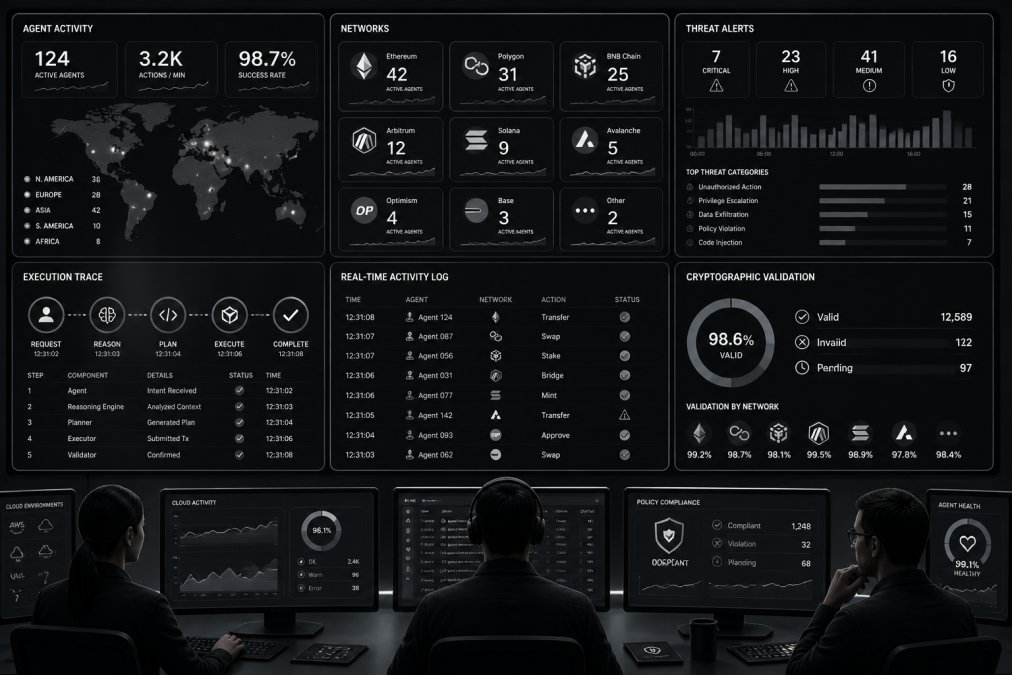
Start by inventorying your agent deployment topology: every agent, every service it calls, every execution environment, and every data source. For each connection, ask: What happens if this connection is intercepted? What if the downstream service is compromised? What if the agent's session token is stolen?
Tool Chain Manipulation and Delegation Risks
Tool chain manipulation occurs when an attacker gains control over the tools an agent is authorized to call. An AI agent authorized to approve transactions up to $100,000 might approve a $500,000 transaction if an attacker modifies the transaction verification tool to underreport the amount.
Preventing tool chain manipulation requires input validation at every tool boundary, cryptographic tool verification before execution, and audit logging at the tool level.
Session Smuggling and Privilege Escalation
Session smuggling is a delegation-chain attack where an attacker uses a legitimate agent's session token to make unauthorized requests. Privilege escalation through delegation chains works when Agent A (read permissions) is tricked into calling Agent B (write permissions) with malicious input.
Preventing these attacks requires scoped session tokens specific to particular actions, cryptographic request signing verified before execution, and session binding to execution context with timestamps.
Implementing AI Agent Security Tools and Controls
Effective chain-agnostic security requires implementing controls at three layers: identity and access management, runtime monitoring, and audit logging.
Identity-Based Access and Scoped Permissions
Identity-based access control assigns permissions to agents based on their cryptographic identity, not their network location. An agent's identity should be a cryptographic key pair: a public key verifiable by any execution environment and a private key used to sign requests.
Scoped permissions limit each agent to the minimum set of actions required for its function. Implementing identity-based access across heterogeneous environments requires public key infrastructure that works across all execution environments, standardized permission models that translate across environments, and cryptographic proof of authorization before executing consequential actions.
Runtime Monitoring and Audit Logs
Runtime monitoring observes agent behavior as it happens and alerts when behavior deviates from expected patterns. Implement runtime monitoring by instrumenting all agent entry and exit points, tracking state changes, detecting anomalies against historical baselines, and correlating logs across environments.
Audit logs should include timestamp, duration, agent identity and version, input parameters, all external service calls and results, output, state changes, and cryptographic signatures.
NIST AI Risk Management Framework for Autonomous Agents
The NIST AI Risk Management Framework provides a structured approach to identifying, assessing, and mitigating AI risks.
Govern: Establish policies, roles, and accountability structures for AI agent deployment. Define which agents are authorized to make which decisions and establish escalation procedures if behavior deviates from policy.
Map: Identify all AI systems and their dependencies. For agents, map delegation chains, data flows, and execution environments.
Measure: Establish metrics for normal agent behavior: decisions per hour, error rate, decision latency. Baseline these metrics to detect anomalies.
Manage: Implement controls to mitigate identified risks, including identity and access management, runtime monitoring, and incident response procedures.
For chain-agnostic deployments, these components must extend across multiple execution environments. According to NIST's AI Risk Management Framework documentation, risk management is an ongoing process requiring continuous monitoring and regular testing of incident response procedures.
Zero-Trust Architecture for Agentic Workflows
Zero-trust architecture assumes every request is potentially malicious and requires verification before granting access.

For agentic workflows, zero-trust means never trusting an agent's claimed identity, permissions, or input without cryptographic verification. Implementing zero-trust for agents requires cryptographic identity for every agent, fine-grained authorization policies, continuous verification on every request, and encrypted channels.
Explore Ecosystem Government Contracting →
Post-Quantum Security and Incident Response for Autonomous Agents
Post-quantum security addresses the threat that quantum computers will break current cryptographic algorithms like RSA and ECDSA. Organizations deploying agents for decades should begin transitioning to post-quantum algorithms now.
For chain-agnostic deployments, post-quantum security is complicated by the need to work across multiple execution environments. Blockchain networks use ECDSA signatures; migrating requires either upgrading the blockchain itself or implementing a hybrid approach where agents use post-quantum algorithms for critical decisions.
When an agent is compromised, it might have already made irreversible decisions. An effective incident response plan includes detection through continuous monitoring, immediate credential revocation, forensics using audit logs, remediation of unauthorized actions, recovery with patched versions, and root cause analysis.
Governance, Compliance, and Regulatory Mapping
Autonomous agents in regulated industries must comply with regulatory requirements. Most regulations predate autonomous agents, so compliance requirements must be interpreted and mapped onto agent architectures.
Auditability and Accountability: Maintain detailed logs of every decision, what data was considered, and what action was taken.
Explainability and Interpretability: If an agent denies a loan application, the applicant might have the right to know why. This is challenging for agents using deep learning models.
Data Protection: Implement access controls, encryption, and audit logging for sensitive data like health information.
Liability and Insurance: Understand your organization's potential liability exposure if an autonomous agent causes financial harm.
Regulatory mapping requires identifying applicable regulations, mapping them to technical requirements, documenting compliance, and conducting regular compliance reviews. According to SEC guidance on AI in financial services, financial institutions deploying autonomous agents must maintain clear documentation of decision logic and be able to explain decisions to regulators.
Practical Implementation Roadmap
Implementing chain-agnostic security is a series of incremental improvements:
Phase 1 (Weeks 1-4): Inventory and Assessment Document all autonomous agents, map agent dependencies and delegation chains, identify execution environments, and assess current security controls and gaps.
Phase 2 (Weeks 5-8): Identity and Access Management Implement cryptographic identity for each agent, establish public key infrastructure, define scoped permissions, and implement authorization checks at critical decision points.
Phase 3 (Weeks 9-12): Monitoring and Logging Deploy runtime monitoring for all agents, implement audit logging at the execution environment level, establish baselines for normal behavior, and set up alerts for anomalous behavior.
Phase 4 (Weeks 13-16): Incident Response and Testing Develop incident response procedures for agent compromise, test through simulations, document compliance mappings, and conduct security assessments.
AI Modularity's execution trust ecosystem supports this roadmap. Agent Verify™ provides visibility into agent code and behavior. A2SPA™ and A2EA™ implement identity-based authorization and runtime monitoring. CryptoValidity™ provides cryptographic proof of execution integrity.
Start with inventory and assessment. You cannot secure what you don't understand. Once you understand your agent deployment topology, implement controls incrementally, testing and refining as you go.
Securing autonomous agents across multiple execution environments requires a fundamentally different approach than securing traditional software. Chain-agnostic security means applying consistent verification, authorization, and accountability controls regardless of where agents run. Organizations deploying agents for consequential decisions cannot afford to treat security as an afterthought. Start with a clear inventory of your agent deployments, implement identity-based access controls, deploy continuous monitoring, and establish incident response procedures. As your agent deployments scale, these foundational controls will determine whether autonomous systems remain trustworthy or become liabilities. Explore AI Modularity's execution trust ecosystem to see how Agent Verify™, A2SPA™, A2EA™, and CryptoValidity™ work together to provide verifiable security, accountability, and financial trust across your autonomous agent infrastructure.
Frequently Asked Questions
What is chain-agnostic AI agent security?
Chain-agnostic AI agent security means securing autonomous agents regardless of which blockchain, cloud platform, or execution environment they operate on. Instead of building security controls tied to a specific chain or infrastructure, this approach uses standardized protocols for verification, authorization, and auditability that work across any deployment context. This matters because enterprises increasingly run agents across multiple chains and cloud providers simultaneously, and security controls locked to one environment create gaps elsewhere.
How does AI agent threat modeling differ from traditional application security threat modeling?
AI agent threat modeling must account for autonomous decision-making, delegation chains, and model drift that traditional applications don't face. Agents can invoke APIs, trigger financial transactions, and escalate privileges without human intervention. Threat modeling for agents requires mapping tool chain manipulation vectors, session smuggling attacks, prompt injection paths, and metadata poisoning scenarios. You must also model the agent's lifecycle from deployment verification through runtime behavior and post-execution attribution.
What does the NIST AI Risk Management Framework require for autonomous agent security?
The NIST AI Risk Management Framework emphasizes risk mapping, performance monitoring, and human oversight for AI systems. For autonomous agents, this translates to: documenting agent capabilities and limitations before deployment, establishing governance frameworks that define authorized actions, implementing continuous monitoring of agent behavior, maintaining audit logs for compliance, and ensuring humans can intervene or halt agent execution. The framework also requires regular risk assessment and documented incident response procedures specific to your agent deployment model.
What should I do if an AI agent security incident occurs?
Incident response for autonomous agents requires immediate detection, containment, and attribution. First, halt affected agents and isolate their execution environment. Second, review audit logs and cryptographic signatures to establish what actions the agent took and whether authorization was valid. Third, determine if the breach was caused by prompt injection, unauthorized API calls, privilege escalation, or model drift. Fourth, notify compliance and legal teams if regulated data or financial transactions were involved. Finally, document findings and update your threat model and security controls to prevent recurrence.
How do I verify an AI agent's behavior before deploying it to production?
Agent verification requires testing the agent's code, training data, and runtime behavior against your threat model before deployment. Use static analysis to check for prompt injection vulnerabilities and unsafe API integrations. Run the agent in a sandboxed environment with limited permissions to observe its decision-making patterns. Validate that the agent only calls authorized APIs and respects scoped permissions. Implement cryptographic signing of agent code and workflows so you can prove the agent running in production matches the verified version. Maintain audit logs from the pre-deployment verification phase for compliance and incident investigation.
Why is session smuggling a critical risk for multi-agent systems?
Session smuggling occurs when an agent reuses or escalates authentication credentials across multiple API calls or delegation chains. If Agent A authenticates to a service with elevated permissions, and then Agent B tricks Agent A into forwarding that session token, Agent B gains unauthorized access. In multi-agent environments where agents delegate tasks to each other, session smuggling can cascade across the entire chain. Prevent this by implementing identity-based access controls where each agent has its own cryptographic identity, by validating session scope at every API call, and by logging all delegation events for auditability.
What is the difference between AI agent security and traditional API security?
Traditional API security focuses on authenticating users and validating requests at the boundary. AI agent security must also govern autonomous decision-making, prevent prompt injection, monitor for model drift, and attribute outcomes to specific agents. Agents can chain multiple API calls together, escalate privileges through delegation, and make decisions based on data they retrieve. You need cryptographic authorization at the point of execution, not just at the API boundary. You also need observability into the agent's reasoning and decision path, and you must maintain a complete audit trail linking each action back to the agent's decision and the data it used.
This article was written using GrandRanker