 how-to
How to Implement AI Agent Access Control
Table of Contents
- Why AI Agent Access Control Matters
- Step 1: Inventory Your AI Agents and Define Permission Scopes
- Step 2: Apply the Principle of Least Privilege for AI Agents
- Step 3: Implement RBAC for AI Agents
- Step 4: Establish Secure Authentication and Token Management
- Step 5: Build an AI Agent Security Framework
- Step 6: Monitor, Audit, and Manage AI Agent Permissions
- Step 7: Ensure Compliance and Risk Mitigation
Last Updated: August 9, 2026
Why AI Agent Access Control Matters
Autonomous AI agents are moving from experimental projects to critical infrastructure. When an agent controls financial transactions, manages data access, or makes consequential decisions, a single misconfiguration or compromised credential can cascade into significant organizational risk.
AI agent access control is the framework that determines what an agent can do, where it can do it, and how those actions get verified and logged. Without it, you're giving your autonomous systems a master key to your infrastructure. With it properly implemented, you gain verifiable oversight, reduced blast radius from compromise, and compliance-ready audit trails.
This guide walks through the seven-step process for implementing AI agent access control, moving from inventory and principle definition through to monitoring, auditing, and compliance.
Step 1: Inventory Your AI Agents and Define Permission Scopes
You cannot control what you haven't inventoried. Start by documenting every AI agent in your environment, including shadow agents that teams have deployed without formal approval.
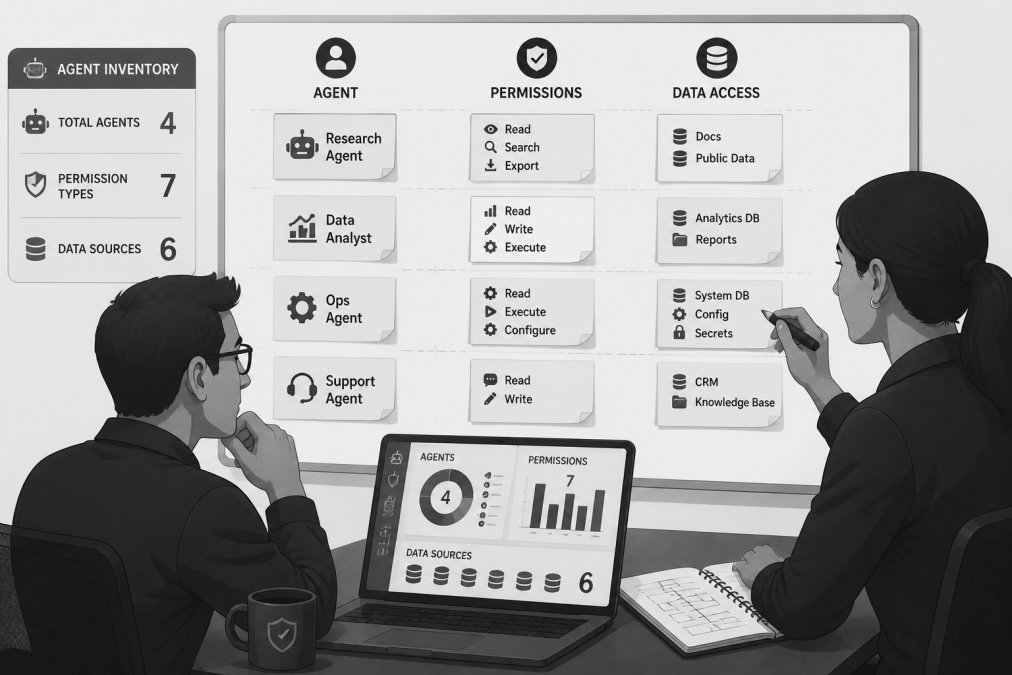
For each agent, capture:
- Agent name and purpose
- Data access requirements (specific endpoints, database tables, or file paths)
- External system integrations
- Execution frequency and volume
- Owner and stakeholders
Map each agent to the specific APIs, data sources, and external systems it needs. One agent might need read-only access to a customer database; another needs to trigger financial transactions. Document these distinctions to prevent over-provisioning later.
Once you have a complete inventory, categorize agents by risk tier. High-risk agents can modify data, trigger external actions, or access sensitive systems. Medium-risk agents read sensitive data but cannot modify it. Low-risk agents operate on non-sensitive data.
Step 2: Apply the Principle of Least Privilege for AI Agents
Grant each agent only the minimum permissions required to accomplish its specific task. For AI agents, this means:
- Read-only access where modification isn't needed
- Scoped API keys that only work for specific endpoints
- Time-limited credentials that expire after a set period
- Data filtering so agents access a subset of records, not entire tables
Start with read-only modes for non-critical operations. An agent that gathers information, analyzes it, and reports findings should be locked to read-only. This eliminates a massive class of potential damage.
For agents that need write access, implement staged authorization. The agent can prepare a transaction or recommend an action, but a human or secondary verification system must approve before execution.
Automate credential rotation every 30 to 90 days. When credentials rotate, old ones stop working immediately, limiting the window of usefulness for any compromised key.
Step 3: Implement RBAC for AI Agents
Role-Based Access Control (RBAC) organizes permissions into roles that map to agent functions. Instead of assigning individual permissions to each agent, assign agents to roles, and roles carry permission sets.
Define roles aligned with agent functions:
- Data Reader - Read-only access to specific data sources
- Report Generator - Read access to data plus ability to write to a reporting database
- Transaction Executor - Ability to initiate transactions with secondary authorization required
- System Monitor - Read-only access to infrastructure and application logs
Create a service account for each role, not for each agent. Multiple agents can use the same service account if they share the same role. Use scoped API keys bound to specific roles. If someone compromises that key, damage is limited to what that role can do.
RBAC becomes your policy enforcement layer. When you need to change permissions for a category of agents, modify the role once, and all agents using that role inherit the change. This scales better than managing individual permissions.
Step 4: Establish Secure Authentication and Token Management
Deploy an identity provider (IdP) that your agents authenticate with. The IdP verifies the agent's identity and issues a token (JWT or OAuth2) that proves the agent is who it claims to be.
The token carries metadata: which agent it was issued to, what permissions it grants, when it expires, and what systems it can access. When an agent makes a request, it presents the token. The receiving system validates the token's signature, checks expiration, and verifies permissions before allowing the request.
Session isolation prevents one agent from using another agent's credentials. Each agent gets its own session. Even if two agents run on the same infrastructure, they cannot access each other's tokens or impersonate each other.
Automate credential rotation frequently. When a new token is issued, the old one is revoked. Any attempt to use the revoked token fails immediately.
For high-risk agents, implement certificate-based authentication instead of or in addition to token-based auth. Certificates are harder to compromise because they can be hardware-bound and require cryptographic operations to use.
Step 5: Build an AI Agent Security Framework
A security framework integrates authentication, authorization, policy enforcement, and human oversight into a cohesive system.
Explore Ecosystem Government Contracting →
Policy Enforcement Layer - Define policies that determine what agents can do. Example: "Agents in the Data Reader role can only read from these specific tables. Agents in the Transaction Executor role can initiate transactions up to $50,000 without approval, but transactions above $50,000 require human approval."
API Gateway - Route all agent requests through a gateway that enforces policies. The gateway checks the agent's token, verifies the requested action against the policy, and either allows or blocks the request.
Human-in-the-Loop (HITL) Authorization - For critical actions, require a human to explicitly approve before execution. Implement HITL for transactions above a threshold, actions that modify sensitive data, access to regulated systems, and any action carrying compliance or financial risk.
Context Window Security - Prevent prompt injection and context manipulation. Implement input validation and sanitization to ensure that user inputs or external data cannot alter the agent's instructions.
Combine these layers into a unified framework. This means you know the agent's code was safe before it ran, you controlled what it could do while it ran, and you have a complete record of what it did after it ran.
Step 6: Monitor, Audit, and Manage AI Agent Permissions
Collect comprehensive audit logs for all agent activity:

- Which agent made the request
- What resource or action it requested
- Whether the request was allowed or denied
- Timestamp and duration
- Result or error message
- If human approval was required, who approved it and when
Store audit logs in a system that agents cannot modify. If an agent is compromised, it should not be able to cover its tracks.
Set up real-time monitoring for anomalies: agents attempting to access resources outside their role, requests at unusual times or frequencies, repeated failures, or unusual data volumes.
Implement revocation and emergency kill-switches. If an agent is compromised or misbehaving, revoke all of its credentials and permissions instantly. Revocation should be atomic, when you revoke a credential, it stops working everywhere immediately.
Regular permission audits are essential. Monthly or quarterly, review which agents have which permissions. Look for agents with unnecessary permissions, permissions that should have been revoked, and permission creep over time.
Step 7: Ensure Compliance and Risk Mitigation
AI agent access control is a compliance requirement in many regulated industries. Map your controls to compliance frameworks:
- SOC 2 Type II requires documented access controls, audit trails, and regular testing.
- GDPR requires that data access is logged, authorized, and auditable.
- HIPAA requires strict access controls on sensitive health information.
- Financial Regulations require that consequential financial actions are authorized and auditable.
Document your compliance mapping explicitly. Show which control addresses which requirement.
Conduct risk assessments for each agent deployment. Assess impact if compromised, likelihood of compromise, risk rating, and mitigation. High-risk agents get the strictest controls.
Prevent data exfiltration by implementing data loss prevention (DLP) controls. Monitor what data agents access and transfer. Implement egress filtering so agents can only send data to approved destinations.
Implementing AI agent access control is a multi-step process that builds from inventory through to compliance. Organizations that move fastest start with clear principles, least privilege, RBAC, HITL authorization, and build incrementally.
AI Modularity's execution trust ecosystem is purpose-built for this workflow. Agent Verify™ validates agent code before deployment. A2SPA™ and A2EA™ enforce authorization at execution time. CryptoValidity™ provides cryptographic proof of what happened. Together, they create verifiable, accountable, and compliant autonomous AI execution.
Start with inventory. Move to principle. Build controls incrementally. Audit relentlessly. The agents that are hardest to compromise are the ones where access control is designed in from the beginning, not bolted on afterward.
Frequently Asked Questions
Why is access control important for AI agents?
AI agents can perform autonomous actions across systems, data, and financial transactions. Without proper access control, a compromised agent or prompt injection attack can exfiltrate sensitive data, execute unauthorized transactions, or damage critical infrastructure. Access control enforces boundaries that limit what each agent can do, reducing risk exposure and ensuring that even if an agent is compromised, the damage is contained to its specific permission scope.
What is the principle of least privilege for AI agents, and how do you implement it?
Least privilege means granting each agent only the minimum permissions required to complete its assigned tasks. Implement it by inventorying your agents' actual needs (which APIs, data sources, and operations they truly require), then assigning granular permission sets that exclude everything else. Use read-only modes for non-critical operations, restrict write access to specific endpoints, and rotate credentials regularly. This approach limits the blast radius if an agent is compromised.
How does RBAC work for AI agents?
Role-Based Access Control (RBAC) for AI agents assigns agents to roles (e.g., 'financial-processor', 'data-analyst', 'notification-sender') and grants each role a specific set of permissions. Instead of assigning permissions directly to individual agents, you define what each role can do, then assign agents to roles. This simplifies permission management at scale: when you need to update permissions, you change the role definition once, and all agents in that role inherit the change. Use service accounts and API keys to enforce these role boundaries.
What should I do if an AI agent is compromised or behaves unexpectedly?
Implement a revocation and emergency kill-switch mechanism. This allows you to instantly revoke an agent's credentials, disable its API keys, or terminate its session without waiting for a full deployment cycle. Set up audit logs that alert your team to suspicious behavior (unusual API calls, permission scope violations, or data access patterns). Combine this with human-in-the-loop authorization for critical actions: require manual approval before the agent executes high-risk operations like financial transfers or data deletion. This creates a safety net for autonomous execution.
This article was written using GrandRanker