 how-to
How to Secure Autonomous AI Agents: A 2026 Guide
Table of Contents
- Understanding the Security Landscape for Autonomous AI Agents
- Step 1: Implement Zero Trust Architecture for AI
- Step 2: Design Your AI Agent Security Architecture
- Step 3: Prevent Prompt Injection in Autonomous Agents
- Step 4: Deploy AI Agent Monitoring and Observability Tools
- Step 5: Establish Incident Response for Autonomous Agents
- Step 6: Map Regulatory Compliance for Agent Deployment
- Step 7: Implement Human-in-the-Loop Security Workflows
Last Updated: August 8, 2026
Understanding the Security Landscape for Autonomous AI Agents
Autonomous AI agents execute consequential actions, financial transactions, data modifications, infrastructure changes, with degrees of autonomy that introduce new attack surfaces. Unlike traditional software following deterministic logic, agents can be manipulated, redirected, or compromised in ways that bypass human oversight. The security challenge is ensuring agents cannot be exploited and that you can verify their behavior before and after execution.
Regulated industries face acute pressure: financial institutions deploying agents for trading, government agencies using agents for resource allocation, and enterprises managing critical infrastructure must answer the same question: how do you verify what an agent will do before execution and prove it did what you authorized afterward? Traditional security models address the perimeter, not the agent itself.
This guide covers the complete lifecycle of securing autonomous AI agents: zero trust architecture for agentic systems, execution isolation, credential management, incident response, regulatory compliance, and human-in-the-loop workflows that maintain security without strangling autonomy.
Step 1: Implement Zero Trust Architecture for AI
Zero Trust Architecture for AI starts with one principle: never trust agent output implicitly, even from your own system. Every decision, API call, and data access request should be evaluated independently against authorization policies before execution.
Traditional zero trust verifies identity and permissions at the network layer. For agents, you must extend this to the action layer. An authenticated agent isn't automatically authorized for every action it requests. A compromised prompt, model poisoning, or behavioral drift could cause it to request unauthorized actions.
Implementation requires three components: establish cryptographic identity for each agent (verifiable chain of custody from deployment through execution), enforce policy at the point where agents request actions (not after execution), and maintain continuous telemetry to detect behavioral deviation from expected profiles.
According to NIST's Cybersecurity Framework guidance on Zero Trust Architecture, verification should occur at every transition point. For agents, this means verifying code integrity, model weights, and each requested action against authorized scope before execution.
Step 2: Design Your AI Agent Security Architecture
Your agent security architecture must address three threat vectors: threats to code and model, threats during execution, and threats to downstream data and systems. These layers cannot be secured independently.

Map your agent's execution flow: where does code live (containerized, serverless, dedicated infrastructure)? Where are model weights stored? How does the agent access credentials? Each point is a potential vulnerability. Treat the execution environment as inherently untrusted, even if it's your own infrastructure.
Identity and Access Management (IAM) for Agents
IAM for agents differs fundamentally from traditional IAM because agents are non-human principals making autonomous decisions. You cannot rely on human review of each access request.
Implement task-scoped permissions: each agent gets only the minimum permissions required for its specific task. An agent retrieving customer data should not modify or delete records. An agent approving transactions up to $10,000 should not exceed that threshold. Enforce these constraints cryptographically as hard limits, not policy guidelines.
Use aggressive credential rotation. If agent credentials are compromised, exposure should be measured in hours, not days. Implement short-lived tokens (15-60 minutes) for agent-to-system communication. When tokens expire, agents must re-authenticate through flows that validate identity and current authorization state.
Separate authentication from authorization. Authentication answers "Is this the agent I deployed?" Authorization answers "Is this agent allowed to perform this action?" These should be independent verification steps.
Execution Isolation and Sandboxing
Execution isolation ensures agents cannot access systems or data outside their authorized scope and failures cannot cascade to other systems.
Deploy agents in containerized or virtualized environments isolated from the host system. Use container security scanning to verify dependencies haven't been compromised. Implement network policies restricting which endpoints agents can reach.
Set resource limits on agent execution: CPU, memory, and execution time. If an agent should complete in 30 seconds but runs for 5 minutes, automatic termination prevents resource exhaustion attacks and infinite loops.
Implement deterministic execution paths where possible. Agents following the same code path for identical inputs are easier to verify before deployment and easier to monitor for anomalies during execution.
Credential Protection and Management
Agents need credentials to access databases, APIs, payment processors, and cloud services. How you manage these credentials determines whether compromising the agent also compromises every system it touches.
Never embed credentials in agent code or configuration files. Use a secrets management system that stores credentials encrypted and issues them on-demand. The secrets manager should authenticate the agent before issuing credentials and log every access.
Implement credential rotation independent of agent deployment. Rotating a database password should automatically deliver the new credential to all agents using it without code changes or redeployment.
Use credential wrapping: agents never see actual credentials. Instead, they receive tokens representing credentials. When agents need to use credentials, they present tokens to an intermediary service that performs the operation. Even if the agent is compromised, attackers don't gain direct credential access.
Step 3: Prevent Prompt Injection in Autonomous Agents
Prompt injection manipulates agent input to cause unintended behavior. Language models respond to semantic content in input, not just explicit instructions. An agent designed to retrieve customer data for user 123 might also return all customer records if an attacker embeds hidden instructions in the request.
Preventing prompt injection requires multiple layers. First, separate user input from system instructions. System prompts should be immutable, not changeable by user input. Use clear delimiters between system instructions and user-provided data.
Second, implement input validation. Analyze user input for injection patterns: phrases like "ignore previous instructions" or "pretend you are" or "now do this instead." While no filter is perfect, basic pattern matching catches obvious attempts.
Third, validate output. After the agent generates a response, verify it matches expected format and scope. If asked to retrieve data for one customer but returning data for 100, that's a red flag.
Fourth, constrain the agent's action space. Design agents with minimal capabilities. An agent that can only read data should not have write permissions.
Step 4: Deploy AI Agent Monitoring and Observability Tools
You cannot secure what you cannot see. Observability means collecting detailed telemetry about what agents do at every step: inputs received, reasoning performed, actions requested, and outcomes.
Implement comprehensive logging. Every agent invocation should generate logs including: input provided, internal reasoning steps, external API calls, responses received, and final actions taken. Write logs to append-only storage where they cannot be modified or deleted, creating an immutable audit trail for forensics.
Collect metrics revealing agent behavior patterns. Track request frequency, task completion time, approval versus denial rates, and error types. Baseline these during normal operation to detect anomalies. If an agent suddenly makes 100x more API calls than usual, something is wrong.
Explore Ecosystem Government Contracting →
Guardrails and Policy Enforcement
Guardrails are runtime constraints preventing agents from taking unauthorized actions, even if requested. Unlike passive monitoring, guardrails actively block violations.
Implement guardrails at the execution layer. A policy states "agents can only access authorized customer data." A guardrail enforces this at runtime, checking every database query and rejecting violations.
Use multiple enforcement mechanisms: API gateways enforce rate limits and validate signatures; proxy services validate request patterns; database engines restrict table and column access. Multiple layers make security more resilient to individual failures.
Implement deterministic policy evaluation. Given the same agent, request, and policy state, evaluation should always produce the same result, allowing pre-deployment verification and easier detection of bypasses.
Audit Trails and Telemetry Collection
An audit trail is a chronological record of every significant action involving the agent: deployment, execution, credential access, policy violations, and incident response.
Structure audit trails for queryability. Log events as records with fields like timestamp, agent_id, action_type, request_details, response_details, and decision_reason, enabling programmatic search and analysis.
Implement telemetry collection feeding into your SIEM (Security Information and Event Management) system for pattern analysis. Set up alerts for suspicious patterns: agents making requests outside normal time windows, accessing unusual data, or generating unusual error rates.
Maintain retention policies balancing storage costs with forensic requirements. Retain detailed logs for 90 days and summary metrics for 2 years, adjusted for your regulatory environment.
Step 5: Establish Incident Response for Autonomous Agents
Incident response for autonomous agents requires different playbooks than traditional incidents. Compromised or malfunctioning agents may be actively taking harmful actions. Response must be fast enough to stop agents before damage occurs.
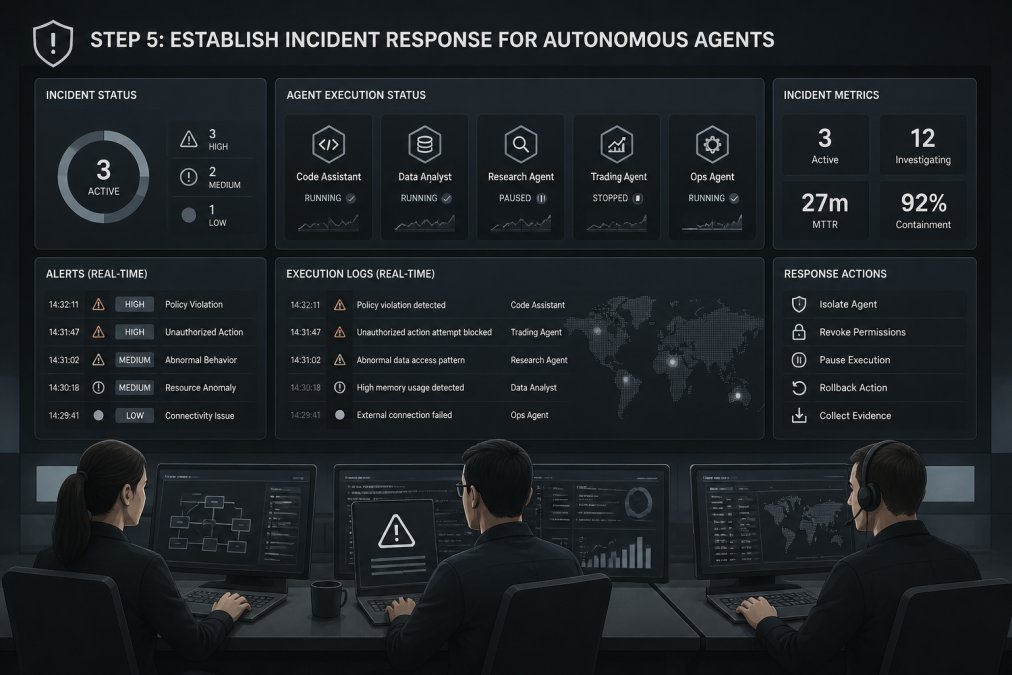
Define incident severity levels specific to agents. Severity-1: agent actively executing unauthorized transactions. Severity-2: agent attempting unauthorized data access (blocked by guardrails). Severity-3: agent behaving anomalously without harmful attempts.
Establish an incident response team with clear roles: incident commander owns overall response; agent operator pauses or terminates the agent; security analyst investigates; compliance officer determines regulatory notification requirements. Pre-assign roles to eliminate response delays.
Create a kill switch for every agent. Implement a mechanism to immediately stop execution without code changes or redeployment, a configuration flag agents check before each action or a network-level block preventing external communication. On-call operators should activate it in seconds.
Document incident response procedures specific to your agents: which logs to check first, what metrics indicate problems, how to determine whether incidents stem from compromised agents, poisoned models, or legitimate bugs, and how to safely restart agents afterward. Practice procedures regularly through tabletop exercises.
Step 6: Map Regulatory Compliance for Agent Deployment
Regulatory requirements for AI agents vary by industry and jurisdiction. Financial institutions face SEC and banking regulator requirements. Healthcare organizations face HIPAA requirements. Government agencies must comply with federal AI governance frameworks. Regulators want to understand what agents do, verify safe operation, and maintain accountability for decisions.
Map specific regulatory requirements before deploying agents. Identify applicable regulations and specific AI-related requirements. Document how your agent security architecture addresses each requirement.
Many regulations require explainability or auditability. You must explain why agents made particular decisions. Agents need decision logs showing reasoning behind each action. For language model-based agents, capture internal reasoning steps or generate post-hoc explanations.
Some regulations require human review of consequential decisions. If agents approve financial transactions, humans may need to review high-value transactions before execution. Your architecture should support human-in-the-loop workflows where agents prepare decisions but humans make final calls.
Document compliance mapping and maintain it as regulations evolve. Regulatory requirements for AI are rapidly changing. Keep compliance documentation as a living document updated as requirements emerge.
Step 7: Implement Human-in-the-Loop Security Workflows
Human-in-the-loop maintains human oversight of agent decisions for consequential actions. This preserves agent autonomy while ensuring human intervention capability and decision attribution.
Implement tiered approval workflows. Low-risk decisions (retrieving customer data) require no approval. Medium-risk decisions (approving transactions under $5,000) require manager approval. High-risk decisions (approving transactions over $100,000) require multiple departmental approvals. Configure workflows in policy, not hardcoded in agents.
Design workflows that don't bottleneck execution. If every decision requires human approval, you've eliminated autonomy benefits. Use risk-based workflows where agents handle routine decisions and humans review exceptional cases. Use alerts to notify humans when agents encounter unusual situations.
Implement workflows capturing human decisions. Log human approvals or rejections with identity, time, and reasoning, creating accountability and allowing audits of whether oversight is effective.
Create feedback loops where human decisions inform agent behavior. If humans consistently reject certain agent decisions, that signals misalignment. Use this feedback to retrain or reconfigure agents.
Securing autonomous AI agents requires thinking beyond traditional security models. You're securing the agent itself, its execution environment, and its decisions. This means implementing zero trust at the agent level, using execution isolation to contain failures, maintaining comprehensive observability to detect problems, and establishing human oversight for consequential decisions.
At AI Modularity, we've built an execution trust ecosystem specifically designed for this challenge. Our platform combines Agent Verify™ for agent verification before deployment, A2SPA™ for cryptographic authorization at execution points, and A2EA™ for comprehensive audit trails after completion. This enables organizations to deploy autonomous agents with confidence, verifying behavior, controlling actions, and proving what agents did. Explore how AI Modularity's execution trust infrastructure can secure your autonomous AI operations across enterprise, financial, and government environments.
| Security Layer | Key Control | Verification Method |
|---|---|---|
| Agent Identity | Cryptographic verification of agent code and model | Signature validation before execution |
| Access Control | Task-scoped permissions with least privilege | Policy evaluation at action request time |
| Execution Environment | Sandboxing and isolation | Resource limits and network policies |
| Credential Management | Short-lived tokens with rotation | Secrets manager audit logs |
| Monitoring | Comprehensive telemetry and audit trails | SIEM analysis and anomaly detection |
| Incident Response | Kill switch and rapid containment | Pre-defined playbooks and team roles |
| Human Oversight | Risk-based approval workflows | Decision logging and feedback loops |
Frequently Asked Questions
What are the primary security risks associated with autonomous AI agents?
Autonomous AI agents face multiple threat vectors: prompt injection attacks that manipulate agent behavior, session hijacking of agent credentials, model poisoning through malicious training data, and data exfiltration when agents access sensitive systems. Additionally, agents operating without proper execution isolation can exceed their intended permissions, and insufficient audit logging prevents attribution when incidents occur. The core risk is that agents operate with minimal human oversight, making unauthorized or harmful actions harder to detect and stop in real time.
How do you implement access control for autonomous AI agents?
Implement least privilege access through task-scoped permissions: grant each agent only the specific credentials and API access required for its defined function. Use an identity provider to manage agent authentication, implement credential rotation on a regular schedule to limit exposure from compromised credentials, and enforce authorization checks at every execution boundary. Separate agent identities from human identities and apply different policy rules to each. Monitor all access attempts and deny requests that exceed the agent's defined scope, even if the request appears valid.
How does the NIST AI Risk Management Framework apply to autonomous agents?
NIST's AI RMF emphasizes governance, mapping, and measurement, principles directly applicable to agent security. Map your agent's intended use and potential failure modes, identify threat vectors specific to your deployment, and establish metrics to measure security posture before and after deployment. The framework requires documenting how agents handle sensitive data, establishing controls to prevent model poisoning and prompt injection, and creating accountability mechanisms through audit trails. Use NIST's risk categories to prioritize which agents need the highest security controls based on their access level and potential impact.
What is the role of human-in-the-loop in securing autonomous agents?
Human-in-the-loop (HITL) security workflows ensure critical decisions remain under human control. Require explicit human approval before agents execute high-risk actions (financial transactions, data modifications, privilege escalations). Implement HITL checkpoints when agents detect anomalies, encounter decisions outside their training scope, or attempt actions that exceed their task-scoped permissions. Use observability tools to alert humans to suspicious agent behavior in real time, enabling rapid intervention. HITL is not about slowing down agents, it's about maintaining a verification layer that prevents autonomous execution of consequential actions without human verification.
This article was written using GrandRanker