 listicle
Witness.ai Alternatives for Enterprise Security
Table of Contents
- Why Enterprise Security Alternatives to Witness.ai Matter
- AI Security Posture Management: Core Requirements
- Top Enterprise Security Alternatives Compared
- LLM Security Best Practices for Agent Deployment
- AI Risk Management Framework for Autonomous Operations
- Integration, Cost, and Implementation Timelines
- Making Your Selection: Key Decision Factors
- Conclusion
Last Updated: August 6, 2026
Why Enterprise Security Alternatives to Witness.ai Matter
The threat landscape for autonomous AI has fundamentally shifted. Organizations deploying agents for critical operations, financial transactions, data processing, infrastructure management, face execution risks that traditional security platforms weren't designed to address. Witness.ai provides agent monitoring, but the market now demands verification before execution, authorization at the point of action, and cryptographic proof of what happened after.
This guide covers enterprise security alternatives that address this gap across network detection, identity governance, cloud posture management, and execution trust. The core question is whether monitoring alone suffices, or whether your risk profile demands verification and authorization upstream.
AI Security Posture Management: Core Requirements
AI security posture management (AI-SPM) is the continuous assessment, monitoring, and remediation of risks specific to AI models, agents, datasets, and infrastructure. It differs from traditional security posture management by addressing AI-native threats: prompt injection, model poisoning, data exfiltration through training pipelines, and unsafe agent execution paths.
Enterprise deployments require visibility across the full autonomous lifecycle: discovery and inventory of all AI assets, runtime defense that intercepts unsafe actions before execution, model security analysis identifying architectural vulnerabilities, compliance monitoring tracking regulatory alignment (SOC 2, FedRAMP, HIPAA, PCI-DSS), and incident response workflows supporting forensics.
Most alternatives specialize in one or two areas. A network detection platform excels at lateral movement but misses model vulnerabilities. An identity governance tool handles access control but doesn't verify agent behavior. An execution trust platform provides verification and authorization but requires integration with your broader security stack. The best alternatives combine depth in their specialty with integration points to your security operations center.
Top Enterprise Security Alternatives Compared
| Alternative | Primary Focus | Best For | Integration Depth |
|---|---|---|---|
| SentinelOne Singularity | Endpoint & Cloud Security | Unified EPP/EDR/CWPP | Native integrations |
| Darktrace ActiveAI | Anomaly Detection & Response | Novel threat identification | Self-Learning AI |
| Wiz AI-SPM | Cloud AI Asset Governance | Shadow AI detection | Cloud-native |
| IBM Security QRadar | SIEM & Log Analysis | Large-scale threat correlation | Extensive |
| Vectra AI Cognito | Network Detection & Response | Behavioral threat hunting | Network-centric |
| Exabeam Fusion | Behavioral Analytics & SIEM | Insider threat detection | User-centric |
| SailPoint IdentityAI | Identity Governance | Non-human identity security | Access control |
| AI Modularity | Execution Trust Ecosystem | Autonomous AI verification & authorization | Chain-agnostic |
SentinelOne Singularity Platform
SentinelOne Singularity unifies endpoint protection (EPP), endpoint detection and response (EDR), cloud workload protection (CWPP), and identity threat detection and response (ITDR) into a single AI-powered platform. For enterprises running AI agents across distributed infrastructure, Singularity provides autonomous prevention and response at the endpoint layer.
The platform's strength lies in unified visibility. Rather than managing separate tools, security teams get a single console with correlated data across endpoint, cloud, and identity domains. Storyline technology automatically correlates events into attack narratives, reducing alert fatigue and accelerating incident response.
For AI agent security, Singularity monitors compute nodes where agents execute, detecting unusual process behavior, unauthorized lateral movement, and data exfiltration. However, it operates at the infrastructure layer, it sees what an agent does after it runs, not whether the agent should run in the first place.
Pros: Unified platform reduces tool sprawl; strong autonomous response; covers endpoint, cloud, and identity.
Cons: Doesn't address AI-specific threats like prompt injection; requires integration with separate tools for upstream agent verification.
Darktrace ActiveAI Security Platform
Darktrace's Self-Learning AI approach differs fundamentally from signature-based detection. Rather than looking for known attack patterns, Darktrace learns normal behavior of your network, users, and applications, then flags deviations as potential threats. For autonomous AI environments where attack patterns are novel, this behavioral approach catches threats that traditional tools miss.
The ActiveAI Security Platform combines network detection, email security, cloud workload protection, and endpoint monitoring under one AI engine with autonomous response capabilities. For organizations deploying AI agents that make autonomous decisions, having security that also operates autonomously creates operational alignment.
The Self-Learning AI approach is particularly valuable for detecting compromised AI agents. If an agent's behavior deviates from its normal pattern, unusual data access, unexpected API calls, atypical timing, Darktrace flags it, catching hijacking scenarios that rule-based systems might miss.
Pros: Self-Learning AI identifies novel threats without signature updates; autonomous response reduces time-to-containment; comprehensive coverage.
Cons: Pricing is not publicly available and depends on factors like user count and modules deployed; requires organizational buy-in to autonomous response; doesn't provide upstream verification of agent code.
Wiz AI Security Posture Management
Wiz's AI-SPM offering is purpose-built for AI security. It discovers all AI assets in your cloud environment (including shadow AI), monitors them continuously, and identifies AI-specific risks: prompt injection vulnerabilities, unsafe model configurations, unencrypted training data, and exposed API endpoints.
The platform integrates with AWS SageMaker, Google Vertex AI, and Azure OpenAI, providing real-time visibility into model pipelines, datasets, and inference endpoints. Its continuous AI red teaming automatically tests models for vulnerabilities without disrupting production.
For enterprises struggling with shadow AI, Wiz solves the discovery problem. However, it's cloud-focused and emphasizes posture management over runtime authorization.
Pros: Addresses AI-specific vulnerabilities; discovers shadow AI; continuous red teaming identifies model vulnerabilities.
Cons: Primarily cloud-native; doesn't provide pre-execution verification or authorization; requires integration with identity and execution trust platforms.
IBM Security QRadar
QRadar is a mature SIEM platform that ingests logs from across your infrastructure and uses machine learning to correlate events into security incidents. For enterprises with complex, distributed AI deployments, QRadar provides centralized visibility and automated incident investigation.
The platform's strength is scale and integration. QRadar can ingest events from hundreds of thousands of devices and apply behavioral analytics to detect insider threats, privilege abuse, and data exfiltration. Its SOAR capabilities automate incident response workflows.
For AI agent monitoring, QRadar excels at forensics. After an agent executes, QRadar correlates all related logs into a single incident narrative, supporting compliance audits and post-incident analysis. However, like most SIEMs, QRadar is reactive, it detects threats after they occur, not before.
Pros: Mature platform with extensive integration ecosystem; strong compliance content packs; flexible deployment.
Cons: Pricing scales with data volume, typically based on events per second (EPS) and flows per minute (FPM); reactive posture means threats are detected after execution; requires significant operational overhead.
Vectra AI Cognito Platform
Vectra's network detection and response (NDR) platform uses behavioral AI to identify threats that bypass endpoint security. It monitors network traffic for lateral movement, privilege escalation, and command-and-control communication.
For autonomous AI deployments, Vectra is valuable for detecting agent hijacking. If an attacker compromises an AI agent and uses it to move laterally, Vectra's behavioral analysis catches the anomalous network activity. It also detects data exfiltration where an agent is manipulated into sending sensitive data externally.
Pros: Detects threats endpoint tools miss; behavioral AI reduces false positives; covers data centers, cloud, and SaaS.
Cons: Pricing is not publicly available and typically requires a custom quote; primarily focused on network detection; doesn't address upstream agent verification.
Exabeam Fusion
Exabeam combines SIEM capabilities with behavioral analytics focused on user and entity behavior (UEBA). It detects insider threats, compromised accounts, and privilege abuse by identifying behavior deviating from normal patterns. For AI deployments, Exabeam detects when an agent's service account is used unexpectedly.
The platform automates security operations by prioritizing genuine threats and reducing alert fatigue. Automated workflows can immediately disable compromised accounts or revoke permissions, containing threats faster.
Pros: Minimizes false positives through context-aware analytics; automates security operations; strong insider threat detection.
Cons: Requires upfront integration and tuning; focuses on user and entity behavior, not AI-specific threats; doesn't provide pre-execution verification.
SailPoint IdentityAI
SailPoint's identity governance platform, enhanced with AI, manages who (and what) can access what. For autonomous AI, this means defining and enforcing permissions for AI agent service accounts. IdentityAI uses machine learning to discover access patterns, identify outliers, and recommend access changes enforcing least privilege.
The platform recently added support for non-human identities (NHI), including AI agents. This is critical for enterprises where AI agents have their own service accounts with specific permissions. IdentityAI detects when an agent's account is used unexpectedly, accessing systems outside its normal scope.
Pros: Transforms identity governance with AI-driven insights; supports non-human identities explicitly; provides compliance-ready governance.
Cons: Pricing is not publicly available and depends on factors like identity count, deployment model, and product edition; focuses on access control, not runtime behavior; requires integration with other tools.
AI Modularity: Execution Trust Ecosystem
AI Modularity secures autonomous AI at the point where trust matters most, execution. Rather than monitoring what agents do after they run, AI Modularity verifies agents before deployment and authorizes specific actions at the moment of execution.
Explore Ecosystem Government Contracting →
Agent Verify™ discovers and catalogs all AI agents, analyzes their code and workflows for vulnerabilities, and provides risk assessment before deployment. A2SPA™ (Autonomous AI Security Policy Architecture) defines fine-grained authorization rules for what agents can do. A2EA™ (Autonomous AI Execution Authorization) enforces those policies at runtime, intercepting consequential actions and verifying they match policy. CryptoValidity™ provides cryptographic proof of what the agent did, supporting compliance audits and forensic investigation.
The result is chain-agnostic execution trust infrastructure. AI Modularity works across blockchain networks, cloud platforms, and on-premises infrastructure. For enterprises deploying agents across multiple execution environments, this flexibility is essential.
For autonomous financial actions, agents that transfer funds, approve payments, or execute trades, AI Modularity's authorization and attribution capabilities are irreplaceable.
Pros: Only platform that verifies agents before deployment and authorizes actions at execution; chain-agnostic; cryptographic attribution supports compliance.
Cons: Requires integration with existing security stack; pricing depends on deployment scale; focuses on execution authorization, not broader infrastructure security.
LLM Security Best Practices for Agent Deployment
Autonomous agents interact with language models as core infrastructure. Securing that interaction requires specific controls:
Input validation prevents prompt injection attacks where malicious input manipulates agent behavior. Before an LLM receives input from external sources, validate that input matches expected format and content.
Output filtering catches cases where an LLM generates unsafe responses. An agent might be instructed to transfer funds, but the LLM generates a response with an incorrect amount. Output validation catches these errors before the agent acts on them.
Model versioning ensures agents use approved LLM versions. If you discover a vulnerability in a specific version, you need to know which agents depend on it and update them deliberately.
Rate limiting and quotas prevent agents from consuming excessive LLM resources through bugs or compromise. An agent making 10,000 LLM calls per minute is either malfunctioning or hijacked.
Audit logging records every LLM interaction: the prompt, response, requesting agent, and timestamp, supporting forensics and identifying misuse patterns.

AI Risk Management Framework for Autonomous Operations
An effective AI risk management framework for autonomous operations addresses five dimensions:
Verification happens before deployment. Does the agent's code contain vulnerabilities? Does its workflow match your security policy? Tools like AI Modularity's Agent Verify™ provide upstream assessment, reducing the risk that unsafe agents reach production.
Authorization happens at execution. When an agent attempts an action, the system checks: Is this agent allowed to do this? Under these conditions? At this time? Fine-grained authorization prevents agents from exceeding their intended scope.
Monitoring happens during operation. What is the agent actually doing? Is its behavior consistent with expectations? Behavioral monitoring tools like Darktrace or Vectra provide runtime visibility.
Attribution happens after execution. Cryptographic attribution creates immutable records supporting compliance audits and forensic investigation.
Remediation is the response to detected issues. If an agent behaves unexpectedly, does the system automatically revoke permissions, pause execution, or alert the security team? Effective remediation is automated and proportional to threat level.
The framework is cyclical. Monitoring feeds back into verification, if runtime behavior reveals new risks, you update agent code and re-verify before redeployment.
Integration, Cost, and Implementation Timelines
Integrating enterprise security alternatives requires understanding your current stack and integration points.
Network-centric alternatives (Vectra, Darktrace) integrate at the network layer through traffic taps or cloud APIs. Implementation typically takes 4-8 weeks.
SIEM-centric alternatives (QRadar, Exabeam) require log forwarding from all infrastructure and parsing rule configuration. Expect 8-12 weeks for mature deployment.
Identity-centric alternatives (SailPoint) integrate with directory services and require defining access policies. For organizations with hundreds of applications, this can take 12-16 weeks.
Execution trust alternatives (AI Modularity) integrate at the application layer. Agents are instrumented to call APIs for verification and authorization. This is typically faster, 2-4 weeks, because it's scoped to specific agents.
For a 500-person enterprise with 50 AI agents running 10,000 transactions per day, budget allocation might look like:
- Endpoint security: Pricing for endpoint security solutions like SentinelOne Singularity varies by tier and number of endpoints, with genuine EDR starting around $179.99 per endpoint per year.
- Network detection: Pricing for network detection solutions like Darktrace and Vectra AI is not publicly available and depends on various factors.
- SIEM: Pricing for SIEM solutions like IBM Security QRadar and Exabeam Fusion varies significantly based on factors like events per second (EPS) or gigabytes ingested per day (GB/day).
- Identity governance: Pricing for identity governance platforms like SailPoint IdentityAI is not publicly available and is typically custom-quoted based on identity count and modules.
- Execution trust: Pricing for AI Modularity depends on deployment scale; please contact AI Modularity for a quote.
These aren't either/or choices. A complete AI security posture requires multiple tools working together. The question is which tools provide the most value for your specific risk profile.
Making Your Selection: Key Decision Factors
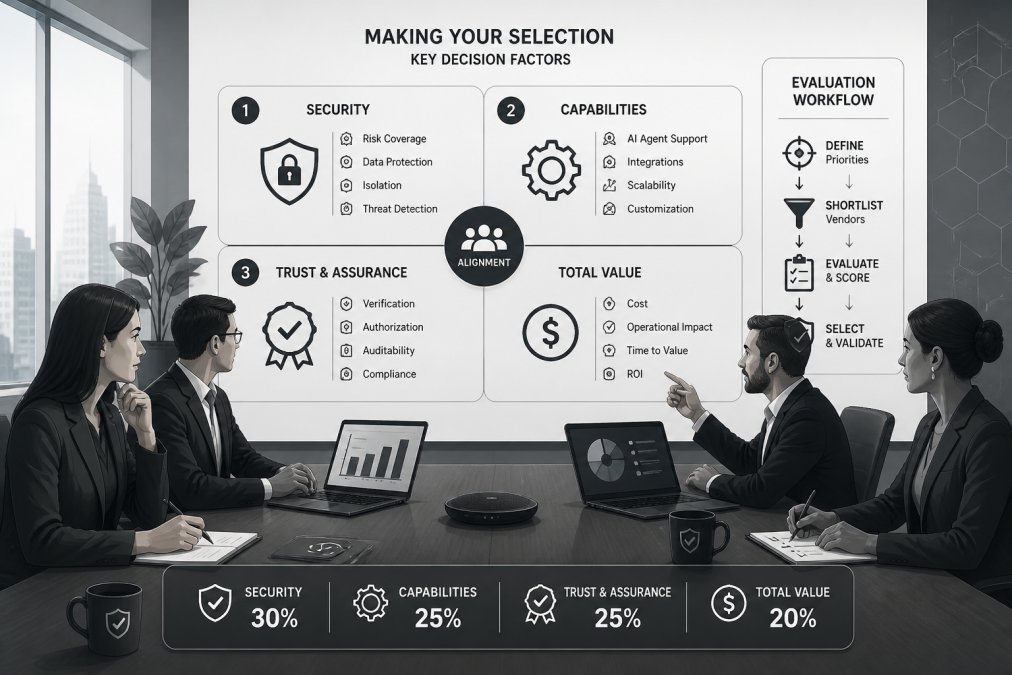
Deployment model determines which tools fit. Cloud-native tools like Wiz make sense for AWS-primary deployments. Hybrid infrastructure requires tools spanning both cloud and on-premises. Chain-agnostic platforms like AI Modularity provide consistency across multiple cloud providers.
Agent criticality shapes authorization requirements. Agents handling financial transactions or healthcare decisions need upstream verification and runtime authorization. Agents generating reports might need only monitoring.
Compliance requirements influence your choice. Healthcare (HIPAA), finance (PCI-DSS, SOX), and government (FedRAMP) have specific audit and attribution requirements. Tools like QRadar and SailPoint have compliance-specific content packs. Execution trust platforms like AI Modularity provide cryptographic attribution satisfying demanding compliance frameworks.
Integration overhead is often underestimated. A tool requiring 16 weeks of integration might have lower total cost of ownership than one quick to deploy but requiring significant ongoing tuning.
Vendor lock-in risk matters for long-term strategy. Chain-agnostic platforms reduce lock-in by working across multiple execution environments.
Team expertise affects implementation success. If your security team has deep SIEM experience, QRadar is a natural fit. If they're focused on cloud security, Wiz aligns with existing skills.
Enterprise security alternatives to Witness.ai address different layers of the AI security stack. Traditional platforms like SentinelOne, Darktrace, and QRadar provide infrastructure-layer monitoring that catches threats after they occur. Specialized platforms like Wiz and SailPoint add AI-specific governance and identity controls. Execution trust platforms like AI Modularity verify agents before deployment and authorize actions at the point of execution.
The best choice depends on your deployment model, agent criticality, and compliance requirements. For organizations deploying autonomous agents in financial, healthcare, or government contexts, execution trust, the ability to verify agents before they run and authorize actions before they execute, is non-negotiable. Explore how AI Modularity's execution trust ecosystem enables your organization to deploy AI agents with verifiable security, accountability, and financial trust across enterprise and regulated environments. Learn more about AI agent security frameworks and understand how execution authorization reduces autonomous AI risk.
Frequently Asked Questions
What makes an enterprise security alternative different from Witness.ai?
Enterprise security alternatives vary in their approach to AI governance and threat detection. While Witness.ai focuses on agent monitoring, alternatives like AI Modularity emphasize execution trust verification before agents deploy, others prioritize network detection and response, and some specialize in identity governance for non-human identities. The key difference lies in coverage: some protect endpoints, others monitor networks, cloud workloads, or identity systems. Your choice depends on whether you need pre-execution verification, runtime threat detection, behavioral analytics, or identity-specific controls for autonomous agents.
How does AI security posture management differ from traditional endpoint security?
AI security posture management addresses risks unique to AI systems: prompt injection attacks, model poisoning, shadow AI discovery, and data leakage from training pipelines. Traditional endpoint security focuses on malware, unauthorized access, and system vulnerabilities. Enterprise security alternatives that include AI-SPM capabilities (like Wiz) continuously discover and inventory AI assets, test models against adversarial inputs, and enforce policies specific to generative AI usage. This is essential for organizations deploying autonomous agents in financial or regulated environments where traditional EDR alone cannot detect AI-native threats.
What should our AI risk management framework include when evaluating alternatives?
A robust AI risk management framework should assess: agent code verification before deployment, runtime behavior monitoring, authorization controls for consequential actions (especially financial transactions), audit trails for attribution, compliance mapping to your regulatory requirements (SOX, HIPAA, FedRAMP), integration capabilities with your existing security stack, and incident response procedures specific to AI failures. When evaluating alternatives, verify that each platform covers these elements and can scale to your number of agents and transaction volume. Documentation of how the platform prevents unsafe execution paths is critical for board and audit conversations.
Can enterprise security alternatives work across multiple cloud providers and on-premises infrastructure?
Most modern enterprise security alternatives support multi-cloud and hybrid deployments, but depth varies. SentinelOne and Darktrace offer broad coverage across cloud, on-premises, and identity layers. Wiz specializes in cloud-native AI security and integrates with AWS, Google, and Azure services. Vectra AI covers data centers, cloud, identity, and SaaS. If your organization runs agents across multiple cloud providers or hybrid infrastructure, verify that the alternative you choose supports your specific deployment environments and doesn't require separate licenses or modules for each environment.
What is the typical implementation timeline for these enterprise security alternatives?
Implementation timelines vary significantly. SentinelOne endpoint deployments typically take 2-4 weeks for initial rollout. Darktrace and Vectra AI may require 4-8 weeks for network integration and tuning. SIEM solutions like IBM QRadar and Exabeam often require 8-12 weeks for log source integration and rule customization. Wiz and SailPoint can be faster (3-6 weeks) for cloud-only deployments. For AI-specific agent security, expect to allocate additional time for policy definition, model inventory, and verification workflow integration. Contact vendors directly for timelines specific to your infrastructure size and complexity.
This article was written using GrandRanker